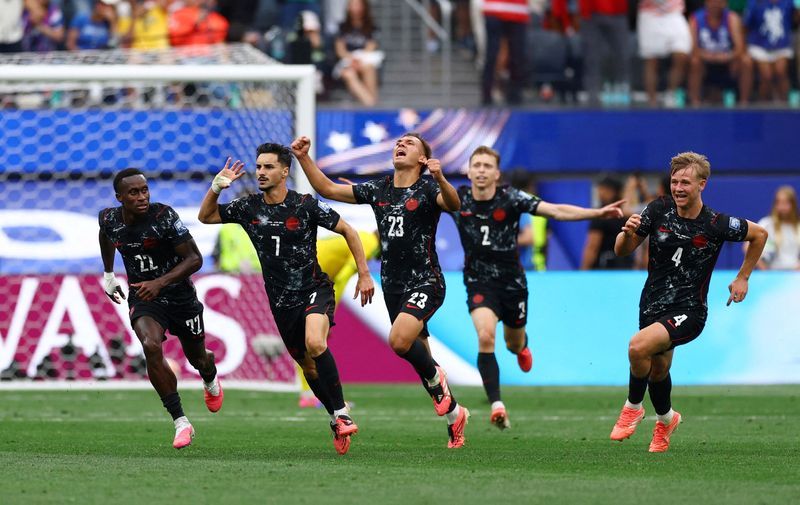
Canada has broken through a significant barrier in international football, advancing to the World Cup knockout stage's second round for the first time after Stephen Eustaquio's stunning strike in the 92nd minute secured a 1-0 victory over South Africa at Los Angeles Stadium on Sunday. The goal came at a moment when the South African side appeared content to push the match into extra time, leaving the Canadian team with an opportunity that Eustaquio, receiving possession at the edge of the penalty box, capitalised upon with a powerful shot that flew past diving goalkeeper Ronwen Williams.
The match itself reflected the intensity that characterizes knockout football, with both teams feeling the weight of their first-ever World Cup round-of-16 appearance. Canada, competing as co-hosts alongside Mexico and the United States, had laboured through much of the contest without finding the clinical finishing that separates victors from vanquished in this format. Coach Jesse Marsch acknowledged this reality after the final whistle, noting that his squad had generated chances throughout but lacked the precision needed to convert them into goals before Eustaquio's intervention changed everything.
For Malaysian and Southeast Asian observers, Canada's success represents an important reminder that smaller footballing nations can compete at the highest level when they demonstrate organisation, resilience, and tactical discipline. The Canadian approach, built on defensive solidity and disciplined pressing, mirrors strategies employed by regional powerhouses like Thailand and Vietnam in their own World Cup qualifying campaigns. Eustaquio's composed finishing under pressure illustrates the quality that emerges when players operating in professional leagues abroad bring their experience back to their national teams.
The first half produced limited scoring opportunities, with both sides feeling each other out in a contest between two teams inexperienced at this level of World Cup competition. Canada's clearest opening came in the final moments before the interval when a corner kick sparked chaos in South Africa's penalty area. Moise Bombito directed a header toward goal, only for Aubrey Modiba to clear the danger from the line, and moments later Tajon Buchanan's follow-up attempt struck goalkeeper Williams directly. A subsequent incident saw Richie Laryea collapse under a challenge, prompting loud appeals for a penalty that the match officials, even after reviewing the incident with VAR technology, declined to award.
The controversial non-decision created visible frustration among Canadian personnel and supporters, with coach Marsch continuing to voice objections as teams departed for the interval. This moment encapsulated the tension that defines knockout football, where marginal decisions can determine the trajectory of entire campaigns. For Canadian supporters who had travelled to Los Angeles, the perceived injustice only intensified their emotional investment in the outcome.
South Africa's second-half approach revealed a team content with defensive depth, seemingly willing to absorb Canadian pressure and exploit any opening through the pace of their counterattacking options. This tactical choice, while perhaps pragmatic given the quality of opponent, ultimately left them vulnerable in the final moments when concentration wavered. Canada continued to press, with Jonathan David squandering a chance when a rebound from a save by Williams went begging following Tani Oluwaseyi's shot. The collective Canadian effort, however, proved more decisive than individual moments of South African inspiration.
Eustaquio's post-match reflection captured the emotional significance of breaking through this particular barrier. The midfielder spoke about the collective belief that sustained the Canadian effort throughout the ninety-two minutes, describing a goal that felt almost inevitably destined given the intensity and persistence his teammates brought to every phase of play. For coach Marsch, the victory vindicated his team's character and work ethic, statements that carry weight in a tournament where many doubted whether Canada possessed the technical quality to advance from their opening group.
The journey to this point had not been straightforward for the hosts. Having secured qualification from their group for the first time in three World Cup tournaments, Canada faced the logistical challenge of departing their home nation to play a knockout match, having arrived in California with only three days' rest following a disappointing 2-1 defeat to Switzerland in their final group encounter. That defeat had created narrative pressure heading into the South Africa fixture, making Eustaquio's moment of clarity all the more valuable.
Canada's next challenge comes on July 4 in Houston, where they will face the winner of the Netherlands versus Morocco round-of-16 tie. Progression to the quarter-finals represents an achievement that will reshape how Canada's footballing programme is viewed both domestically and internationally. The victory carries implications for the sport's development in a nation traditionally dominated by ice hockey and American sports, potentially inspiring increased investment and participation at grassroots levels.
South Africa, conversely, departs having reached the knockout stage at only their second attempt and fourth World Cup appearance overall. While the exit carries disappointment, the team's achievement in reaching this stage from a relatively competitive group demonstrates progress in South African football development. Coach Hugo Broos, aged seventy-four, indicated this would represent his final World Cup, leaving the national federation to consider succession planning as they evaluate the programme's direction moving forward. The Belgian tactician's departure will create both challenges and opportunities for restructuring.
The broader regional context matters for Southeast Asian football observers. Canada's success demonstrates that persistence in infrastructure development and systematic player cultivation can yield results on the World Cup stage. Nations like Vietnam, Thailand, and Indonesia monitor how countries with comparable economic resources but similar football traditions to their own perform at this level, using such examples to inform their own strategic planning. Eustaquio's transformation from a player who might have remained obscure into a World Cup hero encapsulates the potential that exists when talented individuals receive proper development pathways and opportunities to compete regularly in strong professional environments.

