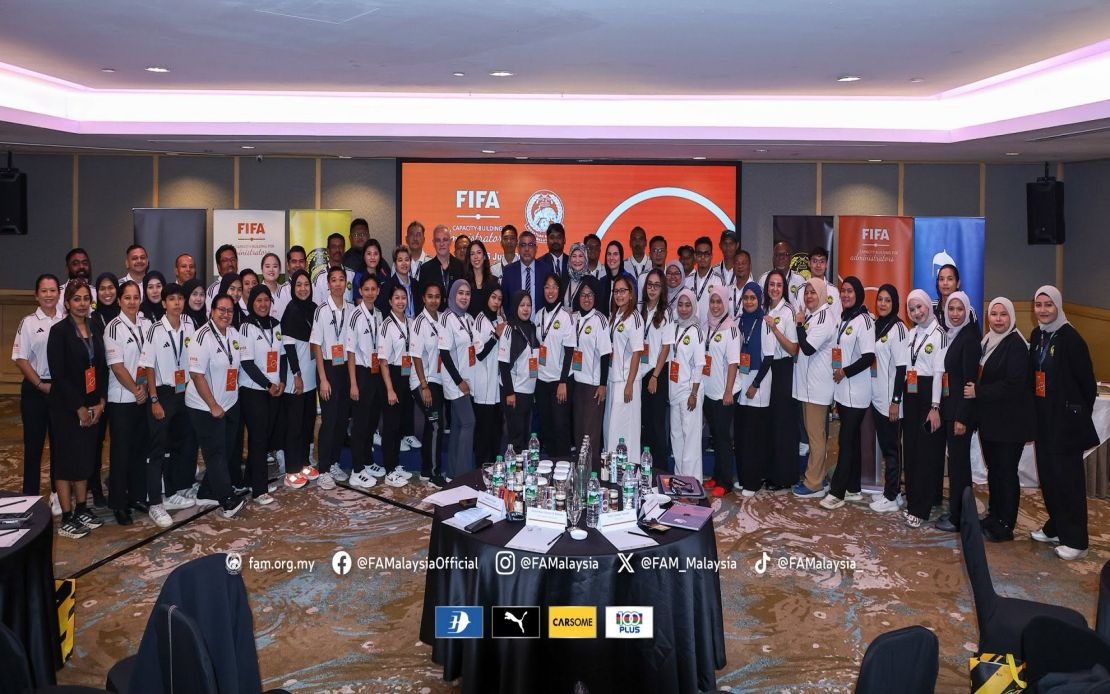
The Football Association of Malaysia (FAM) has launched an ambitious capacity-building initiative designed to elevate the standard of administration and management across the nation's women's football sector. Starting on June 23, the four-day FIFA Capacity-Building For Administrators 2026 programme represents a deliberate shift in how Malaysian football authorities approach development, recognising that sustainable growth in women's football depends equally on strengthening the off-field infrastructure as it does on nurturing on-field talent.
The programme, delivered through collaboration between FAM and FIFA, brings together two renowned Women's Football Development Experts: Safia Abdeldayem and Pema Choden Tshering. Their involvement underscores the international calibre of instruction participants can expect. The initiative targets team managers, administrative officers, and aspiring leaders within the women's football ecosystem, positioning them to drive systemic improvements across Malaysian clubs and national structures.
Centrally, the curriculum addresses four interconnected domains critical to modern football administration. The Women's Leadership module equips participants with frameworks for fostering inclusive, effective governance structures. Women's Competition modules examine how leagues and tournaments can be structured and managed professionally. Training on Club and Players' Rights ensures administrators understand the legal and ethical dimensions of player welfare and contractual obligations. Strategic Planning components enable managers to develop long-term visions aligned with both club objectives and broader national development agendas.
For Malaysia's football landscape, this initiative arrives at a pivotal moment. Women's football in Southeast Asia has gained considerable momentum in recent years, with rising participation rates and increasing fan engagement. However, many nations in the region, including Malaysia, have struggled to match technical development investments with corresponding improvements in governance and administrative capacity. FAM's decision to prioritise this dimension reflects a maturing understanding that technical excellence on the pitch requires sophisticated management frameworks off it.
The programme carries particular significance given Malaysia's position within Asian football. As a member of the Asian Football Confederation (AFC), Malaysia operates within a competitive environment where neighbouring countries have invested heavily in women's football infrastructure. Datuk Suraya Yaacob, who holds roles within both FIFA's Women's National Team Competitions Committee and the AFC Women's Football Committee, brings direct knowledge of regional benchmarks and international best practices to FAM's strategic planning.
FAM's stated philosophy emphasises ecosystem thinking. Rather than viewing women's football development as a narrow technical endeavour, the federation recognises that attracting and retaining talent depends on creating professional career pathways, transparent governance, robust player protection mechanisms, and sustainable club operations. By developing a cadre of skilled administrators, FAM aims to create multiplier effects throughout the system—improved management at one club or programme ripples outward, raising standards across the sector.
The involvement of FAM Women's Football Technical Director Soleen Al-Zoubi signals integration between administrative development and technical coaching strategies. This coordination prevents siloing of knowledge and ensures that administrative innovations support rather than hinder technical objectives. It also demonstrates FAM's commitment to embedding women's football priorities at every level of the organisation's decision-making apparatus.
From a broader regional perspective, Malaysia's investment in administrative capacity-building may influence peer organisations across ASEAN. Thailand, Indonesia, Vietnam, and the Philippines are all expanding women's football programmes, and successful models emerging from Malaysia could inspire parallel initiatives elsewhere. Such cross-border learning strengthens the entire Southeast Asian football ecosystem and contributes to the region's growing prominence in international competition.
FAM's explicit link between this programme and FIFA's global women's football development strategy is noteworthy. FIFA has placed unprecedented emphasis on women's football expansion since the early 2020s, and member associations that align with this agenda gain access to technical expertise, funding opportunities, and international networks. Malaysia's participation positions the nation as a serious stakeholder in FIFA's vision, potentially unlocking resources and partnerships that could accelerate growth.
The challenge ahead involves translating training insights into sustained institutional change. Many capacity-building programmes globally demonstrate that participant enthusiasm during workshops does not automatically translate into transformed workplace practices. FAM will need to establish follow-up mechanisms, mentoring networks, and accountability structures that ensure trainees apply learning within their respective organisations. Creating feedback loops and performance metrics will be essential to validate the programme's effectiveness.
Moreover, recruitment and retention of trained administrators remains challenging in developing football markets. Malaysia must ensure career pathways are sufficiently attractive to retain the skilled professionals this programme develops. Without competitive compensation, clear advancement routes, and recognition of contributions, even highly trained administrators may drift toward more lucrative sectors.
Looking forward, FAM's commitment signals confidence in women's football's potential to drive broader institutional modernisation. As these newly trained administrators return to their clubs and positions, they carry frameworks and networks that can catalyse improvements in governance, financial management, and strategic planning more broadly. The programme thus transcends women's football, functioning as a lever for elevating standards across Malaysian football administration generally.
The FAM initiative ultimately reflects a maturing sporting nation investing strategically in foundations for long-term success. Women's football in Malaysia stands at an inflection point where smart administrative architecture could unlock decades of sustained competitive progress and social impact.