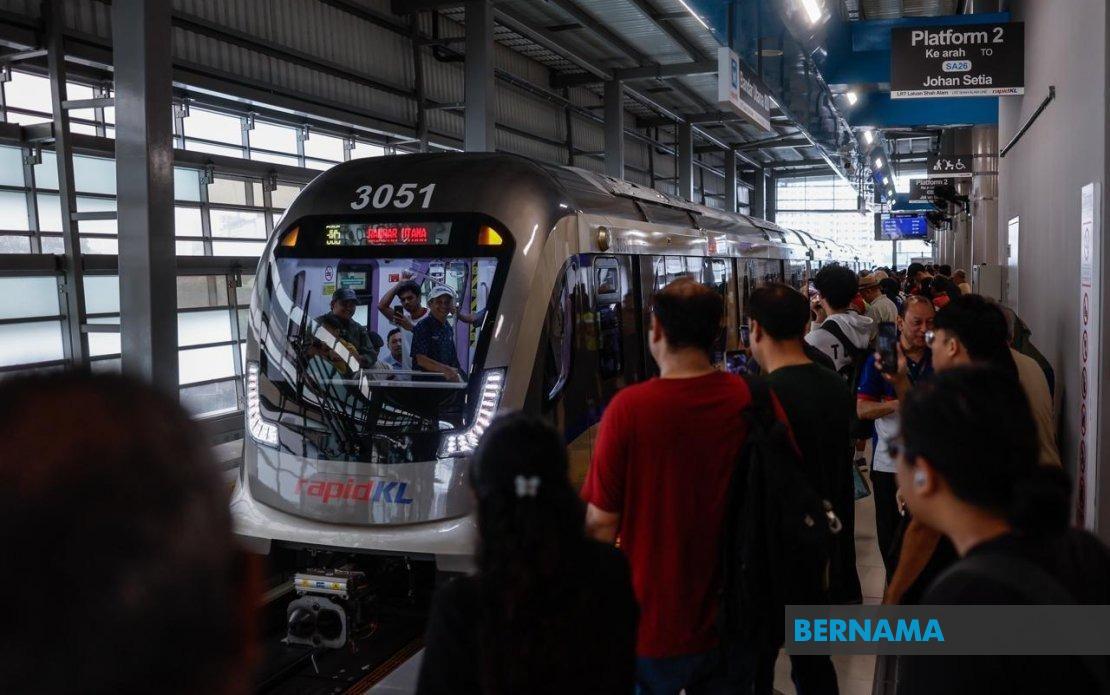
A technical malfunction in one of the train's key components led to an incident on the Light Rail Transit 3 line serving the Shah Alam corridor on July 4, when the affected part made unexpected contact with the power conductor at Shah Alam Stadium Station. The mishap, which took place at 7.05 pm, generated a dramatic but ultimately harmless outcome—a loud explosion-like noise accompanied by sparks—though authorities confirmed no passengers or staff sustained injuries during the event.
Rapid KL, the operator managing the LRT3 Shah Alam Line, disclosed the incident details in a formal statement released on July 14, more than a week after the occurrence. According to the company's account, the situation was contained swiftly and the regular movement of trains continued without significant disruption to the broader service network. The rapid response reflected established safety protocols designed to isolate problem vehicles before they compromise passenger movements across the system.
The immediate action taken demonstrated the operator's commitment to passenger safety management. Upon detection of the fault, staff moved quickly to remove the affected train from active circulation. Passengers aboard the vehicle were instructed to disembark at the subsequent station along the line, from which they transferred to a replacement train to complete their journeys without substantial delay. This evacuation and transfer procedure ensured that no travellers were stranded and that alternative transport capacity was deployed promptly.
Following withdrawal from service, the train underwent a comprehensive inspection process at Rapid KL's dedicated depot facility. Technical personnel identified the specific faulty component and removed it from the train entirely, replacing it with a new unit meeting operational specifications. The detailed inspection regimen enabled engineers to pinpoint the root cause of the power conductor contact and verify that no secondary damage had occurred elsewhere on the vehicle.
Only after engineers confirmed through rigorous testing that all systems functioned correctly did Rapid KL authorise the train's return to active passenger service. This cautious approach reflects international best practice in rail operations, where extensive validation precedes the resumption of any vehicle involved in a technical incident. The company's willingness to keep the train in depot for however long necessary demonstrates that schedule adherence does not override safety assurance measures.
Beyond addressing the immediate problem, Rapid KL initiated a precautionary inspection and monitoring campaign covering other trains within the LRT3 fleet. Such fleet-wide vigilance becomes standard protocol when a specific component failure is discovered, as engineers seek to determine whether the same defect might exist in other vehicles sharing identical specifications or manufacturing batches. This preventive approach aims to identify and remedy any latent weaknesses before they manifest as operational incidents.
For Malaysian commuters who depend on the LRT3 service for daily travel, such incidents underscore the technical complexity underlying modern rapid transit systems and the engineering rigour required to maintain safety standards. The Shah Alam Stadium Station incident, while dramatic in its visual manifestations, represents precisely the kind of problem that modern monitoring and maintenance systems are designed to catch and resolve. The fact that it occurred at a specific moment and location meant that trained personnel could act decisively.
The LRT3 line, which connects key nodes across the Selangor corridor including Shah Alam, represents a critical piece of Malaysia's urban mobility infrastructure. Thousands of commuters traverse its routes daily, making it essential that operational reliability and safety standards remain consistently high. Rapid KL's transparent communication about the incident and the corrective measures undertaken helps maintain public confidence in the system's overall integrity and the operator's willingness to address problems forthrightly.
From a broader transportation perspective, the incident illustrates the importance of robust component quality control and supplier management within rail operations. Whether the faulty component originated from a manufacturing defect, a design oversight, or damage sustained during normal service remains unclear from the available information, but identifying the root cause helps prevent recurrence across the entire fleet. Rapid KL's investigation and remedial steps represent the kind of systematic response that characterises professional transit operations.
The absence of injuries stands as the most significant outcome, reflecting both the inherent safety design of modern LRT systems and the effectiveness of rapid incident response protocols. Modern rapid transit vehicles incorporate multiple protective systems to ensure that component failures do not cascade into safety-critical problems. Passengers who experienced the incident and witnessed the sparks and noise may have been startled, but they emerged unharmed and were promptly reaccommodated on alternate transport.
Going forward, the incident serves as a reminder that rail systems require vigilant maintenance, swift incident response, and transparent communication with the travelling public. Rapid KL's handling of the July 4 incident demonstrates an operator taking such responsibilities seriously. For passengers using the LRT3 Shah Alam Line, the message conveyed by the company's actions is that technical problems, while possible in any complex system, will be identified, addressed, and resolved before service resumes. This commitment to passenger welfare through rigorous safety protocols remains the foundation upon which public trust in Malaysia's rail infrastructure ultimately depends.

