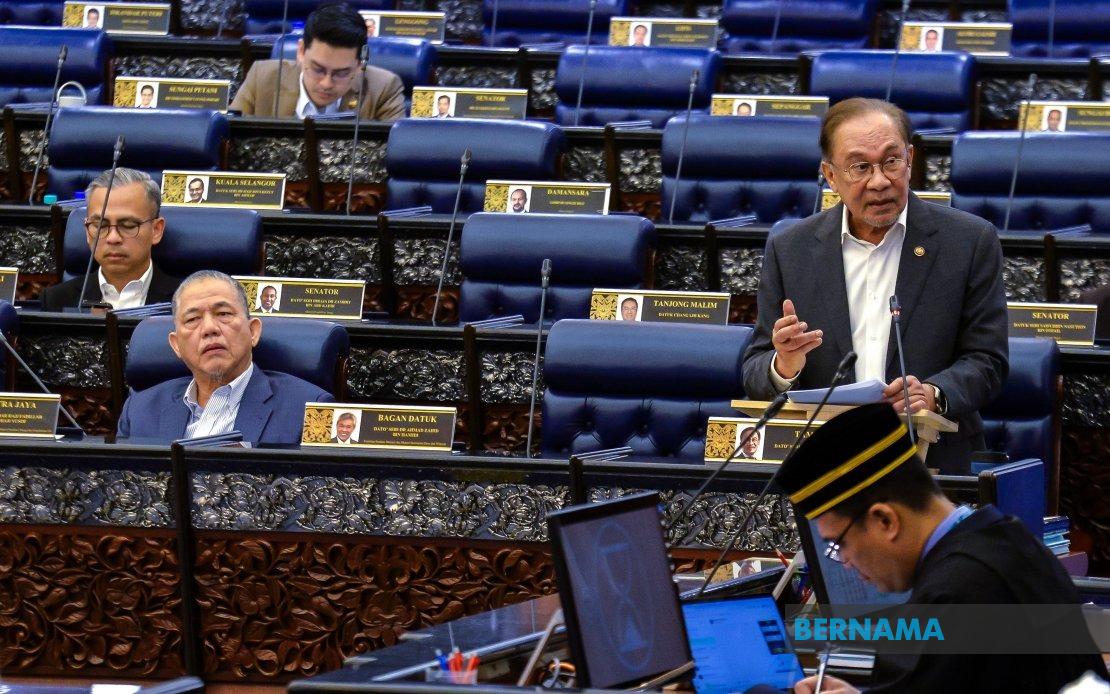
Prime Minister Datuk Seri Anwar Ibrahim has defended the federal government's approach to distributing development funds to states, asserting that allocations reflect each region's infrastructure and social needs rather than proportional tax revenue contributions. Speaking during parliamentary proceedings in Kuala Lumpur on June 30, Anwar pointed out that the vast majority of states benefit from receiving substantially larger federal grants than the tax revenue they generate, with only Selangor and Penang functioning as net contributors to the national Treasury.
The clarification came in response to parliamentary concerns raised about the fairness and adequacy of federal funding distribution mechanisms. Datuk Seri Doris Sophia Brodi, the GPS representative for Sri Aman, had questioned whether the current allocation system disadvantages certain states and whether recent government reforms have improved the distribution formula. The inquiry reflects ongoing tensions in Malaysia's federal structure, where wealthier, more industrialised states generate disproportionate tax revenues whilst less developed regions contend with greater infrastructure deficits and higher poverty rates.
Anwar emphasised that the MADANI administration has restructured its allocation criteria to prioritise urgent development imperatives across all regions. The framework now channels resources toward critical infrastructure gaps, including comprehensive flood mitigation initiatives that remain essential across multiple states vulnerable to seasonal inundation. The Pan Borneo highway represents another major investment priority, reflecting the government's commitment to improving connectivity and economic opportunities in the vast Sarawak and Sabah territories, historically challenged by geographic isolation and limited transport networks.
Beyond major transportation arteries, federal grants support the expansion and rehabilitation of road networks, the construction and maintenance of adequate drainage infrastructure, and targeted poverty alleviation programmes across Malaysia's most economically disadvantaged communities. Educational advancement constitutes another significant allocation focus, with federal funding supporting the establishment, expansion and improvement of schools throughout the country. This needs-based approach acknowledges that development requirements vary dramatically across regions, with less developed areas requiring proportionally greater investment to achieve comparable outcomes in service delivery and quality of life.
The Prime Minister explicitly contrasted the MADANI Government's allocation patterns with those of its predecessor, highlighting substantially increased funding directed toward states including Kedah, Terengganu and Kelantan. This comparison underscores a deliberate policy shift prioritising equitable regional development. These three states have historically grappled with lower revenue bases and greater development challenges, making them candidates for more intensive federal support under a needs-based allocation model. The increased allocations signal a government commitment to narrowing the development gap between Malaysia's economically advanced urban centres and its less industrialised regions.
This federal funding distribution approach reflects broader Malaysian policy debates about balancing fiscal responsibility with equitable regional development. The tax contribution comparison effectively illustrates the redistributive function of federal fiscal transfers in any diverse economy. Wealthier regions like Selangor, home to Malaysia's dominant commercial and industrial base, naturally accumulate greater tax revenues, yet receive smaller federal allocations relative to their contributions. Conversely, states with less developed private sectors and lower personal and corporate tax collections receive disproportionately larger federal grants, reflecting the principle that government funding should address collective needs rather than merely recycle wealth according to existing economic disparities.
For Malaysian readers and regional observers, this represents a significant policy statement about how federal governments balance competing principles of fiscal fairness and regional equity. The allocation framework acknowledges that purely revenue-based distribution would perpetuate existing economic inequalities, concentrating public resources in already prosperous areas whilst neglecting areas most requiring public investment to build foundational infrastructure and services. Instead, the government has adopted an explicit needs assessment methodology, directing resources toward specific gaps in infrastructure, education, social services and economic development potential.
The statement also addresses implicit concerns from state governments about their financial sustainability and development prospects. By clarifying that allocations reflect assessed needs rather than penalising lower-revenue states, Anwar reassures stakeholders that federal policy does not discriminate against particular regions or deliberately marginalise certain communities. This becomes particularly important in Malaysia's federal system, where state governments must cooperate with federal authorities on development initiatives, taxation, and service delivery coordination. Transparent allocation criteria enhance trust in the funding mechanisms and reduce perceptions of political favouritism.
The infrastructure priorities mentioned—flood mitigation, transportation improvements, water systems and poverty reduction—address persistent regional development challenges requiring sustained federal investment. These investments generate multiplier effects throughout state economies, improving living standards, enhancing business competitiveness and creating employment opportunities. The emphasis on schools and educational facilities particularly supports long-term human capital development, essential for enabling states to participate effectively in Malaysia's evolving knowledge-based economy and attracting investment beyond extractive or low-value manufacturing industries.
For Southeast Asian context, Malaysia's approach offers insights into federal resource distribution mechanisms within diverse, geographically dispersed nations. The region includes several federated or quasi-federal systems managing similar tensions between revenue generation and equitable development, making the Malaysian model relevant for comparative analysis. The explicit articulation of needs-based criteria provides clarity absent in less transparent systems, potentially informing governance discussions throughout the region about fair and effective federal fiscal transfers that advance both national integration and regional prosperity.

