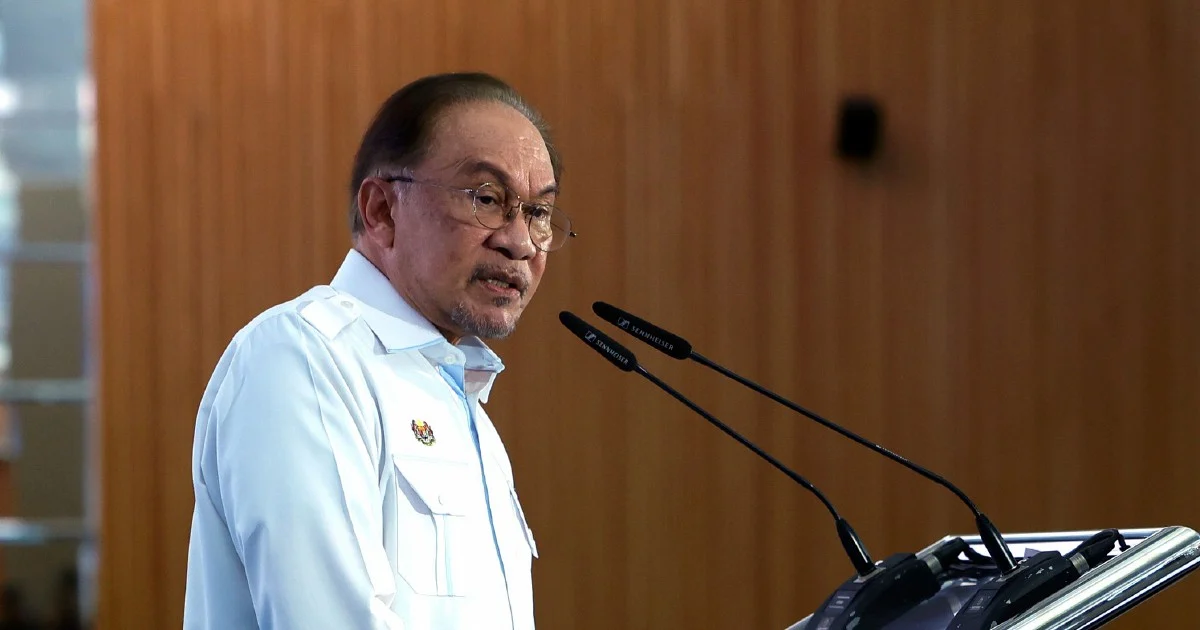
Prime Minister Datuk Seri Anwar Ibrahim has firmly rejected suggestions that Putrajaya distributes development resources unevenly across the country's states, insisting that the federal government operates a transparent and merit-based allocation system. The statement comes amid ongoing debate about regional development disparities and questions regarding whether certain states receive preferential treatment in federal funding decisions.
The assertions of unequal distribution have persisted as a contentious issue in Malaysian politics, with state governments and opposition parties occasionally questioning whether their regions receive equitable shares of the national development budget. These concerns typically intensify during periods of political tension between federal and state administrations, particularly when different political coalitions govern at the federal and state levels. The debate reflects deeper anxieties about regional inequality and the concentration of resources in more economically developed areas.
Anwar's dismissal of these claims represents a broader defense of the federal government's fiscal management and administrative processes. His position suggests that allocation methodologies incorporate standardized criteria for assessing state needs, population demographics, and development priorities rather than partisan considerations. The Prime Minister's response indicates confidence in the mechanisms governing resource distribution, though critics have historically argued that such systems may inadvertently perpetuate existing imbalances or lack sufficient transparency for independent verification.
The timing of Anwar's comments reflects the government's sensitivity to accusations of regional favoritism, a perennial challenge for any administration managing a geographically diverse federation. Malaysia's landscape encompasses developed urban centers alongside less industrialized regions, creating inherent pressures for equitable development. The federal government must balance competing demands from states with different economic capacities, infrastructure requirements, and demographic compositions, making allocation decisions inherently complex and inevitably subject to scrutiny.
Investigations into federal funding patterns have occasionally revealed disparities, though determining whether these reflect policy choices or objective need-based assessments remains contested terrain. Different stakeholder groups interpret funding data through contrasting lenses: those favoring the incumbent administration typically emphasize the neutral application of objective criteria, while critics contend that subtle mechanisms or informal preferences influence outcomes. This divide underscores how development allocation operates as both a technical exercise and a politically charged arena where trust in institutions fundamentally shapes public perception.
From a Southeast Asian perspective, Malaysia's situation mirrors broader regional challenges in managing federal fiscal systems where central authorities must serve diverse constituent territories. Countries throughout the region grapple with similar tensions between national development priorities and subnational aspirations for resources. The mechanisms Malaysia employs for allocation decisions, including economic formulas, population-based metrics, and priority-setting processes, represent approaches increasingly examined across the region as federalism gains traction in various contexts.
The implications of this debate extend beyond technical discussions about budget mechanics. Perceptions of fair treatment influence the stability of federal-state relationships, investor confidence in regional stability, and public trust in government institutions. When significant segments of the population doubt the impartiality of distribution systems, political consequences ripple through the federation, potentially complicating collaboration on critical issues requiring coordinated federal-state action. This concern motivates Anwar's explicit rebuttal, signaling that the government views the fairness question as sufficiently important to warrant direct prime ministerial intervention.
Moving forward, the administration faces pressure to address lingering skepticism through enhanced transparency mechanisms and clearer communication regarding allocation methodologies. Greater disclosure of decision-making processes, quantitative breakdowns of funding by state, and independent audits could help substantiate claims of equitable treatment. Such measures would acknowledge legitimate public interest in understanding how federal resources are distributed while demonstrating confidence in the underlying systems.
The federal government's response also reflects recognition that development disparities, whether resulting from allocation decisions or pre-existing structural factors, remain politically significant across Malaysia. States experiencing slower economic growth or infrastructure development inevitably scrutinize whether federal support matches their needs relative to more prosperous regions. Addressing these perceptions requires not only defending current systems but also demonstrating commitment to reducing regional inequalities through targeted investments and development initiatives that respond to specific state challenges.

