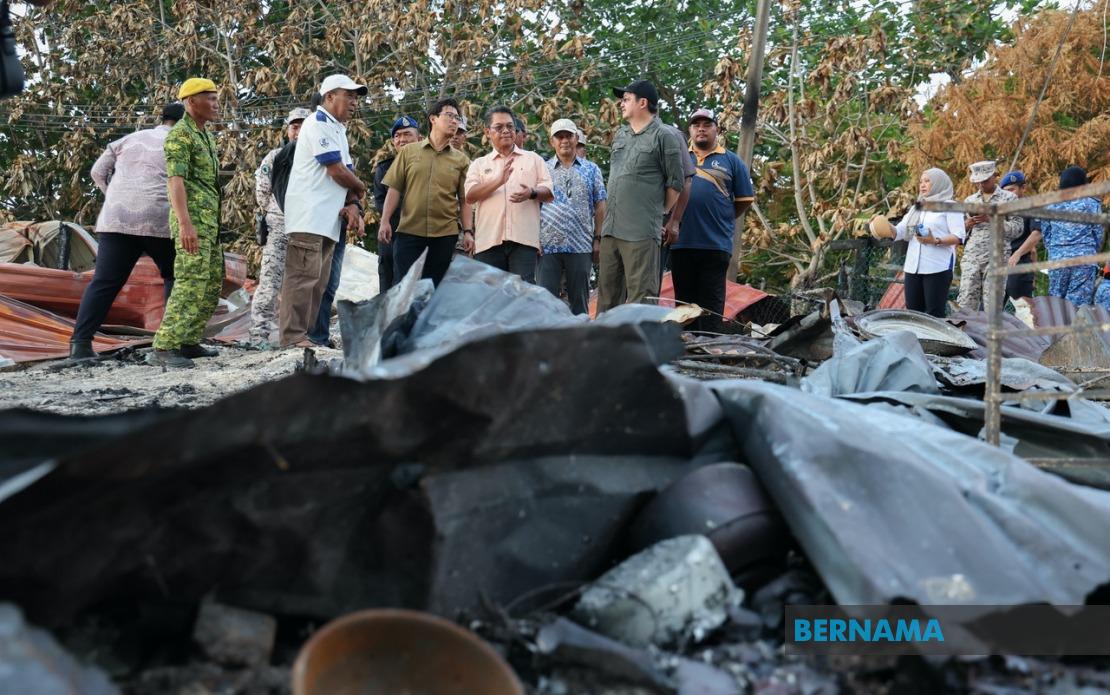
The Federal Government has swiftly mobilised support for residents of Pulau Nunuyan Laut following a destructive early-morning fire that claimed 28 dwellings and displaced more than a hundred people in Sandakan, Sabah. Through the Prime Minister's Department, initial relief assistance has been extended to 29 household heads affected by the blaze, which occurred around 3 am yesterday. The rapid deployment of federal resources underscores the government's commitment to disaster response in East Malaysian communities, where infrastructure challenges and geographic isolation often complicate emergency relief efforts.
Datuk Mustapha Sakmud, the Minister in the Prime Minister's Department responsible for Sabah and Sarawak affairs, personally visited the affected settlement alongside Sandakan Municipal Council president Datuk Walter Kenson to assess conditions and coordinate assistance. Mustapha outlined how the Implementation Coordination Unit has already begun practical interventions, notably providing mobility aids such as wheelchairs to elderly residents requiring additional support during this crisis. Beyond immediate relief items, the department has instructed relevant agencies, particularly the municipal council, to conduct comprehensive needs assessments across the affected population to identify priorities and gaps in assistance.
The fire has disrupted essential services that residents depend upon daily, particularly the jetty infrastructure used by schoolchildren to commute to educational institutions. Recognising the potential for the disaster to derail children's education, Mustapha emphasised that restoring this critical piece of public infrastructure remains urgent. He has requested the Sandakan Municipal Council to escalate damaged facilities requiring immediate repair to the Implementation Coordination Unit for expedited resolution, signalling that federal support extends beyond household relief to community-wide recovery.
The relocation of displaced residents represents a complex logistical and administrative challenge that extends beyond immediate relief operations. Walter disclosed that the Rural Development Department will lead planning efforts to establish temporary and permanent housing solutions in appropriate locations, including potential use of village reserve land. This suggests a coordinated approach involving multiple agencies across different administrative and development portfolios. The involvement of state-level development authorities indicates that Sabah's governance structures are being activated to support the federal response, creating a multi-tiered assistance framework.
A complicating factor in the relocation process stems from the land tenure situation in Pulau Nunuyan Laut. Walter revealed that the affected residents were occupying private land belonging to two separate landowners, a detail that adds legal and property rights dimensions to the recovery process. Rather than presenting this as an obstacle, authorities have signalled their intention to engage directly with the private landowners to discuss arrangements for relocation and future settlement patterns. This collaborative approach suggests that government agencies are prioritising pragmatic solutions over rigid adherence to land regulations, though negotiations with property owners may influence the pace and scope of reconstruction efforts.
Beyond housing, the recovery plan encompasses broader infrastructure development intended to support residents' long-term welfare and integration into community life. Authorities have committed to establishing essential services including electricity connections and water supply systems for any relocated settlement. The inclusion of jetty facilities in reconstruction plans recognises that waterborne transport remains the primary connectivity option for island communities in this region, where conventional road networks are absent. These infrastructure components are not merely conveniences but fundamental requirements for normal daily functioning in a maritime setting.
The scale of the disaster—affecting over 100 people and destroying 28 structures—reflects the vulnerability of small island communities in Malaysian coastal areas. Such settlements often lack robust building codes, fire prevention infrastructure, and rapid emergency response capabilities that characterise urban centres. The compressed geography of island villages means that fire spreads quickly and evacuations proceed with difficulty, creating humanitarian emergencies that demand swift federal intervention. The government's visible and coordinated response demonstrates recognition of these vulnerabilities and the special obligations owed to remote communities.
The involvement of the Implementation Coordination Unit signals that this response is being treated as a priority matter at the federal level rather than being delegated entirely to local administrative structures. This agency functions as an inter-ministerial coordination mechanism, suggesting that resources from multiple federal departments—defence, infrastructure, health, social services—may be mobilised to support the Sandakan recovery effort. Such coordination prevents the siloed approach where different agencies operate independently and allows for comprehensive, integrated support addressing housing, livelihoods, education continuity, and social welfare simultaneously.
For Malaysian policymakers and development practitioners, the Pulau Nunuyan incident highlights persistent challenges facing island and maritime communities throughout Southeast Asia. Infrastructure deficits, land tenure complexities, and exposure to natural and human-caused disasters create layers of vulnerability that require not simply reactive disaster response but proactive investment in resilience. The federal government's provision of wheelchairs and commitment to jetty repairs indicates sensitivity to these particular community needs, though long-term vulnerability reduction will require sustained commitment to infrastructure upgrading and disaster preparedness in similar settlements across Sabah, Sarawak, and neighbouring jurisdictions.

