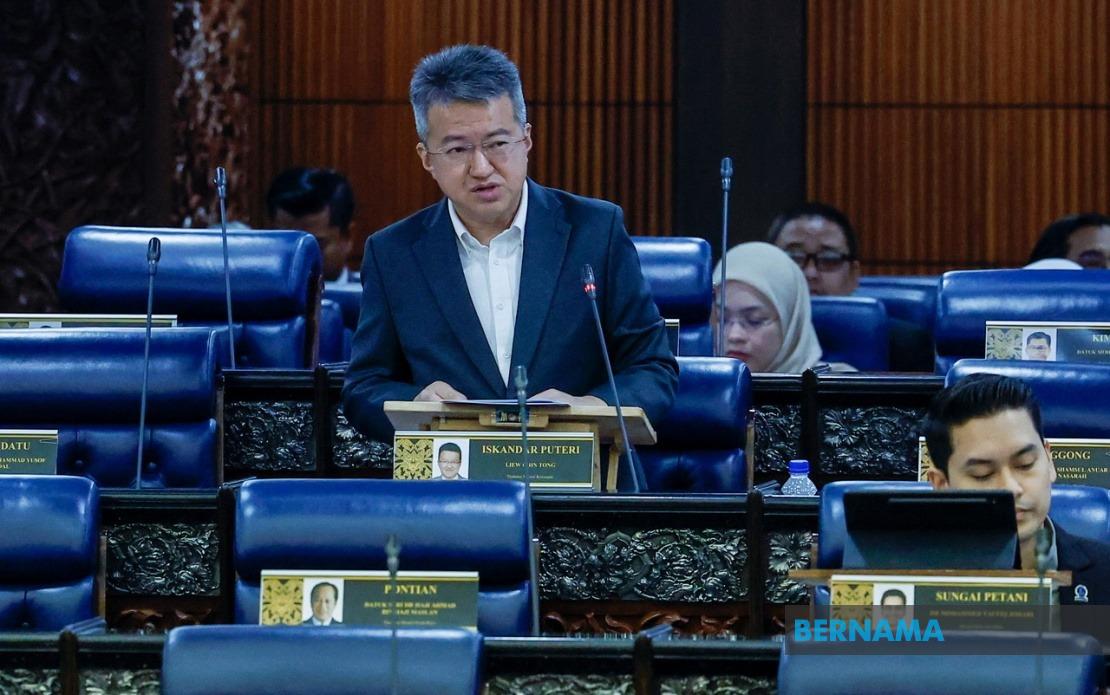
Deputy Finance Minister Liew Chin Tong has moved to allay concerns that Sabah's enlarged interim special grant will come at the expense of its development budget, providing parliamentary assurance that the state's allocation ceiling remains intact under this year's federal budget. The clarification came during the Special Chamber session at Dewan Rakyat on July 14, responding to queries raised by WARISAN MP Isnaraissah Munirah Majilis regarding the mechanics and constitutional underpinnings of the increased funding.
The RM1.5 billion boost to Sabah's special grant, which Prime Minister Datuk Seri Anwar Ibrahim unveiled in May, has generated questions about how the additional resources would be distributed and whether they might squeeze other funding streams to the state. Liew's intervention was designed to dispel such anxieties, emphasising that the federal government remains committed to sustaining investment in Sabah's infrastructure and social development despite the separate injection of special grant money.
According to Liew's parliamentary statement, Sabah's development allocation has risen from RM6.7 billion to RM6.9 billion in the current financial year, with funding directed towards signature infrastructure initiatives including the Pan Borneo Highway, rural road networks, and electrification schemes serving remote communities. The allocation also encompasses substantial investments in healthcare facilities, educational infrastructure rehabilitation, and police station upgrades, demonstrating a deliberate federal strategy to address long-standing gaps in Sabah's public services.
Beyond capital projects, the federal government has maintained its commitment to subsidising electricity tariffs for Sabah consumers, even after the state assumed regulatory powers over the sector in 2024. Liew disclosed that electricity subsidies for Sabah are projected to reach RM880 million in 2026, representing a significant ongoing commitment to keeping energy costs manageable for residents and businesses across the state. This arrangement underscores the complexity of intergovernmental fiscal relations on Malaysia's eastern frontier, where federal support complements state-level administration.
Rural water infrastructure has emerged as another priority area within the enlarged budget envelope. Liew reported that allocations for rural water supply have expanded from RM103.5 million in 2025 to RM143 million this year, reflecting heightened federal attention to improving water access in Sabah's interior settlements. This nearly 40 percent increase signals recognition of persistent service delivery challenges in communities beyond the main urban centres, where infrastructure deficits have historically been more acute.
Social assistance programmes targeting cost-of-living pressures have also received enhanced funding through federal allocations to Sabah. The combined value of direct cash transfers through the Sumbangan Tunai Rahmah and Sumbangan Asas Rahmah schemes is estimated at RM1.2 billion for the state, providing immediate relief to households struggling with inflation and rising expenses. These welfare schemes reflect broader federal fiscal measures to cushion citizens from economic headwinds while maintaining development momentum.
Navigating the constitutional terrain surrounding Sabah's special grants has proven delicate for the federal government. Liew stressed that both Kuala Lumpur and the Sabah state administration must adhere to procedures laid out under Article 112D of the Federal Constitution when disbursing the special grant, following the same protocols that governed allocations in 2022, 2023, and 2025. This insistence on procedural compliance reflects the legal sensitivities inherent in Sabah's special constitutional status as a former British protectorate that joined Malaysia through a distinct arrangement.
The Deputy Finance Minister also acknowledged that the federal government has filed an appeal challenging certain aspects of the Kota Kinabalu High Court's ruling on special grants, yet simultaneously reaffirmed respect for the constitutional principle underlying Article 112C, which enshrines Sabah's entitlement to such grants. This balancing act reflects the complexities of federalism in Malaysia's East Coast region, where historical agreements and contemporary fiscal pressures sometimes create tensions requiring careful negotiation and legal precision.
Looking forward, Liew signalled federal openness to establishing a revised mechanism for determining future special grant amounts through dialogue with the Sabah state government. Such negotiations would operate within the framework of Articles 112C and 112D of the Federal Constitution, suggesting that rather than simply litigating disputed interpretations, both levels of government are exploring collaborative solutions. This forward-looking stance offers potential for reducing friction while maintaining fiscal sustainability at the federal level.
For Malaysian observers tracking federalism dynamics, Sabah's fiscal arrangements offer instructive lessons. The state's unique constitutional position—stemming from its voluntary accession to Malaysia rather than the emergency federation formula applied to Malaya—grants it negotiating leverage uncommon among other states. The RM1.5 billion grant increase represents recognition of this reality, while also embodying federal acknowledgment that Sabah's development needs remain substantial relative to its fiscal base and population size.
The episode also illustrates the intricate dance between political symbolism and fiscal substance in Malaysian governance. Announcing the grant increase through the Prime Minister elevated its political profile, signalling commitment to East Malaysia during a period when national development policies have faced criticism for perceived Peninsular-centricity. Simultaneously, ensuring that existing development allocations remain uncut provides material assurance that the gesture carries real budgetary weight rather than merely shuffling resources.
For businesses and civic organisations operating in Sabah, Liew's parliamentary assurances carry practical implications. Maintained development spending suggests continued federal procurement activity, ongoing infrastructure projects creating employment opportunities, and sustained investment in public services that underpin economic stability. The explicit protection of the development allocation ceiling reduces uncertainty about project timelines and funding continuity.

