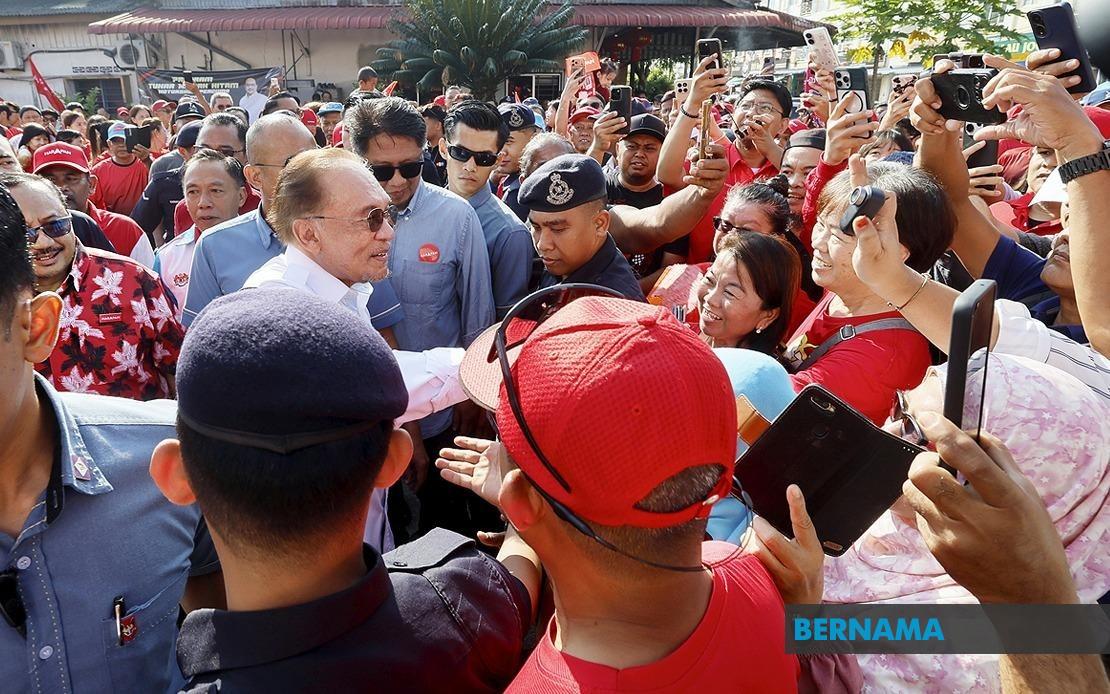
Prime Minister Datuk Seri Anwar Ibrahim has moved to quash perceptions of partisan governance, insisting that his administration distributes federal resources and development projects on the basis of genuine need rather than political colour. Speaking at a Pakatan Harapan campaign event in Johor on July 9, the premier underscored the coalition's commitment to serving all communities and states with equal vigour, a message particularly salient given Malaysia's fractured electoral landscape where opposition-controlled and coalition-run territories coexist.
The timing of Anwar's declaration—made during campaigning for the 16th Johor state election—carries strategic weight. Johor, historically a stronghold of the Barisan Nasional and earlier the United Malays National Organisation, represents crucial electoral terrain where perceptions of federal fairness could influence voter behaviour. By explicitly referencing development outcomes across ideologically diverse regions including Kelantan and Kedah, Anwar sought to demonstrate that Pakatan Harapan's governance transcends the zero-sum politics that have long characterised Malaysian federalism.
Central to Anwar's argument is the distinction between electoral promises and tangible delivery. He emphasized that his government does not merely extend campaign pledges during election seasons, a pointed rebuke to established political practice whereby incumbent coalitions historically concentrate resources in favourable constituencies. Instead, he pointed to concrete projects already underway or completed across the federation. This rhetorical positioning attempts to reframe the government's credibility around implementation rather than rhetoric alone, addressing voter scepticism born from decades of unfulfilled promises.
The Johor-Singapore Special Economic Zone represents a flagship initiative designed to position Malaysia as a premium economic corridor in Southeast Asia. By advancing this high-profile infrastructure project in Johor, the federal government signals both confidence in the state's economic potential and commitment to major capital investment regardless of electoral politics. Similarly, the flood mitigation schemes in Segamat and Muar—areas that have experienced devastating inundation in recent years—address immediate public welfare concerns while demonstrating responsive governance.
The emphasis on flood management is particularly significant for Malaysian readers in vulnerable districts. Climate change and increasingly erratic precipitation patterns have rendered water security and disaster prevention central policy concerns. Federal allocation of billions of ringgit to these projects indicates prioritisation of public safety over political considerations, addressing a category of expenditure that benefits populations across party lines. This framing positions infrastructure spending as a public good rather than pork-barrel politics.
For states governed by opposition parties, the question of federal resource allocation has remained contentious. Historically, Kelantan and Kedah have faced accusations of receiving diminished federal support during periods of non-Barisan Nasional governance. By explicitly mentioning these states alongside Johor, Anwar attempts to demonstrate a departure from such patterns. The credibility of this assertion, however, remains subject to independent audit and comparative analysis of expenditure allocations across state lines—metrics that opposition parties and civil society organisations continue to scrutinize.
The presence of Communications Minister Datuk Fahmi Fadzil alongside Anwar, along with parliamentary candidates for three Johor constituencies, reflects Pakatan Harapan's coordinated campaign infrastructure. The coalition's emphasis on ministerial participation in state-level elections signals the centrality of Johor to its broader political strategy. A strong showing in the 16th Johor state election would reinforce Anwar's claims of electoral resilience and substantiate his assertion that voters across the state recognize federal commitment to their welfare.
The distinction between Pakatan Harapan's coalition governance and the earlier Barisan Nasional model carries implications beyond electoral politics. Malaysia's federal system has long concentrated significant resources and regulatory authority at the federal level, creating asymmetries of power that can be weaponized along partisan lines. The current government's stated commitment to equitable treatment, if operationalized effectively, could contribute to more balanced centre-state relations and reduced politicization of development allocation—outcomes that would benefit all Malaysians regardless of party affiliation.
Yet translating rhetorical commitments into sustained practice remains challenging in a polarized political environment. State governments controlled by opposition parties may remain suspicious of federal intentions, particularly regarding major infrastructure projects that could generate political capital for the ruling coalition. Similarly, federal resources allocated to opposition-held territories may be perceived by coalition supporters as reward for political disloyalty. Overcoming these perceptual barriers requires not merely asserting principles of impartial governance but demonstrating them through transparent, auditable processes.
For Southeast Asian observers, Malaysia's approach to federal-state resource distribution offers lessons in how Westminster-derived systems navigate deep political divisions. The region contains multiple examples where federal structures have been weaponized to consolidate ruling coalition dominance or marginalize political opposition. Anwar's emphasis on non-partisan allocation, if credible and sustained, could serve as a regional precedent for more inclusive federalism.
The broader context involves Malaysia's economic pressures, including inflation, labour market adjustments, and infrastructure deficits that require coordinated national responses. Strategic projects like the Johor-Singapore Special Economic Zone appeal to voters across party lines because they promise employment generation and regional economic dynamism. By positioning such initiatives as products of non-partisan federal commitment rather than coalition patronage, Anwar frames development policy as technocratic necessity rather than political choice.
Moving forward, the durability of Anwar's commitment to equitable governance will be tested through measurable outcomes: relative per-capita federal expenditure across states, project completion timelines in opposition territories, and transparency in allocation decisions. Civil society organisations and opposition-aligned media will likely subject these claims to rigorous scrutiny. International investors and regional partners also monitor such governance signals, as predictable, impartial policy environments attract sustained capital flows more reliably than politically volatile landscapes.
Ultimately, whether Malaysian voters accept Anwar's assertion that the federal government treats all states fairly regardless of political affiliation will depend on accumulating evidence rather than campaign rhetoric. The 16th Johor state election provides an immediate test of whether Pakatan Harapan's governance record, particularly regarding development initiatives and infrastructure investment, resonates with an electorate evaluating competing claims about federal fairness and competence.

