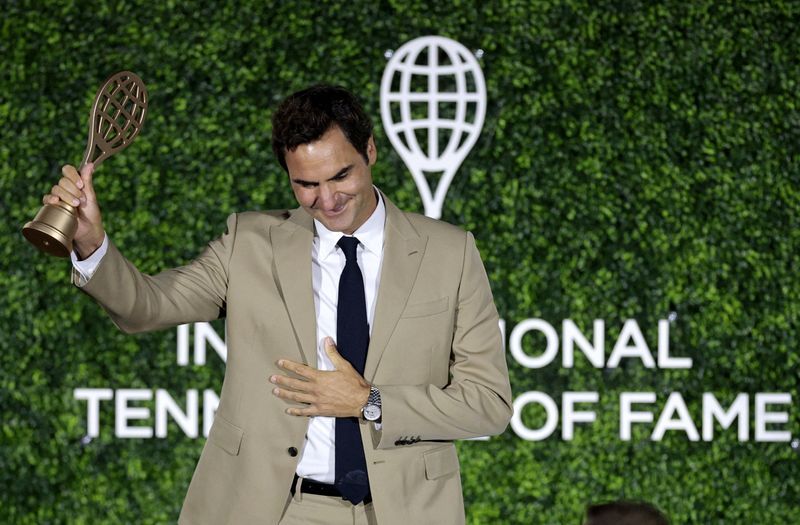
Roger Federer's induction into the International Tennis Hall of Fame in Newport, Rhode Island, this week was less a victory lap and more a meditation on a life transformed by tennis. The Swiss champion, who retired in 2022 after amassing 103 ATP Tour titles, took to the stage visibly moved as he grappled with the weight of the honour and what it represents to his journey. What emerged from his speech was not the typical athlete's eulogy to past glories, but rather a nuanced portrait of a man still wrestling with his relationship to a sport that fundamentally shaped his existence.
Federer's emotional testimony centred on a crucial distinction that many professional athletes never articulate: the difference between pursuing fame and pursuing excellence with love. He articulated his life's philosophy with clarity that clearly resonated with the audience, repeatedly bringing himself to tears as he thanked those who made his career possible. His words underscored that the Hall of Fame recognition, while meaningful, was never the destination he sought. Instead, his ambition had always been to spend his working life doing what he loved alongside people who shared that passion—a seemingly simple objective that becomes increasingly rare at the highest levels of professional sport.
The statistical achievements that earned Federer his place in tennis immortality are staggering. His eight Wimbledon titles remain a men's record, a testament to his mastery of grass courts and his ability to adapt his serve-and-volley style across an entire career. Coupled with six Australian Open crowns, five US Open victories, and a French Open title, Federer's Grand Slam portfolio dominated the landscape for nearly two decades. His 310 weeks as world number one stands as another measure of his sustained excellence. Yet during his speech, Federer deliberately shifted the conversation away from trophy cabinets and ranking points, instead emphasising the creative process of innovation that he brought to professional tennis.
What particularly distinguished Federer's approach to the game was his willingness to experiment and take calculated risks in pursuit of aesthetic and strategic innovation. He spoke candidly about evolving from a baseline player to a serve-and-volley specialist, about his return-of-serve strategies that became famous as the SABR, and about his constant tactical evolution that kept opponents off-balance throughout his career. This commitment to pushing the boundaries of what was considered conventional tennis strategy revealed a player who viewed the sport not merely as a competition to be won through superior athleticism, but as a canvas upon which to paint new possibilities. The detail about wearing more than 5,000 signature headbands throughout his career, and his characteristic two-socks fashion choice, illustrated how even his personal presentation became part of a larger artistic vision.
Federer's gratitude extended deeply to the human architecture that supported his career. His voice cracked noticeably when he acknowledged his wife Mirka, who he described as instrumental not just to his athletic success but to his character development as a husband, father, and friend. The emphasis on relationships and personal integrity suggested that Federer understood his legacy extends far beyond the tennis court. This is particularly resonant for Southeast Asian audiences, where family and personal character remain central to how public figures are assessed. His recognition that success in tennis cannot be separated from the support systems that enabled it reflects values that align with many Malaysian and regional perspectives on achievement and gratitude.
The arc of Federer's career also provided him with a unique vantage point on the evolution of professional tennis across multiple generations. He recalled competing against and observing players spanning from Andre Agassi and Lleyton Hewitt in one era, through Andy Roddick in the transition years, to his greatest rivals Rafael Nadal and Novak Djokovic in his later career. This temporal perspective allowed him to speak with authority about how the sport has transformed, particularly in terms of pace, athleticism, and globalisation. His induction alongside broadcaster and journalist Mary Carillo, a respected voice in tennis commentary, reinforced the notion that Hall of Fame recognition encompasses not just players but those who have shaped how the sport is understood and transmitted to audiences worldwide.
Looking forward, Federer articulated a concern that will resonate with purists across Asia and globally: the risk that professional tennis, in pursuit of ever-greater pace and global expansion, might lose something essential about its character. He expressed hope that the amateur spirit, camaraderie among players, and authenticity would persist as the sport continues to accelerate and internationalise. This appeal comes at a moment when professional tennis is actively expanding into new markets across Asia, with events in India, China, and Southeast Asia becoming increasingly prominent. Federer's implicit question—whether commercialisation and globalisation can coexist with the human and relational dimensions that make tennis meaningful—carries particular weight for a region where Western professional sports are establishing deeper roots.
Federer's message to the next generation of tennis players was simultaneously conservative and radical. He urged them to remain young at heart, to stay true to themselves, and to refuse the temptation toward conformity or complacency. Yet he also challenged them to do things with tennis that have never been attempted, to keep pushing boundaries, to take intellectual and tactical risks. This dual exhortation—remain authentic but also innovate—reflects Federer's own career philosophy and offers a template for aspiring athletes everywhere. For Malaysian and regional sports enthusiasts, his words suggest that excellence at the highest level need not come at the expense of personal integrity or creative expression.
The significance of Federer's induction extends beyond individual achievement to represent a moment of reflection for professional tennis as a global institution. His Hall of Fame entry is not merely backward-looking recognition but a platform from which he could articulate a vision for the sport's future. By emphasising that his time as a player is complete but his relationship with tennis enduring, Federer reframed retirement not as an ending but as a transition. This perspective offers a valuable counter-narrative to the often-melancholic retirement stories that dominate sports journalism. Instead, Federer presented his Hall of Fame induction as a beginning of sorts—a moment when his influence on tennis could shift from direct competition to stewardship and mentorship of the sport's evolution.
The emotional depth of Federer's speech revealed something often obscured by sports journalism's obsession with rankings and records: that the most durable satisfaction in athletic life comes not from external validation but from the integrity of the pursuit itself. His insistence that he is still writing his love letter to tennis, that this induction is not a goodbye, suggested a man who has integrated sport so thoroughly into his identity that separation between professional and personal life has become meaningless. For audiences in Malaysia and across Southeast Asia, where the distinction between work and life purpose remains less sharply drawn than in some Western contexts, Federer's integrated vision of what sport can mean may resonate more deeply than the typical athlete's compartmentalisation of achievement and living.
As Federer took his place in the International Tennis Hall of Fame, he did so not as a relic of tennis's past but as an active voice in its future. His speech functioned as both retrospective and manifesto, examining what made his career distinctive while arguing for how the sport should evolve. That balance between honouring tradition and embracing change, between personal achievement and collective responsibility, marks Federer's contribution to tennis as potentially his most enduring legacy.

