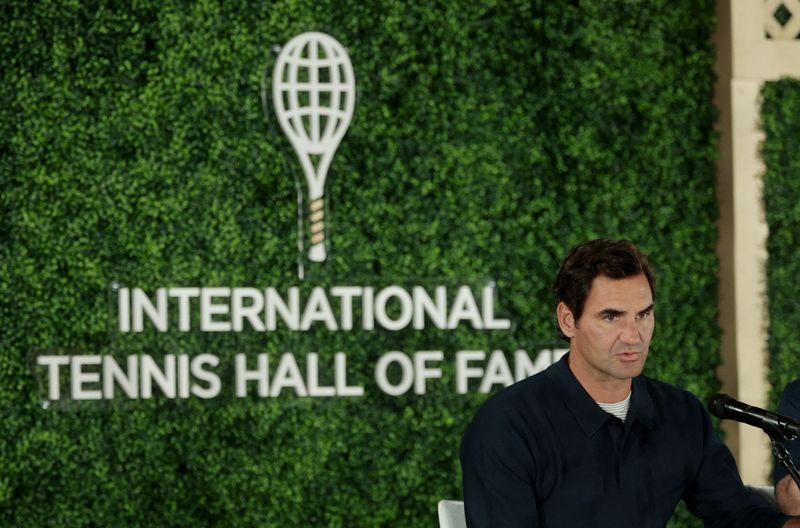
Roger Federer views his induction into the International Tennis Hall of Fame as an opportunity to contemplate not merely the medals and rankings accumulated during his storied career, but rather his profound influence on the sport's trajectory and infrastructure. The 45-year-old Swiss champion, who will be formally inducted in Newport alongside renowned broadcaster and journalist Mary Carillo, distinguishes this recognition from the tangible achievements that characterised his competitive years, describing it as fundamentally different in nature and significance.
Federer's palmarès remain extraordinary by any measure: eight Wimbledon championships—a men's record—alongside six Australian Open titles, five U.S. Open crowns, and the 2009 French Open, securing a career Grand Slam. His international accomplishments extended beyond singles competition, including Olympic doubles gold with Stan Wawrinka in 2008 and instrumental participation in Switzerland's Davis Cup triumph in 2014. When he retired in 2022, Federer had accumulated 103 ATP Tour titles and spent an unprecedented 310 weeks ranked world number one, statistics that underscore his dominance across three decades of professional tennis.
Yet the Hall of Fame recognition prompted Federer to articulate a vision of legacy extending well beyond tournament victories and signature technical mastery. Speaking at a news conference moderated by Hall of Fame president Patrick McEnroe, he emphasised his belief that his contribution should encompass advocacy for systemic improvements benefiting the entire professional tennis ecosystem. Rather than resting solely on competitive achievements, Federer highlighted collaborative efforts with ATP leadership, Grand Slam organisers, and player representatives in shaping policies affecting the sport's operational and financial dimensions.
A central component of Federer's advocacy concerns prize money distribution across all levels of professional competition. Rather than concentrating financial rewards at tournament summits where only champions and finalists benefit substantially, Federer noted the importance of ensuring viable income for players competing in early rounds. This democratisation of earnings reflects recognition that professional tennis requires a sustainable financial foundation enabling emerging talents to pursue their careers without external financial pressure. By expanding compensation beyond elite winners, Federer contended that exponentially more players could sustain themselves through tennis alone—a transformation potentially reshaping opportunities for athletes across developing tennis nations, including emerging talent from Southeast Asia seeking to establish international careers.
Beyond remuneration, Federer acknowledged driving improvements across multiple operational aspects of professional tennis. Enhanced working conditions for players accompanied upgraded facilities for media personnel and medical staff, whilst stadium infrastructure underwent significant modernisation throughout the tour. These institutional improvements reflect understanding that competitive excellence depends on supporting ecosystems encompassing not just athletes but entire tournaments' operational personnel. For regional players aspiring to compete at the highest echelons, such infrastructure improvements facilitate smoother integration into international circuits.
Federer's philosophical approach to his rise from talented Swiss teenager to global sporting icon reveals deliberate psychological engagement with competitive expectations. Rather than resisting pressure accompanying elite status, he consciously embraced the demands of performing on prestigious stages like Centre Court at Wimbledon. This mental orientation transformed pressure into motivation rather than paralysis, enabling sustained excellence across multiple decades. The introspection suggests that psychological resilience and genuine enjoyment of competition formed foundational elements of his dominance—factors transcending technical or physical attributes.
However, Federer acknowledged the psychological toll accompanying elite sporting visibility in contemporary media environments. The relentless external commentary surrounding every match outcome and ranking fluctuation creates psychological turbulence that can diminish the fundamental pleasure underlying athletic pursuits. For modern players navigating social media scrutiny and instantaneous global commentary, Federer's candid assessment about maintaining joy amidst constant external noise offers perspective on psychological sustainability within professional sport. His testimony to successfully preserving happiness despite overwhelming external pressures provides valuable insight for younger players confronting unprecedented media intensity.
Looking forward, Federer left open multiple pathways for continued involvement in professional tennis. Possibilities include eventually assuming a captaincy role with the Laver Cup—the innovative team competition he helped establish—potentially mentoring younger generations, or transitioning into commentary roles providing expert analysis and perspective to global audiences. His commitment to attending three to five events annually demonstrates intent to remain meaningfully connected to professional tennis rather than completely withdrawing from the sport following retirement.
Federer's articulated desire to "give back" reflects understanding that prominent athletes possess platforms and knowledge extending their influence beyond individual competitive achievement. For a figure of Federer's stature, continued engagement with professional tennis can shape institutional evolution and provide mentorship accelerating younger players' development. Recent exhibition performances, including a match at Arthur Ashe Stadium preceding the U.S. Open, confirm his physical capacity for occasional public engagement whilst maintaining post-retirement lifestyle boundaries.
The Hall of Fame induction ultimately represents validation spanning beyond quantifiable statistical achievement, encompassing Federer's broader contributions to professional tennis' development as a global institution. His advocacy for improved player conditions, financial sustainability across competitive hierarchies, and infrastructure modernisation demonstrates that legendary athletes can influence sport through collaborative leadership and systemic thinking. As professional tennis continues evolving—particularly with emerging markets like Southeast Asia generating increasingly competitive players—Federer's legacy of institutional improvement provides a foundational framework for sustainable development benefiting current and future generations of international competitors.

