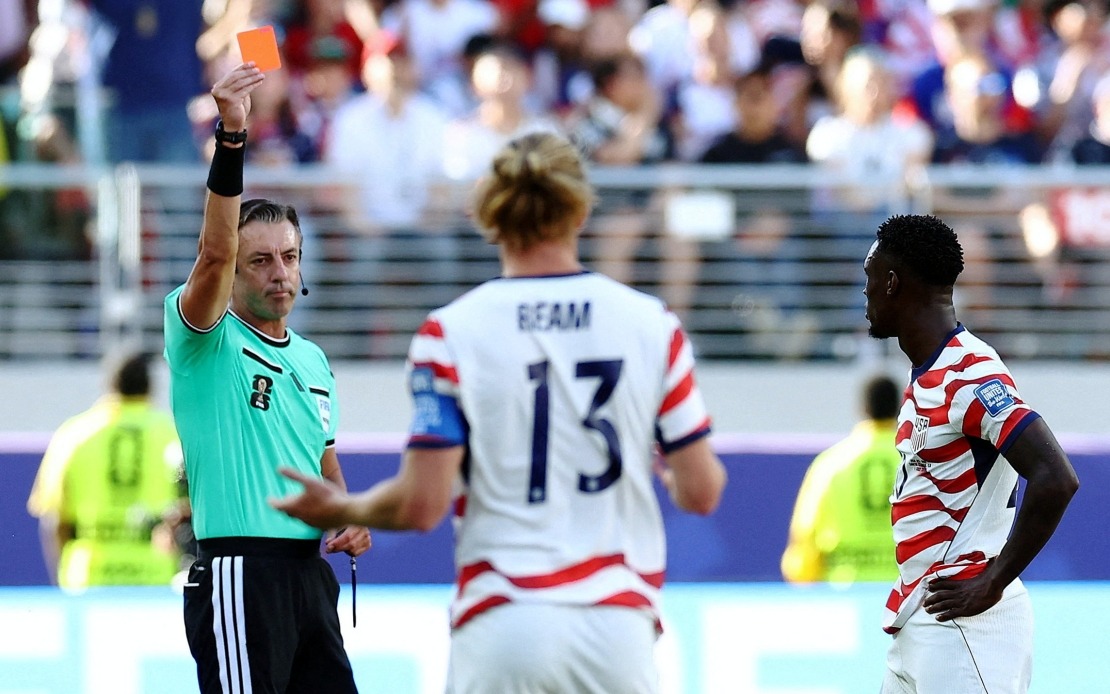
The world football governing body has moved to shield Brazilian referee Raphael Claus from political scrutiny after US President Donald Trump labelled his officiating as suspect during the FIFA World Cup 2026. The dispute centres on Claus's decision to send off American striker Folarin Balogun following a VAR review in last week's last-32 encounter against Bosnia and Herzegovina, a moment that drew the presidential ire.
Balogun's dismissal initially appeared to derail the United States' tournament ambitions, yet the suspension of the red card on Sunday enabled him to participate in the subsequent last-16 fixture against Belgium held in Seattle, which the Americans lost decisively 4-1. This sequence of events prompted Trump to voice concerns about the referee's judgment, questioning the consistency and fairness of the decision-making process at the world's premier football competition.
In response, FIFA issued a formal statement affirming Claus's standing as a match official of the highest calibre. The organisation characterised him as one of the planet's most accomplished professional referees and emphasised his role within Team One, the designated referees contingent at this year's World Cup. The statement further underscored that throughout his professional trajectory, Claus has upheld the most exacting standards of conduct and ethical behaviour.
Pierluigi Collina, FIFA's chief of referees, amplified this defence by highlighting Claus's extensive experience at the sport's grandest stage. Collina noted that Claus is competing in his second FIFA World Cup, having previously served as an official during the 2022 tournament in Qatar. Collina's comments reinforced FIFA's institutional backing, describing Claus as an experienced referee who commands respect throughout the football community and maintaining that the governing body retains absolute confidence in his abilities as a trustworthy and impartial arbiter.
The backing proves timely given speculation within football circles that Claus could emerge as a candidate to officiate the tournament final. Brazil's elimination at the last-16 stage removes potential complications or perceptions of bias that might otherwise arise from a Brazilian referee presiding over the championship match. This positions Claus favourably should FIFA's selection committee consider him for football's most prestigious appointment.
FIFA President Gianni Infantino took a measured approach to the controversy, offering a broader endorsement of the tournament's referees without directly addressing Claus or the contentious decision. Infantino declined Trump's personal request to review Balogun's red card, instead choosing to celebrate the collective contributions of match officials. The Swiss administrator used Instagram to articulate his vision of the World Cup as an triumph, crediting the quality of on-field officiating as central to that success.
Infantino's statement emphasised that match officials at this World Cup represent the elite tier of global refereeing talent, selected through rigorous evaluation processes that weighed their technical proficiency, consistency in decision-making, and sustained demonstration of excellence. This methodical selection framework, he argued, ensures that only the most qualified arbiters take charge of matches, thereby legitimising the decisions they render during play. The implicit message suggested that Trump's criticism, whilst understandable from a national perspective, underestimated the rigour and professionalism embedded in FIFA's vetting procedures.
The Infantino intervention also served a broader educational purpose for audiences, reasserting fundamental principles about the necessity of referee authority within the sport. He articulated a philosophical position that football cannot exist without referees and that respect for officiating decisions forms the bedrock upon which the game's integrity rests. This stance, whilst not uniquely addressing the Balogun incident, positioned FIFA as defender of institutional systems and referee autonomy against external political pressure.
The episode highlights the intersection of politics and sport at international tournaments, particularly when decisions affect powerful nations. Trump's intervention represents an unusual but not unprecedented instance of high-level political figures questioning match officials' impartiality. For Malaysian and Southeast Asian observers, the situation underscores how even the most regulated competitions remain susceptible to scrutiny and challenge when outcomes appear unfavourable to participating teams or their supporters.
The incident also illuminates deeper questions about VAR implementation at World Cup tournaments. The technology was introduced partly to eliminate controversial decisions, yet Balogun's case demonstrates that subjective interpretations persist even with video assistance. The process whereby the red card was subsequently suspended suggests administrative mechanisms exist to reconsider referee decisions, though the circumstances and criteria governing such reconsideration remain opaque to public understanding.
For football administrators throughout Southeast Asia and beyond, FIFA's vigorous defence of Claus offers a template for how governing bodies might respond when political or national interests challenge referee credibility. The approach prioritises institutional solidarity whilst appealing to merit-based selection processes and professional standards as justification for maintaining confidence in match officials. This strategy seeks to insulate the referee corps from external pressure whilst reasserting that the sport's integrity depends upon stable, predictable officiating frameworks.
Looking forward, the Claus controversy may influence how FIFA calibrates communication with political stakeholders at future tournaments. The willingness of Infantino and Collina to publicly defend the referee suggests confidence that institutional procedures can withstand external scrutiny. However, the episode also reveals potential vulnerabilities in match official decision-making at high-stakes moments, particularly when VAR interpretations result in game-altering consequences that national interests perceive as inequitable.

