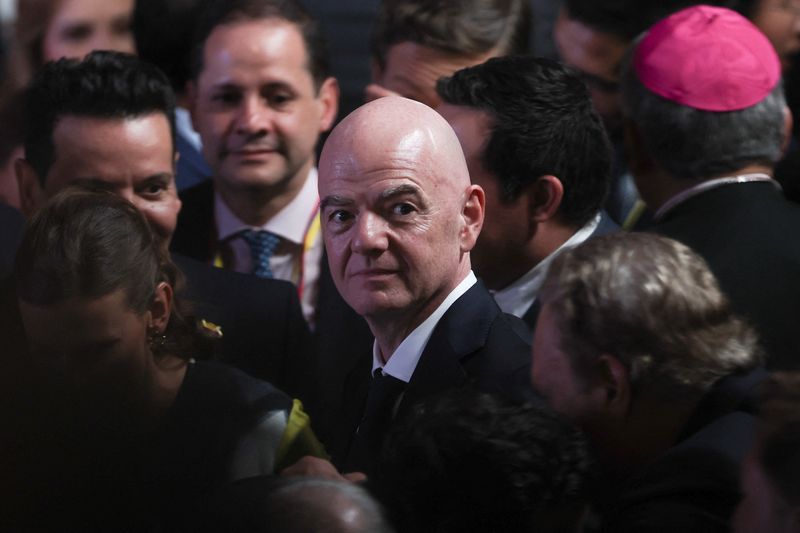
FIFA has forcefully pushed back against what it characterises as a deliberate and sustained campaign to challenge President Gianni Infantino's authority, insisting that any challenge to his leadership must adhere strictly to the organisation's established governance framework and democratic procedures. The statement, issued on Saturday, represents an escalation in rhetoric from the world governing body as it seeks to consolidate support for its embattled president during a period of unprecedented institutional turbulence.
The crisis engulfing FIFA stems directly from the catastrophic failure of Infantino's ambitious commercial scheme, which sought to raise approximately $4.2 billion by licensing a stake in the commercial rights associated with the FIFA World Cup and other major tournaments. The proposal, which would have fundamentally restructured FIFA's revenue model and market positioning, instead triggered a firestorm of opposition that exposed deep fissures within the international football establishment and raised serious questions about Infantino's strategic judgment.
The backlash against the initiative has been geographically and institutionally broad. UEFA, the governing body for European football, emerged as the scheme's most vocal opponent, while numerous national football associations and several senior FIFA officials joined calls for Infantino to step down. These developments prompted FIFA to convene an emergency leadership meeting in Morocco this week, where the organisation's governing structures attempted to shore up support for the president and manage the reputational damage caused by the failed proposal.
FIFA's Saturday statement notably refrains from naming specific opponents or identifying particular allegations and reporting it views as problematic. However, the timing of the statement directly follows recent investigative journalism by The Daily Telegraph regarding payments UEFA allegedly made to a former employee during the period when Infantino served as the European body's general secretary. Infantino has categorically denied these allegations, and FIFA has likewise dismissed them as baseless. The refusal to engage substantively with specific claims suggests FIFA strategy rests on procedural arguments rather than factual rebuttal.
Central to FIFA's defence is its assertion that Infantino enjoys the democratic endorsement of the organisation's 211 member associations and therefore possesses the legitimate mandate to continue leading the institution. This claim warrants scrutiny, however, given that significant regional confederations have openly challenged his authority. UEFA's declaration that it no longer has confidence in Infantino represents a particularly serious blow, as the European confederation represents some of the world's wealthiest and most influential football markets.
Norwegian Football Federation President Lise Klaveness crystallised the growing institutional skepticism by arguing explicitly on Friday that Infantino had forfeited the trust necessary to govern effectively. Her intervention carries symbolic weight, coming from a Nordic nation known for governance standards and institutional accountability. Yet her call for resignation appears to have gained limited traction among other federation leaders, suggesting that criticism of Infantino, while broadening, has not coalesced into an organised removal campaign.
Infantino's position remains substantially reinforced by strong backing from regional power centres outside Europe. The Confederation of African Football unanimously reaffirmed support for his leadership on Thursday, a particularly significant show of strength given that Africa represents a substantial voting bloc within FIFA's membership. South America's CONMEBOL has similarly rejected any effort to remove Infantino outside the formal electoral process, effectively protecting him from extralegal removal whilst not necessarily indicating enthusiastic personal support.
Mexico's football federation presented a more ambiguous picture, publicly backing Infantino despite pressure from its regional confederation CONCACAF, which had called for a thorough reassessment of his presidency. The federation's statement emphasised that any institutional changes must occur through recognised FIFA mechanisms, suggesting that even among regional critics, support exists for maintaining procedural legitimacy even when substantive concerns persist.
Infantino's path to securing a fourth term at the FIFA Congress scheduled for Morocco in March remains unclear but not impassable. No credible alternative candidate has yet emerged to challenge him in that election, despite widespread criticism of his performance and judgment. This absence of a viable opponent matters considerably, as removing an incumbent FIFA president requires not merely dissatisfaction but active mobilisation around a plausible replacement figure. For Malaysian football stakeholders and Southeast Asian football observers more broadly, the outcome of this power struggle carries implications for FIFA's direction on commercial matters, governance reform, and the distribution of tournament hosting opportunities.
For Malaysia specifically, which competes within FIFA's Asian confederation alongside regional powerhouses like Japan, South Korea, and Australia, the nature of FIFA's leadership during the next World Cup cycle will influence investment priorities, competitive structures, and the resources available for football development in the region. A leadership transition at this moment could reshape FIFA's engagement with emerging football markets and alter the calculus around tournament expansion and commercial arrangements.
The deeper significance of this crisis extends beyond personality politics to fundamental questions about FIFA's governance culture. Whether FIFA can implement genuine reform in its decision-making processes, transparency standards, and stakeholder engagement remains unresolved. The failed commercial proposal itself revealed decision-making that alienated major stakeholders and proceeded without apparent consultation with key confederations. Regardless of whether Infantino survives this particular challenge, the underlying governance deficits that triggered this crisis will demand attention from whatever leadership structure eventually emerges.

