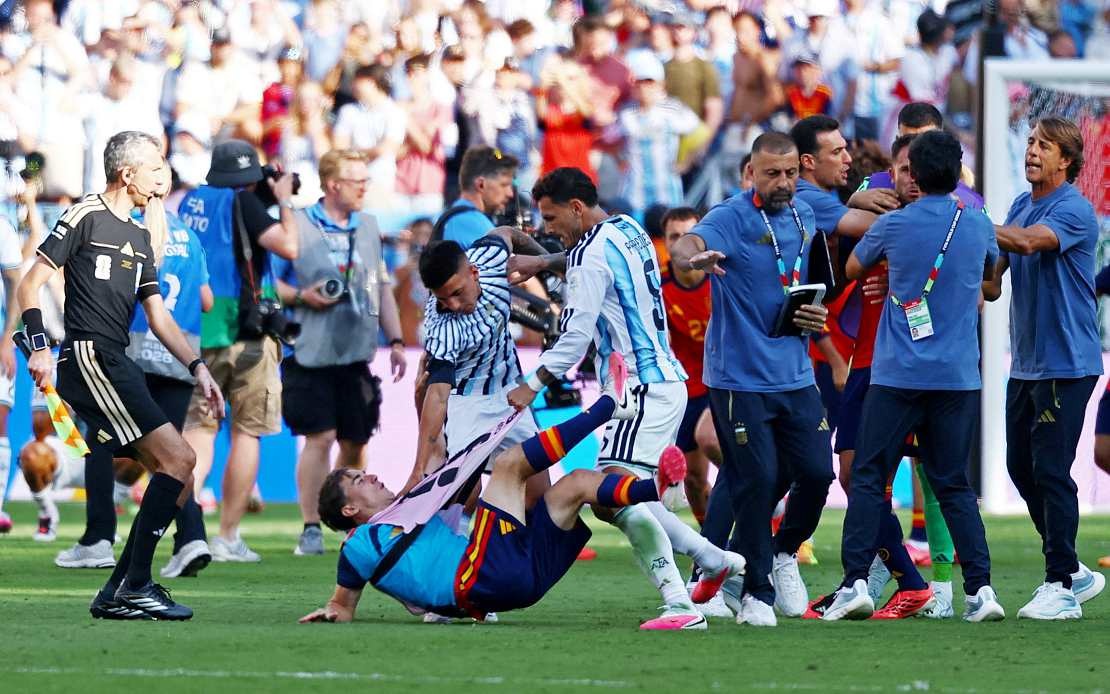
Football's governing body FIFA has formally initiated an investigation into Argentina's conduct during and immediately after the World Cup final against Spain, signalling a serious response to incidents that marred the conclusion of the tournament. The decision to appoint a dedicated Disciplinary and Ethics Prosecutor came after FIFA reviewed the match commissioner's detailed report, indicating that potential violations of the FIFA disciplinary code warrant formal examination rather than summary closure.
The most visible flashpoint occurred in the moments following the final whistle in New Jersey, when Argentina midfielder Leandro Paredes was captured appearing to throw punches directed at Spanish players who were celebrating their victory on the pitch. This altercation, captured on multiple camera angles and widely circulated through sports media channels, provided concrete evidence of conduct that FIFA deemed sufficiently serious to justify investigation by a specialised prosecutor rather than routine administrative handling.
Argentina's physical and aggressive style of play had already drawn criticism throughout the tournament, with observers noting their robust approach in the semi-final victory over England. That match saw Enzo Fernandez sent off after accumulating two yellow cards, further establishing a pattern of disciplinary concern that extended beyond isolated incidents. The accumulation of these incidents across multiple matches strengthened the case for a comprehensive investigation into whether Argentina's approach systematically violated tournament regulations.
While the post-match altercation between Paredes and Spanish players forms the primary focus of the investigation, FIFA's statement carefully avoided specifying whether additional conduct would be examined. Notably, Argentina faced potential charges related to holding aloft a banner proclaiming Argentine sovereignty over the Falkland Islands following their semi-final victory over England. Such political demonstrations occupy an ambiguous zone within FIFA regulations, with Article 34.3 of tournament rules appearing to restrict national teams from making overt political statements during matches and immediate post-match celebrations.
The precedent for how FIFA handles such political expression remains inconsistent and controversial. In 2014, the Argentine Football Association received a financial penalty after displaying similar sovereignty claims during a friendly match against Slovenia. However, UEFA's enforcement in comparable situations has proven considerably more stringent, as demonstrated when Euro 2024 winners Spain saw two of their players, including midfielder Rodri and forward Alvaro Morata, receive one-match bans for chanting about Spanish territorial claims to Gibraltar. This disparity in enforcement raises questions about whether FIFA will apply consistent standards or adopt a lighter approach toward Argentina.
FIFA's documented stance on political expression during tournaments has historically emphasised restriction and discouragement of such gestures, regardless of their source or political orientation. The English Football Association received explicit warnings before the 2022 World Cup in Qatar that captain Harry Kane faced potential sporting sanctions, beginning with yellow card punishment, should he wear the 'OneLove' rainbow-coloured armband intended to advocate for LGBTQ+ rights in a nation where homosexuality remains criminalised. That decision attracted significant international criticism while simultaneously demonstrating FIFA's willingness to police symbolic political expression when deemed inconsistent with tournament regulations.
The investigation's scope and timeline remain deliberately vague in FIFA's official statement, with the governing body indicating that further details will only emerge after the prosecutor completes their comprehensive examination. This procedural approach prevents premature public commentary while ensuring a thorough investigation, though it also creates uncertainty regarding potential consequences and their severity. The disciplinary committee's ultimate decision could range from warnings and financial penalties to match bans for individual players, should evidence support such escalation.
For Malaysian readers, this situation illuminates broader tensions within international sport regarding the balance between competitive conduct, political expression, and organisational authority. The investigation underscores how even the world's premier sporting competition operates within a framework where disciplinary matters extend beyond pure athletic performance to encompass behaviour, respect, and adherence to institutional regulations. Southeast Asian nations participating in FIFA competitions should note how such investigations unfold and what precedents they establish for future tournaments.
Argentina's position as a major football power means the investigation receives intense media scrutiny, with potential outcomes likely to influence how FIFA approaches comparable situations involving other national teams. Should Argentina face significant consequences, the decision would reverberate through international football and establish clearer boundaries for acceptable conduct. Conversely, lighter penalties might suggest FIFA reserves stronger enforcement for particular circumstances or nations, a perception that would undermine the organisation's stated commitment to consistent application of disciplinary standards across all member associations.

