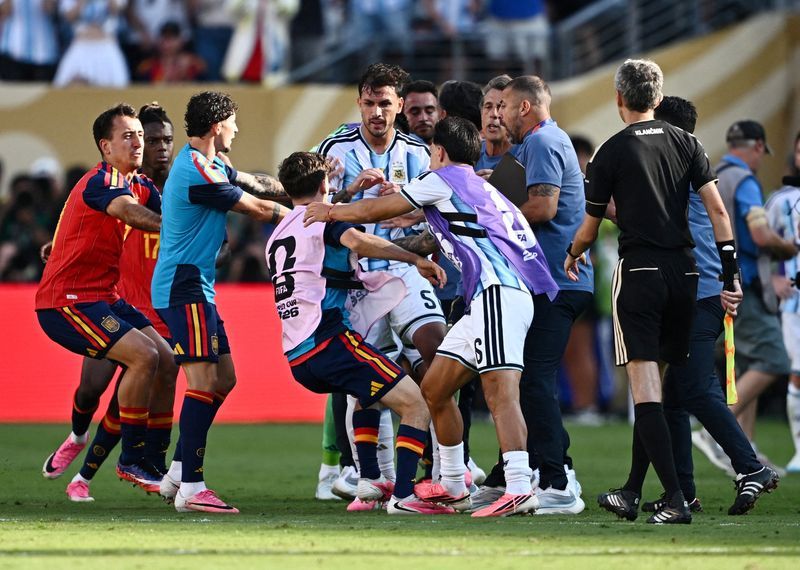
FIFA has commissioned a disciplinary and ethics prosecutor to examine the violent confrontation that broke out after Spain claimed their second World Cup title with a 1-0 victory over Argentina in extra time, casting a shadow over what should have been a moment of celebration and sporting excellence. The melee that followed the final whistle served as a stark reminder that even the sport's grandest stage remains vulnerable to outbreaks of unsporting behaviour, raising questions about player conduct and the pressures that accumulate during matches of such magnitude.
The match itself had already been marked by tension and controversy before the brawl commenced. Argentina midfielder Enzo Fernandez received his marching orders in the 93rd minute of regular play after collecting a second yellow card, reducing the South American side to 10 players and fundamentally altering the dynamics of the contest. This sending-off appeared to intensify frustrations among the Argentine contingent, setting the stage for the explosive scenes that would follow when Spain's winger Ferran Torres secured the decisive goal during the additional period.
When the referee's whistle sounded to end the match, disciplined restraint evaporated entirely. Argentine midfielder Leandro Paredes initiated contact with several Spanish opponents, most notably defender Eric Garcia and midfielder Gavi, in what witnesses described as a deliberate provocation. Rather than allowing tensions to dissipate naturally, this action proved the catalyst for a broader physical altercation that saw players from both teams engage in shoving matches and aggressive confrontations across the pitch.
The severity of the incident forced officials and coaching staff to intervene directly to prevent further deterioration. Argentina's head coach Lionel Scaloni made efforts to restore order among his players, attempting to guide them away from Spanish players and defuse the charged atmosphere. The need for such intervention underscored how quickly competitive frustration had boiled over into conduct unbecoming of international footballers on the world's biggest platform.
For Malaysian and Southeast Asian observers, this incident carries particular resonance given the region's own experiences with heated matches and player discipline. Football in Southeast Asia, while growing in competitive standards, has occasionally been marred by similar conduct issues. The FIFA investigation into this World Cup final brawl demonstrates the international governing body's commitment to maintaining standards of player behaviour at the highest level, a principle that should apply equally to all competitions and regions. The willingness to investigate high-profile teams sends a message about accountability that extends throughout global football.
The composition of the investigating panel—a dedicated disciplinary and ethics prosecutor—indicates FIFA's seriousness in addressing not merely the physical confrontation but the underlying ethical breaches. Such investigations typically examine video footage, gather statements from match officials and players, and determine whether sanctions are warranted. The involvement of an ethics component suggests FIFA is also considering whether pre-match conduct or other factors contributed to the post-match explosion.
Potential consequences could range from fines imposed on the national federations to individual match bans for players deemed to have initiated or significantly contributed to the brawl. Argentina and Spain, both footballing powerhouses with strong reputations to protect, face the prospect of disciplinary action that could damage their standing and affect future competition. For smaller nations watching from the sidelines, the precedent set by how FIFA handles this case will influence expectations about enforcement consistency across different teams and competitions.
The timing of the investigation also matters. While no deadline has been specified for completion, FIFA must balance thoroughness with the need for timely conclusions that provide closure to what became a blemished finale to an otherwise compelling tournament. Prolonged uncertainty could allow narrative disputes to fester and provide fodder for ongoing tensions between the nations involved.
Beyond the immediate disciplinary question lies a broader issue about match management and preventing such incidents before they escalate. Match officials bear responsibility for reading the emotional temperature of a game and implementing preventive measures, such as early cautions or stern warnings to key individuals. The question of whether sufficient measures were taken to calm the contest after Fernandez's dismissal will likely form part of FIFA's examination.
For Spanish football, the World Cup triumph stands as a considerable achievement that resurrects the nation's dominance after a period of relative decline on the international stage. However, the marring of the celebration by post-match violence threatens to shift the narrative away from tactical excellence and towards questions of sportsmanship. Similarly, Argentina, despite the heartbreak of losing in the final, risked tarnishing the memory of their tournament run through the conduct of their players after the whistle.
The investigation also reflects evolving standards in international football, where governing bodies face increasing pressure to enforce discipline consistently and transparently. Social media amplification of such incidents means that FIFA cannot dismiss or downplay the brawl without facing criticism about selective enforcement. The appointment of a dedicated prosecutor signals a professional, methodical approach rather than ad-hoc decision-making based on public sentiment.

