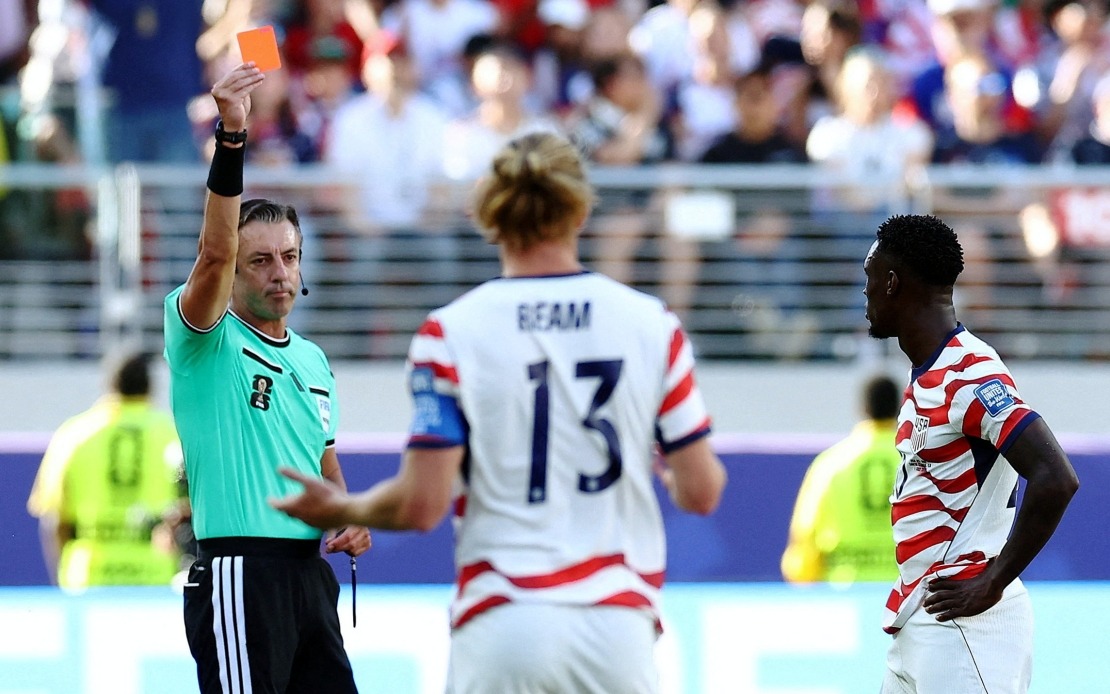
FIFA has intervened to allow American striker Folarin Balogun to line up against Belgium in Monday's World Cup knockout round, overturning what would ordinarily be an automatic suspension from his recent red card. The decision, announced on Sunday, has triggered an immediate and pointed protest from the Belgian Football Association, which questions whether the international football body's own regulations have been properly observed.
Balogun earned his dismissal during the United States' 2-0 victory over Bosnia and Herzegovina on July 1 after stamping on opposing defender Tarik Muharemovic. Under conventional World Cup protocol, such a sending-off carries an automatic one-match ban, which would have sidelined the American star for the round-of-16 encounter in Seattle. However, FIFA's Disciplinary Committee invoked Article 27 of its Disciplinary Code, which grants discretion to suspend the enforcement of sanctions, citing a probationary mechanism that allows competitive exemptions under specified conditions.
The decision carries particular weight given Balogun's contribution to his team's tournament campaign. As the leading American goalscorer with three strikes, his availability significantly enhances the host nation's prospects in a high-stakes match where progression to the quarterfinals awaits the victor. The United States has not reached the World Cup quarterfinals since 2002, making this encounter against a strong European opponent a pivotal moment in the country's footballing ambitions at the tournament.
Belgium's federation responded with an official statement expressing "astonishment" at FIFA's ruling and flagged its intention to pursue every available remedy to challenge the determination. The Belgian association's objection rests on what it characterises as a fundamental contradiction within FIFA's own regulatory framework. According to Article 66.4 of the Disciplinary Code, any player receiving a direct red card faces automatic suspension for their team's next match. Belgium points out that this provision has been consistently applied throughout the tournament, with no previous exceptions granted to players sent off in earlier rounds.
The Belgian federation further anchors its grievance in the FIFA World Cup 2026 Competition Regulations, specifically Article 10.5, which explicitly stipulates that any player or official receiving a direct red card or accumulating two cautions "will automatically be suspended from their team's subsequent match," with the possibility of additional penalties. This language, Belgium contends, is unambiguous and leaves no room for discretionary suspension of enforcement. The federation emphasises that FIFA itself reaffirmed this automatic suspension protocol in World Cup 2026 Circular No. 16, distributed to all participating member associations on May 12, and reiterated the principle during match coordination meetings and official tournament workshops held before competition commenced.
The collision between Article 27's discretionary suspension mechanism and Article 66.4's automatic ban creates an interpretative tension that now sits at the heart of this controversy. FIFA's statement indicates that the probationary framework under Article 27 allows a one-year probationary period during which enforcement is deferred, provided the player commits no further similar infringements. Should Balogun breach disciplinary standards again during this window, the original suspension would activate automatically, and additional sanctions could follow. This reasoning suggests that FIFA views the probationary provision as a legitimate tool for managing proportionality in disciplinary outcomes, particularly in knockout tournaments where player availability carries outsized consequences.
Yet Belgium's interpretation presents a coherent counter-argument: that the automatic suspension articulated in Article 66.4 operates as a mandatory requirement that supersedes discretionary mechanisms when red cards are issued during active tournament play. From this perspective, the distinction between suspension enforcement and suspension existence becomes material. A player might theoretically face a suspended sentence in domestic competition, but the knockout format of a World Cup, combined with explicit regulatory language mandating automatic suspension, creates a context where discretion should yield to certainty and uniformity.
The implications of this dispute extend beyond Monday's Seattle encounter. Tournament integrity hinges partly on consistent application of disciplinary standards. If one team's star player avoids a suspension that would typically ground another team's player for an identical offence, the competitive balance shifts in ways that fans and rival federations may view as inequitable. Belgium's willingness to challenge FIFA publicly signals that smaller nations remain willing to contest decisions by the sport's governing body, even when the odds of reversing determinations appear slim.
From a Southeast Asian perspective, this controversy underscores how tournament regulations can be interpreted with surprising flexibility by football's governing authorities. The situation mirrors occasional disputes in regional competitions where consistency in rule application becomes contested, particularly when major nations or high-profile athletes are involved. Malaysian football observers familiar with AFC competitions will recognise the pattern of how regulations intended to maintain order can become subject to administrative discretion in high-stakes moments.
The United States' advancement prospects hinge substantially on Balogun's presence. Facing a Belgium side that has consistently ranked among world football's elite makes this matchup a genuine examination of American progress. Conversely, Belgium's challenge to FIFA reflects the broader tension between regulatory clarity and administrative flexibility that characterises international sport governance. The Royal Belgian Football Association's stated commitment to "safeguard the legitimate rights of all participating teams and to protect the fundamental principles of fair play" signals an intention to pursue the matter through available channels, potentially establishing precedent for future tournaments.
The outcome of Monday's match will inevitably inform how this disciplinary controversy is ultimately assessed. A convincing American victory might render Belgium's protest a footnote, while a Belgian triumph could reinvigorate calls for retrospective review of FIFA's suspension decision. Regardless of the result, the episode illustrates that even in tournaments governed by detailed rulebooks, interpretation and discretion remain surprisingly consequential forces in determining how international football's regulatory framework is applied when major competitions hang in the balance.

