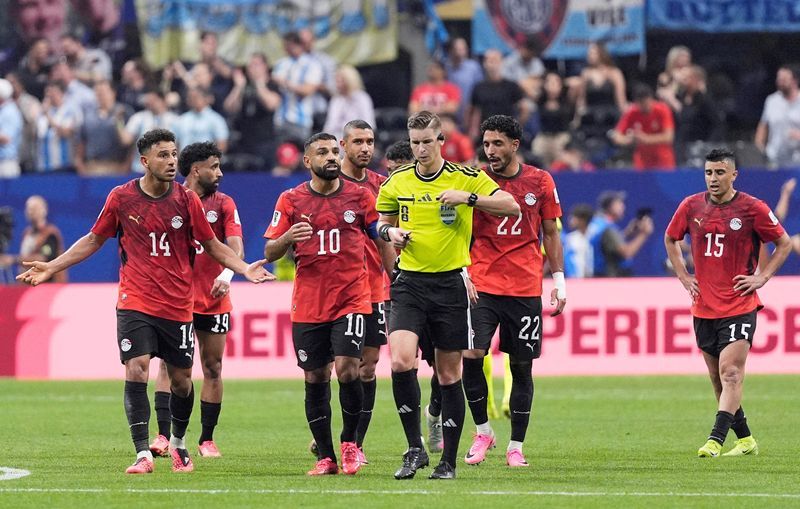
FIFA's head of refereeing, Pierluigi Collina, has firmly pushed back against accusations of unfair treatment in Argentina's dramatic 3-2 triumph over Egypt in the World Cup knockout round, insisting that the officials made their decisions free from external influence and in strict adherence to the rules of the game. In remarks released through the official FIFA website, Collina acknowledged the emotional nature of football and the natural inclination for losing sides to scrutinise controversial moments, but drew a clear distinction between legitimate sporting debate and what he characterised as baseless claims attacking the impartiality of the match officials.
The Egyptian Football Association and national team coach Hossam Hassan had raised serious objections to the refereeing performance, questioning whether the officials had been subject to pressure to keep Argentina—a major football nation and tournament favourite—in contention. Egypt's position gained credibility given the match's dramatic narrative: Argentina had overturned a two-goal deficit through a last-minute winning goal from Enzo Fernandez, a sequence of play that occurred amidst several contentious refereeing decisions. The Egyptian complaints centred on two specific incidents that they believed had cost their team either a goal or a penalty opportunity in the closing stages.
Collina's response directly addressed both flashpoints. On the disallowed goal scored by Mostafa Zico in the second half, the FIFA official explained that the Video Assistant Referee system had correctly identified a foul committed by Egyptian defender Marwan Attia against Argentina's Lisandro Martinez during the build-up to the strike. While acknowledging that the infraction may not have been visually obvious to the on-field referee, Collina stressed that this was precisely the scenario for which VAR existed—to catch fouls that occurred outside the official's immediate line of sight but were nonetheless breaches of the rules. His language suggested a degree of frustration with the notion that referees should overlook technical violations simply because they occurred in less prominent moments of play.
The second disputed incident involved minimal contact between Mohamed Salah and Argentine defender Julian Alvarez moments before the winning goal was scored. Egypt maintained that this contact warranted a penalty kick, which would have fundamentally altered the match's trajectory. Collina's position on this matter reflected a philosophical stance on football contact: he distinguished between legitimate physical challenges where a defender makes first contact with the ball and incidental body contact thereafter, versus deliberate or excessive contact that impedes an opponent's movement. According to his interpretation, Alvarez had won the ball first and the subsequent contact with Salah fell within the boundaries of normal football play and therefore did not constitute a punishable offence.
A significant element of Collina's response involved warning against the broader implications of questioning referee integrity. He noted that unfounded allegations about bias or external pressure could place officials and their families at risk of threats and harassment, transforming sporting disappointment into personal intimidation. This consideration speaks to the increasingly toxic atmosphere surrounding high-stakes football matches, where emotional investment and national pride can fuel aggressive campaigns against match officials. The FIFA refereeing chief appeared to be signalling that organisations like the Egyptian Football Association bear some responsibility for the safety of referees when they publicly suggest that decisions were influenced by improper pressure.
Collina's broader defence rested on the assertion that FIFA's refereeing structures are designed with sufficient checks and balances to prevent outside interference. He explicitly rejected any suggestion that even the FIFA president himself could exert influence over match officials' decisions, framing the integrity of World Cup refereeing as a foundational principle of the tournament's credibility. This position implicitly pushes back against conspiracy-oriented thinking, though it may strike some observers as somewhat defensive given the high stakes and significant resources involved in World Cup competition.
The VAR system itself emerged as a central theme in Collina's remarks. While acknowledging that football will always contain subjective elements requiring human judgment, he expressed confidence in how the system had been deployed throughout the tournament. His comments suggest that FIFA views VAR as having successfully enhanced fairness by catching errors that would otherwise pass undetected, rather than introducing additional controversy. However, the Egypt case demonstrates that VAR has not eliminated disputes over interpretation—it has simply relocated them from on-field decisions to technical judgments about what constitutes a foul or normal contact.
For Malaysian and Southeast Asian football fans, the Argentina-Egypt controversy highlights the tension between modern football's technological ambitions and the sport's inherent interpretive challenges. As VAR systems are increasingly adopted in regional leagues, the question of how such technology should be applied remains contested territory. The Egypt example shows that even the world's most prestigious tournament, with the most experienced referees and the most sophisticated systems, cannot eliminate legitimate disagreement about what the rules should require in ambiguous situations.
The broader context matters here: Argentina's progression to the later stages of the tournament ultimately vindicated Collina's refereeing staff, from a results perspective, but that outcome cannot retroactively settle the question of whether the specific decisions were correct. Football governance in the digital era appears to be navigating an inherent paradox—technology promised to remove human error, but instead it has shifted the terrain of debate from what officials saw to whether they interpreted what they saw correctly. For tournaments and regional competitions across Asia, this precedent from the world's biggest stage suggests that VAR adoption requires not just technical infrastructure but a clear philosophical framework for how rules should be applied to grey-area situations.

