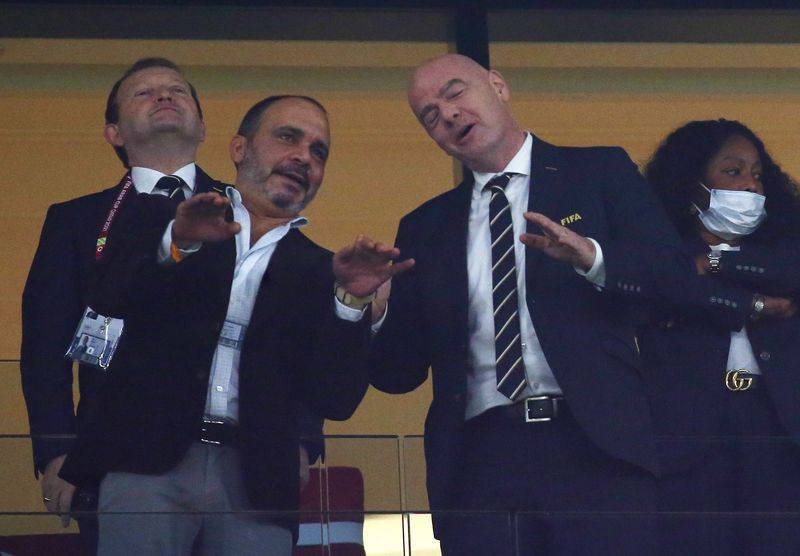
Jordan's national football team and support staff have at last received compensation for their participation in the 2025 Arab Cup after an eight-month delay, according to an announcement by the Jordan Football Association's President Prince Ali bin Hussein on Thursday. The vindication came just two days after he levelled serious accusations at FIFA, describing the world governing body's conduct as tantamount to blackmail in pursuit of political favour.
Prince Ali's frustration centred on allegations that FIFA had used promises of institutional assistance as leverage to pressure the Jordanian football association into endorsing FIFA President Gianni Infantino. According to the Jordanian leader, FIFA officials had communicated verbally during discussions surrounding the World Cup that backing Infantino's continued leadership "would go a long way to helping our FA out". The timing of these overtures, combined with the unexplained withholding of legitimate prize money, painted a troubling picture of conditional aid distribution.
The payment dispute itself had become emblematic of deeper governance concerns within FIFA. Jordan reached the final of the Arab Cup competition in Qatar in December, a significant sporting achievement that entitled the national federation to prize winnings. However, those funds remained frozen in FIFA's accounts through January, February, March, April, May, June, and into July—a period spanning more than half a year during which the Jordan FA had no explanation for the administrative failure. For a smaller confederation managing limited budgets, such prolonged delays create genuine operational hardship.
Prince Ali's public criticism of FIFA's conduct proved sufficiently uncomfortable that the organisation moved swiftly to settle the outstanding obligation. The morning after his social media posts highlighting the eight-month delay, FIFA's administration processed the payment. In his statement of acknowledgement, Prince Ali thanked FIFA for delivering the funds but made explicitly clear that the gesture would not mollify his concerns about institutional dysfunction at the international football authority.
The underlying tension between Prince Ali and the FIFA leadership reflects broader currents of discontent within the confederation structure. Infantino's tenure has repeatedly prompted controversy, and various national associations have grown increasingly vocal about perceived power imbalances and inconsistent administrative practices. The Jordanian FA president's willingness to speak publicly about these dynamics—and to link the delayed prize money directly to attempts to secure his political support—suggests that frustration with FIFA's operational culture is reaching a breaking point among member federations.
Infantino recently abandoned a controversial proposal to sell commercial rights to the World Cup tournament, a scheme that had generated significant pushback from confederations and national associations across multiple continents. That reversal itself reflected the political vulnerability of his position and the degree to which member federations have begun asserting collective resistance to his agenda. However, rather than prompting self-reflection, FIFA's leadership doubled down on Infantino's authority following a crisis meeting held in Morocco on Wednesday. The body issued an apology to members for "mistakes made" regarding the abandoned commercial rights initiative but confirmed continued institutional support for the sitting president.
For Southeast Asian football stakeholders, the Jordan situation carries instructive implications. Smaller confederations and their member associations often find themselves navigating an inherent power asymmetry within FIFA's structures, where larger, wealthier footballing nations typically exercise greater influence over governance decisions. Prize money, qualification funding, tournament allocations, and other financial mechanisms can become tools of leverage within a political environment where federation leaders seek endorsement for contested leadership positions. Malaysia and other regional federations must reckon with the possibility that their own claims on FIFA resources could similarly become subject to political calculus.
The dispute also illuminates FIFA's approach to accountability and transparency. The fact that Prince money for a legitimate sporting achievement could remain withheld for eight months without official explanation, only to be expedited following public criticism, suggests systemic problems in FIFA's administration rather than isolated administrative error. A properly functioning organisation would have cleared such payments automatically upon verification of performance, regardless of the political preferences of federation leadership. That FIFA apparently required external pressure to meet what should be routine financial obligations raises troubling questions about how the body prioritises and executes its foundational responsibilities.
Prince Ali concluded his statement by reaffirming his explicit refusal to endorse Infantino or support his bid for re-election. This positions the Jordan FA among those federations now openly declaring their opposition to the incumbent president's continuance in office. Such declarations from regional associations, while not individually determinative of electoral outcomes, collectively signal the erosion of the consensus that Infantino had previously cultivated, particularly among smaller confederations that might once have deferred to perceived inevitability of his re-election.
The payment episode ultimately serves as a microcosm of FIFA's institutional culture: delayed delivery of obvious obligations, conditional assistance masquerading as institutional support, opaque decision-making processes, and reactive rather than proactive governance. Whether FIFA's leadership will respond to the accumulating criticism by undertaking genuine structural reform remains uncertain, but the willingness of federation leaders like Prince Ali to speak candidly about such dysfunction represents a meaningful shift in the political dynamics that have characterised international football governance.

