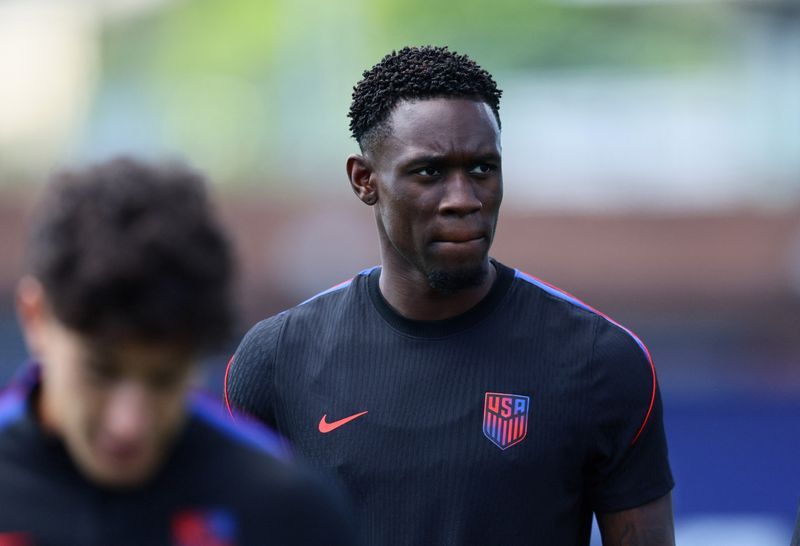
FIFA's extraordinary decision to suspend the automatic one-match ban stemming from Folarin Balogun's red card—made shortly after U.S. President Donald Trump lobbied FIFA President Gianni Infantino—has unleashed a firestorm of condemnation across European football. The move cleared the American striker to participate in Monday's World Cup last-16 encounter against Belgium, but at the cost of undermining the sport's regulatory framework and raising uncomfortable questions about the influence of political actors on sporting competition.
The controversy centres on FIFA's invocation of Article 27 of its Disciplinary Code, which permits the disciplinary committee to suspend the enforcement of previously imposed sanctions. However, this provision stands in direct tension with Article 66.4 of the same code, which stipulates that red cards automatically trigger suspension for the next match—a rule applied uniformly to other players throughout the tournament. Football authorities across Europe view this inconsistency as fundamentally unjust, particularly given that multiple other competitors have accepted their mandatory suspensions without exception or appeal.
Belgium's Football Association articulated this concern with particular force, noting that FIFA's reliance on Article 27 cannot logically override the explicit automatic suspension mandate embedded in Article 66.4. The Belgian federation's statement underscores a critical principle: when disciplinary codes contain both automatic provisions and discretionary escape clauses, the automatic provisions should prevail in matters of objective fact like red card issuance. To allow one nation's political leadership to secure relief from rules applied uniformly to others fundamentally corrupts competitive fairness.
German Football Association President Bernd Neuendorf pressed for immediate clarification on whether Trump's telephone conversation with Infantino preceded the reversal decision. His demands reflect widespread anxiety that political interference has crossed an unprecedented threshold. In professional football, such interventions are virtually unknown at the World Cup level, making this episode extraordinarily alarming. Neuendorf's assertion that "the impression that there has been active political interference in sport must be dispelled swiftly and conclusively" frames the controversy not merely as a procedural error but as an existential threat to FIFA's legitimacy.
The integrity argument extends beyond the immediate case. By creating a precedent within an ongoing tournament, FIFA has effectively signalled that similar circumstances in remaining matches demand equivalent treatment. Other teams facing unfavourable disciplinary decisions may now reasonably expect that diplomatic pressure from their governments could yield similar relief. This prospect transforms World Cup proceedings into a competition where political capital becomes as consequential as athletic performance—a prospect that horrifies football administrators invested in rule-based competition.
Multiple voices within the football community have articulated this domino effect concern. Some observers worry that if the United States advances using a player who should have been unavailable under standard regulations, any future victory becomes permanently tainted by suggestions of external advantage. The taint extends not only to the American team but to FIFA itself, which becomes seen as susceptible to political pressure rather than bound by its own governance structures.
The Belgian federation's methodical parsing of FIFA's regulatory architecture reveals the technical weakness underlying the reversal decision. By demonstrating that Article 66.4 provides mandatory automatic suspension specifically for red cards while Article 27 addresses discretionary suspension of previously imposed sanctions, the Belgians argue that FIFA conflated two distinct legal concepts. The automatic suspension is not a "previously imposed sanction" requiring implementation via separate decision—it operates directly upon the issuance of the red card itself, bypassing any intermediate discretionary stage.
European football figures have emphasised the competitive harm flowing from retroactive rule reinterpretation. When VAR and the on-field referee examined Balogun's conduct, four officiating perspectives (the referee plus three VAR personnel) determined that a red card was warranted. Reversing this collective technical judgment through administrative procedure rather than challenging the sporting assessment itself suggests that regulatory gymnastics, not athletic merit or proper refereeing, drove the outcome.
The timing compounds the damage. Coming midway through a major tournament where numerous other players have received identical red cards and served mandatory suspensions, the reversal creates a two-tier system: those whose nations lack direct political access to FIFA leadership remain bound by established rules, while those with such access obtain exemptions. This inequality fundamentally corrodes the World Cup's standing as a competition governed by impartial rules rather than geopolitical leverage.
For Malaysia and other Southeast Asian nations observing these developments, the episode illustrates how international sporting governance remains vulnerable to political manipulation despite formal independence claims. Smaller football nations without permanent seats at FIFA's decision-making table may reasonably question whether their teams face uniformly applied regulations or whether a hierarchy of political influence shapes outcomes. The Balogun reversal exposes FIFA's institutional weakness in resisting pressure from powerful governments, a vulnerability that could reshape how emerging football nations navigate World Cup politics.
The controversy also raises uncomfortable questions about FIFA President Infantino's judgment and priorities. Rather than deflecting the presidential call, Infantino apparently entertained it sufficiently to discuss the matter internally, ultimately endorsing a decision that contradicts both stated regulations and equal treatment principles. This responsiveness to executive pressure—however diplomatically packaged—signals to other governments that similar approaches might yield similar results in future disciplinary matters.
Ultimately, the Balogun case represents far more than a single player's availability. It demonstrates how political intervention can exploit ambiguities within seemingly clear regulatory frameworks, and how institutional leadership can prioritise diplomatic convenience over competitive integrity. The damage to FIFA's credibility extends beyond this tournament; it establishes a precedent suggesting that the world football governing body's rules are ultimately subject to revision by those with sufficient political standing to make phone calls to its leadership. That represents a fundamental corruption of sport's claim to operate beyond political manipulation—a principle that fans, federations, and footballers across every continent rightly regard as essential to the World Cup's legitimacy.

