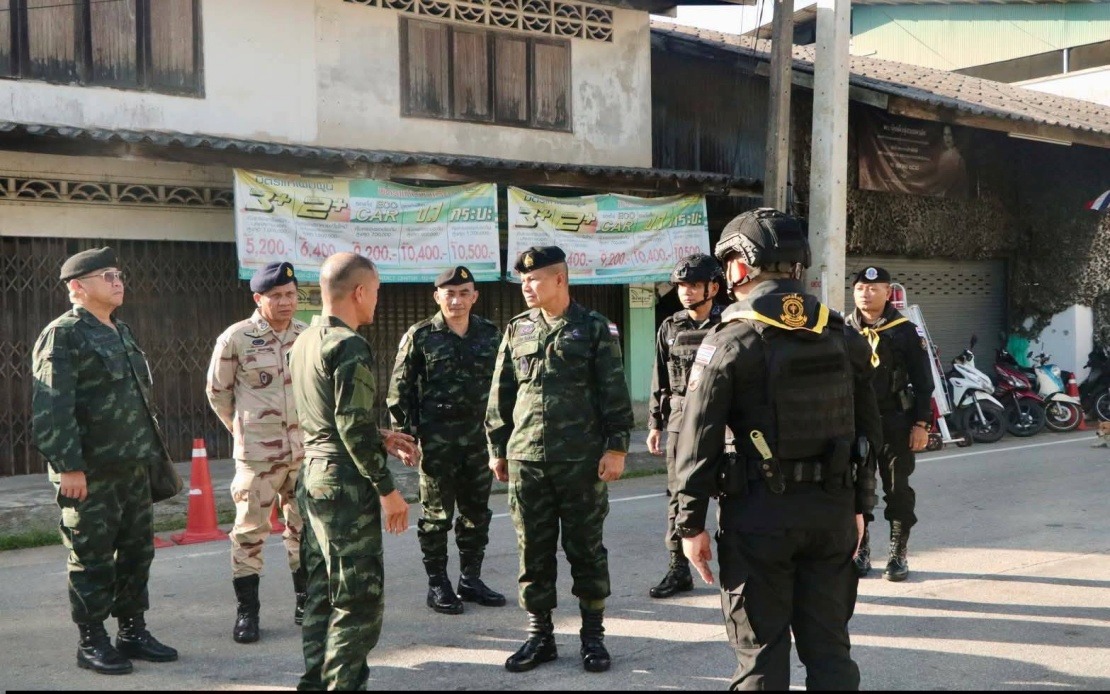
A security checkpoint in Thailand's troubled Narathiwat province came under sustained attack on Wednesday evening, leaving five rangers dead and six civilians wounded in what officials describe as a well-coordinated assault. The incident, which unfolded around 6.45 pm at the 4509 Ranger Company checkpoint positioned on Sami Hill in Rangae District, marks the latest in an escalating series of violent incidents plaguing the restive southern border region shared with Malaysia.
Lieutenant General Norathip Phoyanok, who commands the Fourth Army Region and oversees Internal Security Operations Command operations across the southern provinces, provided details of the attack after inspecting the scene the following morning. His account paints a picture of a coordinated strike: multiple assailants, their faces concealed and dressed entirely in dark apparel, descended upon the checkpoint with overwhelming firepower and explosive devices. The attackers unleashed gunfire while simultaneously hurling pipe bombs at the security personnel stationed there, a dual assault method indicating tactical sophistication beyond spontaneous violence.
The casualties included not just trained personnel but innocent bystanders caught in the crossfire. Among the six civilians injured were a three-year-old girl and an elderly resident, underscoring the indiscriminate nature of the violence. Such attacks targeting civilians alongside military installations have become increasingly common in Narathiwat and neighbouring provinces, creating a climate of fear that extends far beyond security installations into everyday civilian life. The involvement of young children and elderly residents suggests the perpetrators show little concern for non-combatants.
Authorities believe the attackers made good their escape in a black four-wheel-drive vehicle, fleeing the scene after the initial barrage. The vehicle description and coordinated nature of the assault suggest the attack was planned and executed by an organized group rather than isolated militant actors. Thai security officials are investigating which faction might be responsible, though separatist insurgent groups operating across Narathiwat's porous border regions remain the prime suspects in such incidents.
Narathiwat Governor Boonchuai Hormyamyen wasted no time in responding to the attack, ordering a comprehensive security posture adjustment across the province. His directive encompassed all relevant agencies—police, military units, and local administrative bodies—with instructions to strengthen security measures along the critical Malaysia-Thailand border as well as across Narathiwat's twelve districts. This province-wide mobilization reflects official concern that the attack signals a potential escalation or organized campaign rather than an isolated incident.
Forensic teams have cordoned off the checkpoint to conduct detailed scene examinations and evidence collection, a necessary step that will likely take considerable time given the scale of destruction from explosives and sustained gunfire. This methodical investigative work represents both a procedural requirement and an implicit acknowledgment that solving such attacks requires more than immediate reactive measures. Intelligence gathering to identify the masterminds behind the assault remained ongoing at the time of initial reporting, suggesting the investigation had not yet yielded clear leads about organizational responsibility.
The timing of this attack within the context of broader regional instability carries particular significance for Malaysia and Southeast Asia more broadly. Narathiwat's geographic proximity to Malaysia's Kelantan and Terengganu states means that regional instability and militant activity in the Thai province directly affect border communities on the Malaysian side. Cross-border militant movements, weapons smuggling, and the flow of personnel between Malaysia and Thailand's southern provinces have long been documented concerns for both governments, making security coordination along the frontier increasingly vital.
Thailand's southern insurgency, which has claimed thousands of lives over recent decades, has proven remarkably resilient despite sustained military pressure and counterinsurgency operations. Attacks targeting security forces continue with disturbing regularity, suggesting that military and paramilitary responses alone have failed to resolve the underlying grievances—whether framed in terms of separatism, religious identity, or broader socioeconomic marginalization—that fuel recruitment into militant organizations. The persistence of such attacks indicates the conflict remains fundamentally unresolved despite official security operations.
For Malaysia, developments in Thailand's deep south carry obvious implications. Malaysian security agencies monitor these incidents closely, understanding that instability across the border can metastasize into cross-border criminal activity, weapons trafficking, and recruitment drives targeting Malaysian citizens. The porous nature of the Malaysia-Thailand border, particularly in the areas facing Narathiwat and neighbouring Pattani province, has historically enabled militant groups to exploit geographic advantages and move freely across jurisdictions.
Governor Boonchuai's mobilization order reflects standard crisis-response protocols but also hints at official concern that the checkpoint attack might represent something more systematic. Whether the assault was connected to broader strategic calculations by insurgent organizations or represented a more localized action remains unclear from initial reporting. However, the coordinated nature of the attack—multiple armed individuals, synchronized use of firearms and explosives, planned vehicular escape—suggests a degree of organization that distinguishes it from opportunistic violence.
The broader strategic picture in Thailand's southern provinces has long involved multiple armed groups with competing agendas, including outright separatist organizations, criminal networks exploiting border instability, and even vigilante groups operating with tacit state tolerance. Distinguishing between these actors and understanding their motivations remains a significant intelligence challenge for Thai and Malaysian security officials alike. The five dead rangers and six wounded civilians represent tragic human costs of a conflict that shows no sign of fundamental resolution despite decades of intensive military engagement and periodic peace initiatives.

