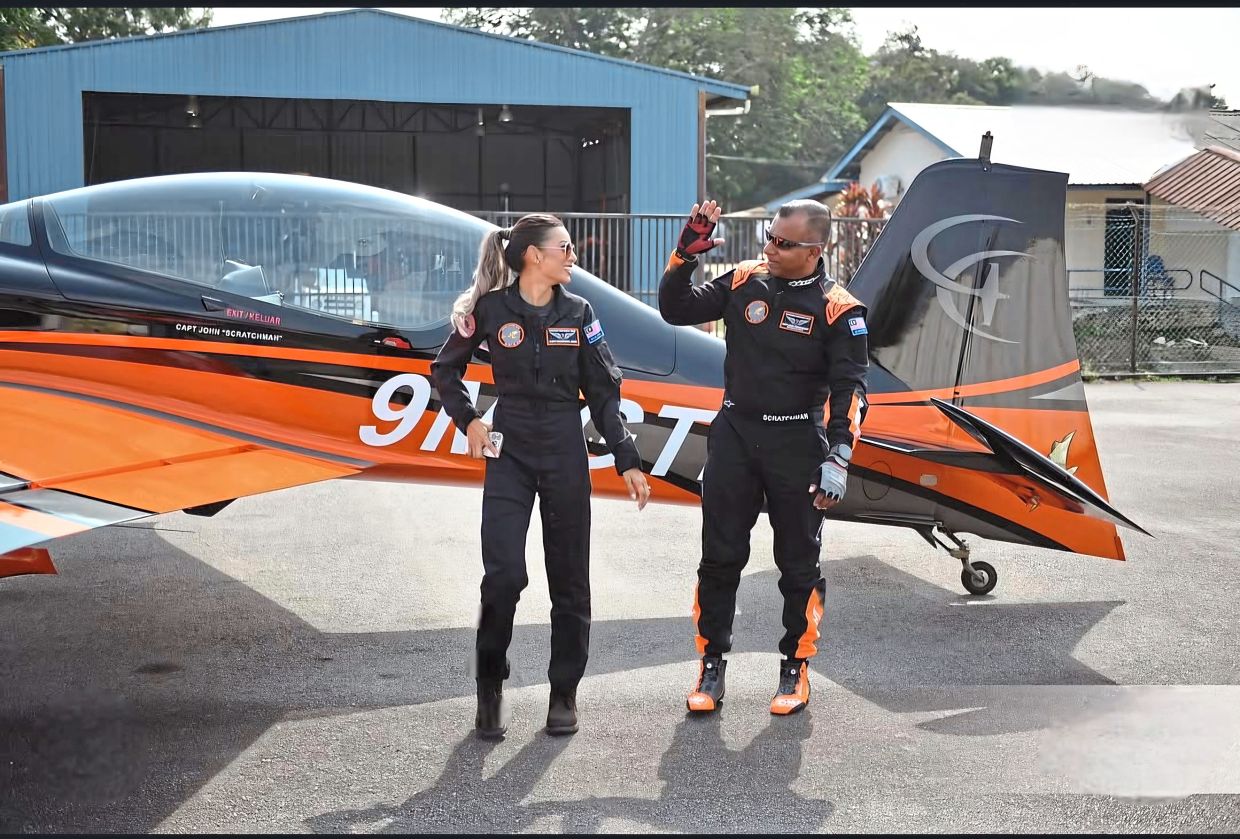
Samantha Laura John represents a growing wave of Malaysian women entering professional aviation, but her path carries singular significance: she is following directly in the footsteps of her father, Lieutenant-Colonel (R) John Sham Alagarsamy, a 54-year-old former fighter pilot whose 26-year career with the Royal Malaysian Air Force established him as one of the nation's most accomplished aviators. After graduating from flight school in Ipoh in 2025, Samantha now holds a commercial pilot's licence, cementing a family legacy that bridges military and civilian aviation across two generations.
Growing up on Malaysian air force bases across the peninsula exposed Samantha to an environment few children experience. Her father's career took the family from Labuan to Kuantan, then to Alor Setar and Butterworth in Penang—each posting a chapter in her formative years. Rather than resenting the frequent relocations, she credits this itinerant childhood with shaping her worldview. The military installations themselves became her classroom, where discipline, purposefulness, and national service were not abstract concepts but visible daily in the lives of personnel around her. Watching her father prepare for combat readiness exercises and navigation missions instilled in her a profound admiration, though she did not immediately recognise it as the spark for her own aviation ambitions.
The path to the cockpit, however, was not entirely linear. After completing her International General Certificate of Secondary Education qualifications, Samantha initially explored alternative careers rather than automatically shadowing her father's trajectory. In 2018, she enrolled in a two-year cadet pilot programme with an airline based in Sepang, Selangor, a role she found rewarding but ultimately incomplete. Only when returning to formal flight training did she acknowledge what had always tugged at her consciousness: aviation was not merely her father's world but her calling. Her eventual decision to pursue a full pilot's licence represented not parental pressure but personal conviction, the culmination of years of reflection on what truly motivated her.
John Sham Alagarsamy's own counsel to his children reflected a philosophy of aspiration without coercion. He frequently told them that dreaming larger visions—aiming for the stars—would carry them further than settling for modest goals, yet he made clear that the choice belonged entirely to them. This balance between inspiration and autonomy appears to have resonated deeply with Samantha, who consciously tested other directions before returning to aviation. Her father's approach contrasts sharply with more prescriptive parenting models, instead trusting that exposure to meaningful work and demonstrated passion would naturally guide his children toward fulfilling paths. That philosophy proved vindicated when his daughter independently concluded that flying represented her deepest professional aspiration.
Beyond his military credentials, Lieutenant-Colonel John Sham Alagarsamy carved out a distinctive niche in Malaysia's aviation landscape after transitioning to civilian flying in 2019. He holds the singular distinction of being the country's first and only civil aviator officially recognised by the Civil Aviation Authority of Malaysia for aerobatics expertise. This specialisation has seen him perform at prestigious international airshows, most notably the Langkawi International Maritime and Aerospace Exhibition (Lima), where he has piloted the GB1 GameBird aircraft in high-precision aerobatic displays. These performances require extraordinary skill and represent the pinnacle of civilian aviation achievement, a rarefied accomplishment that elevates his professional standing far beyond typical commercial pilot credentials.
The diversity of John Sham Alagarsamy's talents extends well beyond aviation. He is an accomplished musician and professional deejay operating under the moniker "Scratchman," a pursuit that culminated in his victory at the Malaysian Open DJ Competition in 1992 during the golden era of vinyl and turntablism. This creative dimension of his identity suggests a personality rich in technical mastery and artistic expression, qualities that perhaps informed his approach to mentoring his daughter. A person equally comfortable in a fighter jet cockpit and behind turntables possesses a flexibility of mind and openness to diverse forms of achievement that may have unconsciously encouraged Samantha to envision a multifaceted life rather than a narrowly defined career.
Currently, Samantha operates at a considerable distance from active flying operations, having established herself in Kota Kinabalu where she co-runs an event management company alongside her husband, David Chong, 30. She also provides vocal coaching services, activities that occupy her professional attention and provide stable income. Despite holding a valid pilot's licence, she has not yet transitioned into commercial flying operations, a gap she describes as temporary rather than permanent. Her declared intention to eventually return to aviation and pursue a formal career in commercial aviation suggests that her current path represents a deliberate detour rather than an abandonment of her childhood dream. This measured approach—securing financial stability and personal relationships before fully committing to an aviation career—reflects mature planning.
The family's international exposure broadened the horizons through which both Samantha and her father viewed aviation and defence. In 2012, when John Sham Alagarsamy was attached to the Australian Defence Force while pursuing a master's degree in military and defence studies from the Australian National University, the entire family relocated to Canberra for an extended period. For Samantha, then a teenager navigating formative educational years, the experience provided unprecedented insight into how different nations approach aviation systems, military training, and defence cooperation. This exposure to international military and civilian aviation standards and practices gave her a comparative framework that many Malaysian pilots lack, potentially positioning her with valuable perspective should she pursue advanced specialisations or international career opportunities.
The phenomenon of aviation running through families is not unique to Malaysia. Sisters Safia Amira Abu Bakar and Safia Anisa Abu Bakar both followed their father Captain Abu Bakar Shafie into aviation careers, demonstrating that the confluence of parental influence and childhood exposure can shape professional trajectories across multiple families. Academic research supports this pattern: a study published in Universiti Teknologi Malaysia's social science journal, titled "Parental Influence and Undergraduates' Career Choice Intentions," found that robust parent-child relationships characterised by open communication and mutual trust substantially influence career decisions by encouraging exploration and long-term strategic planning. These findings suggest that families like the Johns and Bakar households operate within documented psychological frameworks where parental example and emotional support create conditions conducive to children pursuing similar professional paths.
When Samantha discusses her experience in the cockpit, her language reveals something profound about what flying provides beyond mere employment. She describes it as therapeutic, a mental state requiring total presence and what she characterises as "working in six dimensions"—a compressed description of the simultaneous attention pilots must devote to altitude, direction, speed, surrounding aircraft, weather systems, and aircraft systems. This multi-dimensional consciousness, she suggests, offers respite from the fragmented attention that characterises modern life. The cockpit demands a completeness of focus that contemporary existence rarely permits, making each flight session intrinsically restorative. This psychological dimension of aviation—the meditative intensity it requires—may ultimately prove more durable than the practical career considerations that initially drew her to her father's profession.
The relationship between John Sham Alagarsamy and Samantha, observed during a recent family gathering in the Klang Valley where she visited her mother Lynda Shanti Ganesaguru and brother Shayne Zacchaeus John, reflects a particular quality of respect woven through affection. The discipline and manners evident in how Samantha interacts with her father represent values deliberately cultivated across her childhood on military bases and reinforced through international exposure. John himself articulates a philosophy of parental influence that privileges demonstration over instruction: impact is measured through positive influence on others, particularly children who absorb lessons from observed behaviour more completely than from explicit teaching. This conviction, rooted in his decades of military service and formally recognised through his decoration with the Most Gallant Order of Military Service (Kesatria Angkatan Tentera), suggests that his approach to fatherhood mirrors his approach to military leadership—leading through exemplary conduct rather than command.
As Samantha Laura John navigates her thirties, her pilot's licence in hand and her event management company operating successfully, she embodies a new generation of Malaysian aviation professionals whose entry into the field reflects both family legacy and independent choice. The fact that she pursued alternative paths before returning to flying demonstrates that her commitment stems from genuine conviction rather than inherited obligation. Her father's willingness to support this unconventional route—allowing exploration before acceptance of legacy—suggests an evolution in how professional and family values are transmitted across generations. For Malaysia's aviation sector, the implications are significant: as more women like Samantha enter professional flying, and as families demonstrate that aviation careers remain accessible and attractive across gender lines, the industry's talent pool expands considerably. The Johns' story, ultimately, is not merely about a pilot and his pilot-daughter, but about how passion, discipline, and respect for individual agency can combine to create meaningful professional legacies.
For Southeast Asian readers observing Malaysia's aviation development, the family's narrative carries regional relevance. As nations throughout the region modernise their aviation infrastructure and expand civil aviation operations, they increasingly require qualified pilots from diverse backgrounds. Malaysia's emergence of women pilots like Samantha, entering the profession through both independent achievement and family connection, positions the country as a regional leader in inclusive aviation talent development. The example also demonstrates that family influence remains a powerful—though not deterministic—factor in career choice, a consideration relevant to aviation schools and industry recruiters across Southeast Asia seeking to understand how young people decide to commit to demanding, specialised professions.
%22%2F%3E%3C%2Fpattern%3E%3C%2Fdefs%3E%3Crect%20width%3D%22100%25%22%20height%3D%22100%25%22%20fill%3D%22url(%23ph5sogmg)%22%2F%3E%3Crect%20width%3D%22100%25%22%20height%3D%22100%25%22%20fill%3D%22url(%23ph5sogmp)%22%2F%3E%3Ctext%20x%3D%2250%25%22%20y%3D%2250%25%22%20text-anchor%3D%22middle%22%20dominant-baseline%3D%22central%22%20fill%3D%22rgba(255%2C255%2C255%2C0.95)%22%20font-family%3D%22Georgia%2C%20'Times%20New%20Roman'%2C%20serif%22%20font-weight%3D%22700%22%20font-size%3D%22320%22%20letter-spacing%3D%22-0.02em%22%3EUS%3C%2Ftext%3E%3C%2Fsvg%3E)
%22%2F%3E%3C%2Fpattern%3E%3C%2Fdefs%3E%3Crect%20width%3D%22100%25%22%20height%3D%22100%25%22%20fill%3D%22url(%23ph1yj1qg)%22%2F%3E%3Crect%20width%3D%22100%25%22%20height%3D%22100%25%22%20fill%3D%22url(%23ph1yj1qp)%22%2F%3E%3Ctext%20x%3D%2250%25%22%20y%3D%2250%25%22%20text-anchor%3D%22middle%22%20dominant-baseline%3D%22central%22%20fill%3D%22rgba(255%2C255%2C255%2C0.95)%22%20font-family%3D%22Georgia%2C%20'Times%20New%20Roman'%2C%20serif%22%20font-weight%3D%22700%22%20font-size%3D%22320%22%20letter-spacing%3D%22-0.02em%22%3EPAS%3C%2Ftext%3E%3C%2Fsvg%3E)
%22%2F%3E%3C%2Fpattern%3E%3C%2Fdefs%3E%3Crect%20width%3D%22100%25%22%20height%3D%22100%25%22%20fill%3D%22url(%23ph3uy27g)%22%2F%3E%3Crect%20width%3D%22100%25%22%20height%3D%22100%25%22%20fill%3D%22url(%23ph3uy27p)%22%2F%3E%3Ctext%20x%3D%2250%25%22%20y%3D%2250%25%22%20text-anchor%3D%22middle%22%20dominant-baseline%3D%22central%22%20fill%3D%22rgba(255%2C255%2C255%2C0.95)%22%20font-family%3D%22Georgia%2C%20'Times%20New%20Roman'%2C%20serif%22%20font-weight%3D%22700%22%20font-size%3D%22151%22%20letter-spacing%3D%22-0.02em%22%3EPerikatan%3C%2Ftext%3E%3C%2Fsvg%3E)