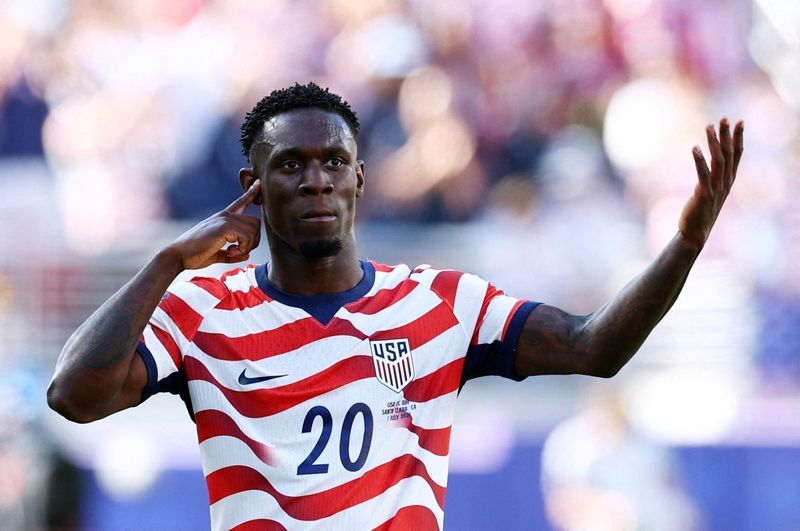
Folarin Balogun faces perhaps the most consequential 90 minutes of his sporting career on Monday, standing at the intersection of soccer performance, national identity, and American political ideology. The Nigerian-born striker, who represents the United States at the World Cup, was initially barred from the knockout stage against Belgium following a straight red card against Bosnia and Herzegovina. The situation spiralled into controversy when FIFA unexpectedly announced on Sunday that it would suspend the ban, allowing Balogun to play. The development carries profound ironies, particularly given the political dimensions now attached to his case.
The incident that triggered the suspension appeared routine by soccer standards. During the Bosnia match, Balogun was dismissed after a Video Assistant Referee review determined he had planted his boot on the ankle of defender Tarik Muharemovic—a challenge that seemed more reckless than deliberate. Standard protocol suggested he would miss the Belgium fixture, a critical round-of-16 encounter. Yet within days, President Donald Trump publicly appealed to FIFA President Gianni Infantino to reconsider the decision, creating an unusual political dimension to what should have been a purely sporting matter.
Balogun's pathway to the American squad makes his case particularly resonant in contemporary political debates. Born in New York when his Nigerian mother could not return home due to her advanced pregnancy, he was an "accidental American" by circumstance rather than choice. His mother returned to Britain one month after his birth, and Balogun grew up in London, progressing through Arsenal's elite academy system. He initially represented England at youth level before switching to the United States in 2023, a decision he described as being influenced partly by a vacation to Orlando where he experienced the passion of American soccer fans firsthand.
The timing of Trump's intervention carries particular significance given the Supreme Court's recent rejection of his central policy objective. Days before appealing to FIFA on Balogun's behalf, Trump suffered a legal setback when the Supreme Court declined to overturn the 14th Amendment's birthright citizenship provision. Advocates of immigration restrictions have long sought to restrict citizenship acquired through birth on American soil, arguing it represents a loophole rather than a core principle. Balogun's case has become a lightning rod for these competing ideologies, with his World Cup performances coinciding with heated national debate over American identity and immigration policy.
Support for birthright citizenship has proved surprisingly resilient among the American public. Recent polling by Reuters and Ipsos showed most Americans oppose ending the practice, suggesting Trump's position lacks broad support despite his political prominence. Advocates have seized on Balogun's trajectory as evidence that birthright citizenship produces tangible national benefits. Jorge Loweree, managing director of programs at the American Immigration Council, characterized Balogun's case as "an extraordinary example of the good that is made available to us by things like birthright citizenship, giving people an opportunity that they would not have otherwise, to be their best and to contribute to the United States in ways that benefit all of us." The Miami Herald editorial board framed his emergence as a World Cup star more directly, declaring that "Balogun prove(s) birthright citizenship isn't a loophole—it's America."
Balogun's emergence as a breakout star has fundamentally altered the narrative around American soccer on the global stage. Christian Pulisic, the traditional face of United States men's soccer, has long served as the sport's primary celebrity in a nation historically ambivalent about association football. Yet Balogun's three goals in the group stage captured public imagination in ways Pulisic had not achieved, generating dreams of a deep tournament run. His performances earned recognition from basketball star LeBron James, who witnessed Balogun mimic his signature "Silencer" celebration on the pitch. Simultaneously, Balogun's presence has contributed to American soccer's evolution away from its historically narrow demographic base, with commentators noting how the team now showcases genuine diversity compared to previous generations.
Critics and observers have questioned whether Trump's personal appeal to Infantino influenced FIFA's decision to suspend the red card ban. Infantino publicly stated that while he had received communication from the American president, this contact had no bearing on the reversal. Yet the coincidence remains striking—FIFA's announcement came less than a week after Trump's direct intervention. The decision contradicts typical enforcement patterns, raising questions about whether extraordinary political pressure can sway international sports governance. Loweree observed that "the timing and the development of the story has been extraordinary to witness," capturing the unusual fusion of diplomatic intervention and sporting discipline.
For Malaysian and Southeast Asian observers, Balogun's situation illuminates broader tensions within international sports governance and the ways political interests intersect with athletic competition. FIFA has faced persistent criticism over its enforcement consistency and susceptibility to external pressure, particularly from powerful nations. The Balogun case demonstrates how individual player circumstances can become proxies for larger political debates within particular countries. Additionally, the incident highlights how developing nations' sporting stars occasionally navigate complex identity questions, a reality familiar to many athletes across Southeast Asia who choose to represent countries other than their birth nations.
Balogun's own perspective on these swirling controversies remains measured. Immediately after receiving the red card, he accepted the moment with relative equanimity, with Pulisic placing a supportive arm around his shoulder as he exited the pitch. Days later, Balogun pledged to channel his energy into supporting teammates from the sideline. His pragmatism stands in contrast to the political firestorm his case has generated, suggesting the young striker views his identity as fundamentally tied to his performance on the field rather than the nationality debates consuming commentators. Whether he plays Monday against Belgium may ultimately matter less than how his journey has already reshaped conversations about American identity, immigrant integration, and the responsibilities of birthright citizenship in the twenty-first century.

