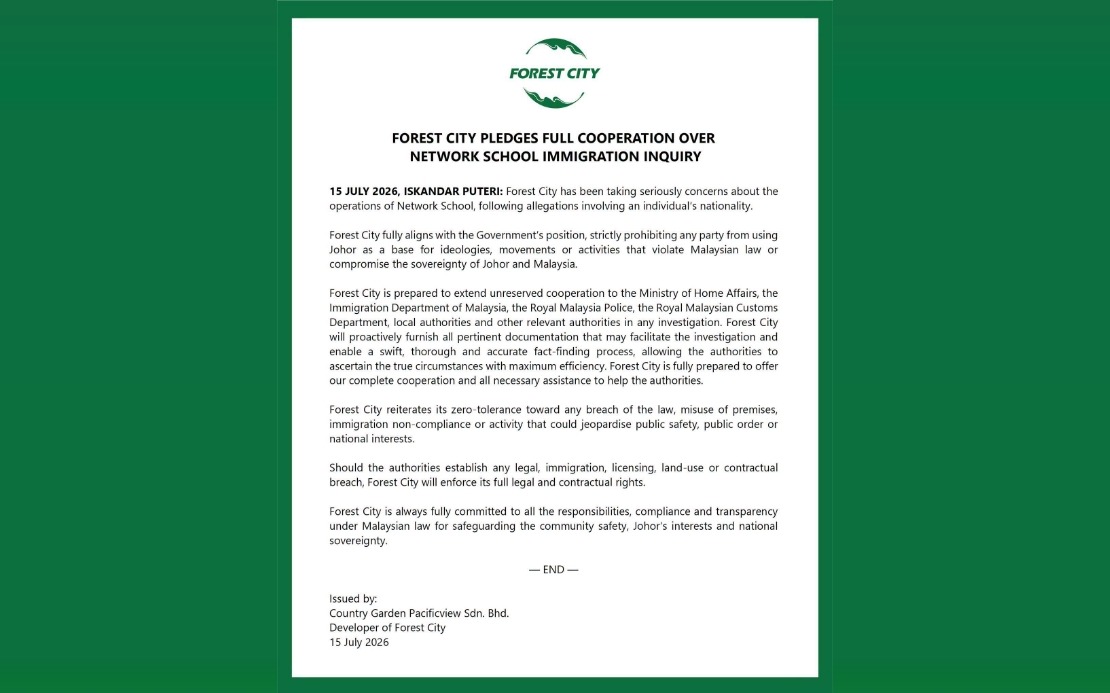
The developer of Forest City in Johor Bahru has signalled its readiness to work with all relevant government agencies investigating the controversial Network School operation, which has drawn scrutiny over allegations involving Israeli nationals. Country Garden Pacificview Sdn Bhd released a statement emphasising its commitment to support the authorities in examining how the school functioned within the mixed-use development and whether proper protocols were observed.
The company's swift public response reflects the sensitivity of the matter in Malaysia, where concerns about activities involving Israeli citizens remain politically charged. Forest City, a major waterfront development project spanning the Johor-Singapore border, has become the focal point of investigation after local officials raised alarms about the school's operations and the nationality of its attendees.
Country Garden Pacificview stated it takes the allegations seriously and aligns itself with the Johor state government's position that the development should never serve as a venue for unlawful activities or anything that compromises national sovereignty. The company framed its cooperation as part of a broader commitment to uphold Malaysian law and protect the integrity of the development from misuse.
The developer indicated it stands ready to engage with multiple agencies, including the Home Ministry, Immigration Department, Royal Malaysia Police, Royal Malaysian Customs Department, and local councils. This multi-agency coordination underscores the complexity of investigating operations at a large, multi-purpose development with diverse tenant operations and regular international visitor traffic.
In its commitment to transparency, Country Garden Pacificview pledged to provide all documentation necessary to support the investigation. The company positioned itself as a willing participant in establishing a comprehensive factual record, suggesting it believes cooperation will help clarify what occurred at the Network School and whether proper regulations were breached.
The developer also articulated a zero-tolerance policy covering violations of law, misuse of premises, breaches of immigration requirements, and activities that threaten public safety and social order. This stance reflects an attempt to reassure both authorities and the public that Forest City maintains strict operational standards and will not tolerate tenant activities that fall outside legal boundaries.
The investigation gained momentum after Johor Menteri Besar Datuk Onn Hafiz Ghazi publicly called for a thorough examination of the Network School, citing concerns that individuals holding Israeli citizenship had allegedly used alternative passports to enter Malaysia and participate in the programme. Such actions, if substantiated, would represent immigration violations and potentially raise national security implications.
Following the state government's directive, the Immigration Department launched an inspection of 266 foreign nationals from 40 different countries present at Forest City. Preliminary findings indicated all individuals carried valid immigration documentation, though authorities stressed that investigations remained ongoing and further scrutiny would continue.
For Malaysia and the broader Southeast Asian region, this incident highlights vulnerabilities in monitoring large-scale commercial developments where multiple organisations operate with international clientele. Forest City, with its cross-border location and significant foreign investment, typifies modern urban projects where oversight becomes more complex as legitimate business activities intersect with potential regulatory gaps.
The episode also demonstrates how quickly security concerns can emerge at major developments and the importance of cooperation between private developers and government agencies in addressing public worries. Country Garden Pacificview's approach sets a precedent for how multinational corporations operating in Malaysia should respond when authorities raise questions about tenant operations.
Looking forward, the outcome of this investigation could influence how future large developments manage tenant vetting, particularly for educational or training operations involving international participants. The case underscores the need for clearer protocols governing activities at commercial properties and stronger coordination between immigration authorities and private sector stakeholders.
The investigation also reflects broader regional tensions and Malaysia's careful navigation of diplomatic relationships. Authorities must balance enforcement of immigration law with operational realities while managing public sentiment around politically sensitive nationalities and activities.

