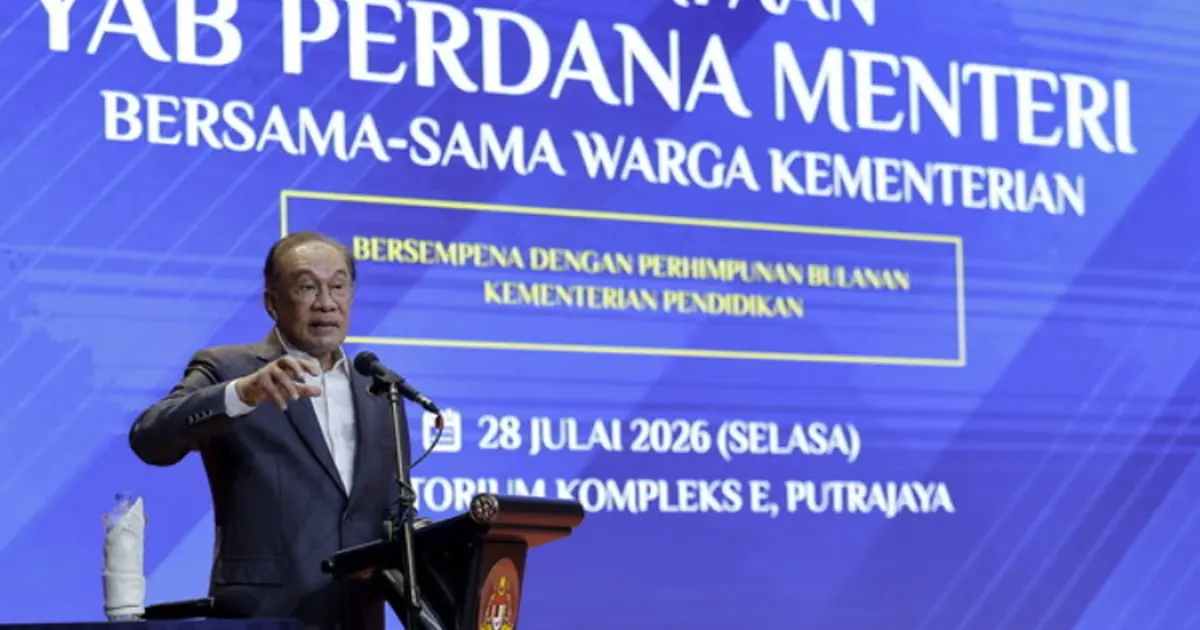
Prime Minister Anwar Ibrahim has moved to settle speculation about the future administrative structure of Malaysia's Form 6 programme by confirming it will remain firmly under the stewardship of the Ministry of Education, citing practical and operational considerations that make such a transition impractical at this juncture.
The confirmation comes as Malaysia continues to refine its upper secondary education framework. Form 6, which serves as the crucial bridge between secondary schooling and tertiary education, has periodically featured in discussions about potential institutional restructuring. Some quarters had proposed shifting oversight to alternative agencies, but Anwar's declaration effectively closes the door on such proposals for the foreseeable future.
The Prime Minister's reasoning centres on the interconnected nature of Malaysia's education system. The Form 6 curriculum is deeply integrated with broader secondary education policies, teacher training standards, and examination frameworks that fall squarely within the Education Ministry's remit. Any transfer would necessitate complex administrative decoupling that could disrupt educational continuity for hundreds of thousands of students nationwide.
Staffing and human resource considerations represent another critical dimension of Anwar's decision. Form 6 teachers are trained, deployed, and managed through established Education Ministry channels. These educators are subject to the ministry's professional development programmes, performance evaluation systems, and career progression pathways. Removing Form 6 from this structure would create significant logistical challenges in maintaining teaching quality and consistency across the country's numerous Form 6 centres.
For Malaysian students, the decision provides institutional stability during a period of broader education system review. The government has been implementing various reforms, including initiatives around technical and vocational alternatives to traditional academic pathways. By maintaining Form 6's existing governance structure, the administration ensures that these parallel initiatives can develop without disrupting the established route for students pursuing conventional tertiary education preparation.
The broader context reveals Malaysia's careful balancing act in secondary and pre-tertiary education. While Form 6 remains the traditional pathway to university, the government has invested heavily in expanding alternatives such as matriculation programmes, diploma courses, and vocational training. Each track operates under different oversight arrangements, reflecting different pedagogical approaches and career objectives. Keeping Form 6 within the Education Ministry preserves clarity in this differentiated system.
Regional implications merit consideration as well. Several Southeast Asian neighbours operate varying models for upper secondary education, from specialised sixth-form colleges to integrated secondary-tertiary institutions. Malaysia's decision to maintain centralised education ministry control positions the nation within a familiar governance model used by comparable economies across the region, facilitating policy learning and educational exchange.
The confirmation also reflects practical budgetary realities. Form 6 infrastructure, from laboratory equipment to library resources, has been developed within education ministry funding mechanisms and procurement systems. Transferring these assets and their management would require substantial reconfiguration of financial allocations and operational budgets across multiple government agencies, an unnecessary burden during periods of fiscal constraint.
Teacher morale and retention represent underappreciated factors in Anwar's decision. Form 6 educators have built careers within the Education Ministry structure, with pension entitlements, leave benefits, and professional standing tied to this framework. Institutional upheaval could trigger career uncertainty and potentially worsen Malaysia's already-challenging teacher retention challenges, particularly in premium subjects like mathematics and sciences.
The decision also preserves the integrity of examination administration and certification. The Malaysian Education Certificate (SPM) and Sijil Tinggi Persekolahan Malaysia (STPM) represent recognised qualifications with decades of institutional credibility. Fragmenting governance could compromise the examination system's uniformity and the recognised standing of qualifications that Malaysian graduates present to universities both domestically and internationally.
Moving forward, Anwar's statement suggests the government will pursue Form 6 improvements through internal reform rather than institutional restructuring. Such reforms might encompass curriculum modernisation, enhanced teacher training, improved infrastructure, and strengthened industry-education linkages—all deliverable within the existing ministry framework. This approach acknowledges that genuine educational progress requires content and methodology innovation, not merely administrative reshuffling.
For educators and administrators managing Form 6 programmes across Malaysia's states, the confirmation removes uncertainty and allows sustained focus on quality improvement initiatives. Institution heads can pursue longer-term strategic planning with confidence in the stability of their operational context and regulatory environment.
Ultimately, Anwar's position reflects pragmatic recognition that Malaysia's education system, despite ongoing refinement, functions effectively through its established institutional structures. Rather than pursuing radical reorganisation, the administration intends to enhance Form 6's relevance and effectiveness within proven governance arrangements that have successfully served the nation's educational objectives for decades.

