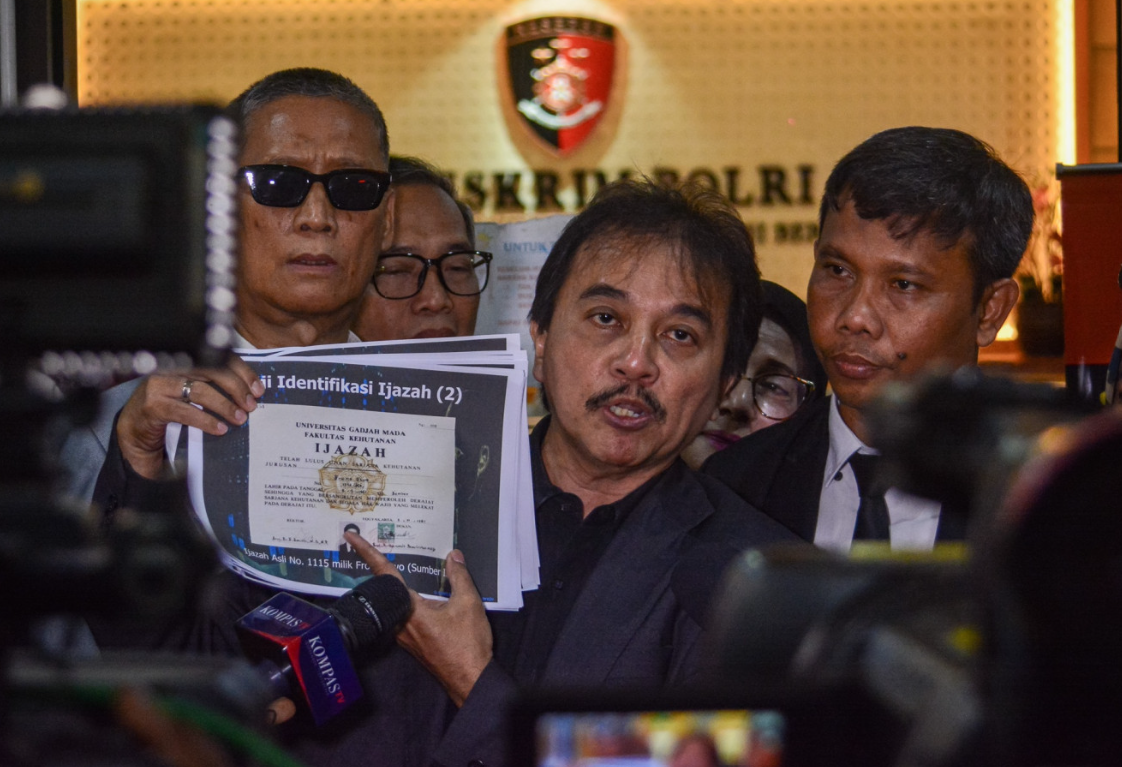
The Jakarta Police have escalated their investigation into allegations surrounding former president Joko 'Jokowi' Widodo's university diploma by detaining ex-youth and sports minister Roy Suryo and health activist Tifauzia 'Tifa' Tyassuma on Friday morning at their homes. The pair face defamation charges under the Electronic Information and Transactions Law, which carries a maximum six-year sentence, marking a significant turning point in a dispute that has festered since 2019 when questions about Jokowi's academic credentials first emerged on social media platforms.
According to Roy's legal representative Ahmad Khozinudin, the arrests represent standard procedure ahead of escalating the matter to the Jakarta Prosecutor's Office. The Jakarta Police's General Crimes Directorate characterised the detention as part of administrative protocol, with investigation director Sr Comr Iman Imanuddin explaining that the measure aimed to facilitate the smooth transfer of suspects and evidence to prosecutors while maintaining procedural momentum throughout the criminal justice system. The police chief emphasised that the detention would permit completion of mandatory health checks and evidence verification without unnecessary delays.
The controversy extends beyond simple allegations of diploma falsification. Both Roy and Tifa have been accused of manipulating electronic documents to substantiate their claims that Jokowi's credentials are fraudulent. Roy himself served in the administration of former president Susilo Bambang Yudhoyono, lending him considerable political standing and credibility when he raised concerns about the authenticity of the presidential documents. The combination of his political background and the electronic manipulation allegations suggests that authorities view this case as involving deliberate and sophisticated efforts to challenge Jokowi's legitimacy through false documentation.
The diploma saga represents one of Indonesia's most prolonged political controversies. Beginning as unsubstantiated social media claims in 2019, the matter evolved into formal legal proceedings, including a civil lawsuit filed in 2022 and numerous investigations and court filings throughout 2025. This progression demonstrates how initial allegations can gain traction and institutional weight within Indonesia's legal framework, transforming informal accusations into serious criminal matters that demand government resources and prosecutorial attention.
Developments earlier this year appeared to settle the question when the National Police formally declared Jokowi's diploma authentic in May 2025 and closed their initial investigation into forgery allegations. However, this official validation failed to silence critics. During a case review conducted in July 2025, Roy Suryo and others renewed their objections to the police findings, suggesting that institutional pronouncements alone cannot extinguish political doubts when they serve broader ideological purposes or reflect genuine factual disputes about evidence quality.
Roy and Tifa's defence team, led by lawyer Refly Harun, immediately challenged the detention's necessity and proportionality. Refly argued that his clients had consistently complied with all police summonses and reporting requirements, rendering their incarceration excessive given that the case would only transfer to prosecutors on Monday. This argument highlights tensions within Indonesia's criminal justice system between procedural regularity and the potential for detention to become a tool of political pressure rather than a genuine investigative necessity.
The broader landscape of this defamation case encompasses eight individuals initially named as suspects. However, police subsequently dropped charges against three of them—Eggi Sudjana, Damai Hari Lubis, and Rismon Sianipar—following mediation efforts, suggesting that authorities possessed discretionary power to resolve certain aspects of the dispute outside formal prosecution. The differential treatment raises questions about whether prosecutorial decisions reflected consistent application of legal standards or responded to negotiations and informal settlements.
For Malaysian observers and Southeast Asian legal scholars, this case illustrates the complex intersection between political legitimacy and institutional authority within Indonesia's constitutional framework. When questions emerge about high officials' qualifications or credentials, the question becomes whether such challenges constitute legitimate political speech and democratic accountability or constitute defamatory attacks warranting criminal prosecution. Indonesia's approach—criminally prosecuting critics under the ITE Law—reflects one position within the region's spectrum of responses to political opposition and institutional scepticism.
The detention of Roy and Tifa also carries implications for how Indonesia manages elite accountability and political opposition during a period of institutional transition. With Jokowi no longer in office but remaining an influential political figure, the prosecution of those questioning his credentials might be viewed either as vindication of his reputation or as evidence of using state power to suppress legitimate scrutiny of powerful individuals. This ambiguity reflects deeper questions about prosecutorial independence and whether criminal law becomes a mechanism for political protection rather than neutral justice.
The case demonstrates how defamation law can become weaponised in political contexts. Once authorities began treating diploma questions as criminal defamation rather than political debate, the dispute transformed from a matter of public contestation into a prosecutorial matter. This escalation pattern—from social media accusations to investigations to formal charges to detention—illustrates how institutional mechanisms can amplify and formalise initial allegations, potentially regardless of their ultimate evidentiary merit.
As the case proceeds toward the Prosecutor's Office, the outcome will likely influence how Indonesians assess both the credibility of Jokowi's academic qualifications and the legitimacy of using criminal defamation charges to silence prominent critics. Whether a conviction results or charges are eventually dropped, the precedent established here will shape the boundaries between protected political speech and prosecutable defamation throughout Indonesia's institutional landscape for years ahead.