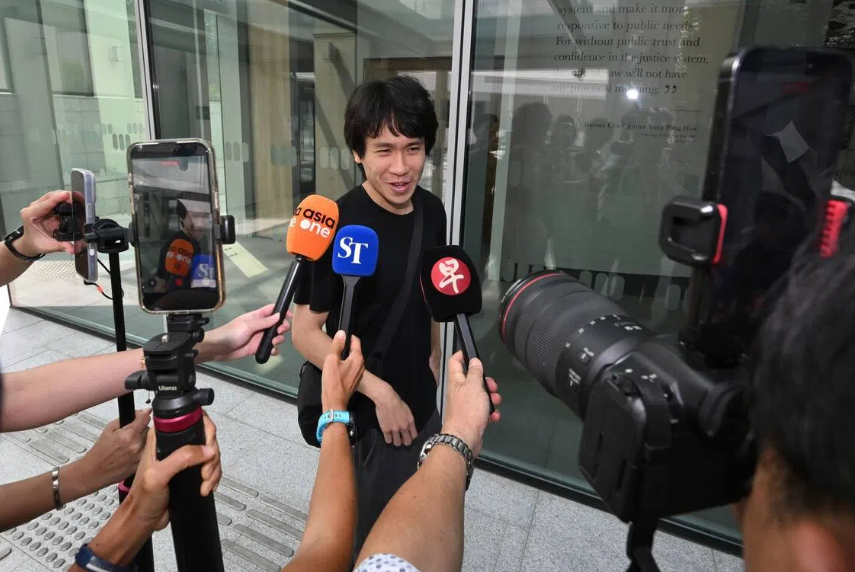
The legal troubles facing Amos Yee, the 27-year-old former child actor in Singapore, have escalated significantly following his appearance at the District Court on August 26, when he was handed four fresh charges that bring his total count to seven. The accumulation of these charges reflects the seriousness with which Singapore's authorities are treating a series of online statements and videos that authorities argue crossed multiple legal boundaries. The case has drawn attention not only within Singapore but also across Southeast Asia, where questions about the balance between free expression and societal protection remain contentious.
One of the principal new charges relates to Yee's blog posts from April 7 and April 11, in which he allegedly sought to stir up racial tensions by claiming that both Malays and Indians faced systemic discrimination from the Chinese majority population in Singapore. Rather than merely expressing an opinion, prosecutors argue that Yee went further by explicitly calling on members of these communities to organise protests against the government. This approach represents what Singapore's legal framework considers an attempt to promote racial disharmony, a charge that carries potential imprisonment of up to three years along with possible fines. The specificity of his alleged call to action—encouraging community mobilisation—appears central to the prosecution's case.
Additional charges stem from a video uploaded on May 27, which prosecutors say contained statements asserting that the Malay and Muslim community faced severe discrimination from the Chinese population in Singapore. The distinction between expressing viewpoints on social inequality and what the law deems incitement to discord remains a critical tension in this case. For Malaysian observers, the comparison is instructive: while Malaysia has its own constitutional provisions protecting religious and ethnic sensitivities, Singapore's approach through its Sedition Act and related provisions demonstrates a more restrictive interpretation of permissible speech on communal matters.
Perhaps the most serious and controversial charges concern Yee's statements regarding child sexual abuse. Two separate charges under the Protection from Harassment Act relate to videos he produced in 2021 in which he allegedly advocated for providing free speech protections to paedophiles. More disturbingly, prosecutors claim he stated that children and infants possessed the capacity to consent to sexual intercourse. He further allegedly called for the elimination of laws that criminalise the creation and possession of child sexual abuse material. A subsequent post on June 30 apparently reiterated these positions. These allegations have generated particular revulsion given their direct nexus to child protection—a cause that commands broad consensus across all communities.
The Singapore Police Force disclosed in a statement dated August 25 that it had received multiple complaints spanning April through July regarding Yee's online activities. This timeline indicates an extended period of concern rather than isolated incidents, suggesting a pattern that prompted intervention. The police action included issuing a disabling direction under the Online Criminal Harms Act on August 18, which prompted the social media platform X to remove the offending video. Additionally, stop communication directions were served requiring Yee to remove posts from his blog. These preliminary enforcement measures preceded the formal charging process, indicating authorities' determination to curtail the reach of his statements.
Bail conditions imposed on August 26 set at S$15,000 include significant restrictions on Yee's online presence. He is explicitly prohibited from posting anything concerning his views on paedophilia or any statements that could incite ill-will between racial groups. These conditions effectively muzzle his ability to discuss the very topics that form the basis of his charges while his case proceeds through the courts. For those concerned about proportionality in bail conditions, the restrictions raise questions about whether preventing future speech is an appropriate condition of pre-trial release, though Singapore courts have historically taken robust positions on protecting social cohesion.
Beyond the charges related to racial harmony and child protection advocacy, Yee simultaneously faces three additional charges under Singapore's Enlistment Act concerning national service obligations. He allegedly failed to appear for pre-enlistment medical screening and departed Singapore without the requisite exit permit on multiple occasions. According to prosecutors, he remained outside Singapore unlawfully from December 13, 2015, to April 19, 2016, and again from December 15, 2016, to March 19, 2026. He also allegedly neglected his national service medical screening obligations from April 26, 2016, through March 19, 2026. These charges, while less politically charged than those involving racial and child protection issues, underscore concerns about Yee's compliance with civic duties.
Violations of Singapore's national service regulations carry penalties of up to S$10,000 in fines, imprisonment for three years, or both. The breadth of potential consequences across all seven charges means Yee faces the possibility of cumulative sentences spanning multiple years should he be convicted on all counts. This concatenation of offences—ranging from sedition-adjacent speech to child protection violations to enlistment breaches—paints a picture that Singapore's legal system portrays as a pattern of deliberate disregard for the law.
For regional observers, particularly those in Malaysia, the Yee case illustrates how different Southeast Asian democracies calibrate their approaches to free expression and social harmony. While Malaysia's constitution explicitly protects the special position of Malays and Islam, and includes restrictions on speech that challenges established safeguards, Singapore employs a matrix of specific statutes including the Sedition Act, the Penal Code provisions on promoting enmity, and the Protection from Harassment Act. Both jurisdictions share concerns about protecting vulnerable communities and maintaining social peace, though their methodologies and enforcement intensity differ.
The case also reflects broader regional tensions regarding online speech and the extent to which platforms and governments should intervene in user-generated content. The involvement of X in removing Yee's video following a police direction illustrates how platform policies increasingly align with government directives in Southeast Asia, a phenomenon that raises questions about digital governance and corporate responsibility. Social media companies operating across the region must navigate divergent legal frameworks and enforcement expectations.
Yee is scheduled to return to court on September 18 for a pre-trial conference, which will allow both prosecution and defence to clarify legal issues and potentially explore settlement possibilities, though the severity of charges suggests a contested trial remains likely. The outcome of this case will likely influence how Singapore's courts interpret boundaries around speech concerning racial matters and child protection, setting precedent that could affect similar cases across the region. For Malaysia, observing how Singapore prosecutes these charges may inform ongoing debates about balancing free expression with the protection of social cohesion and vulnerable populations.

