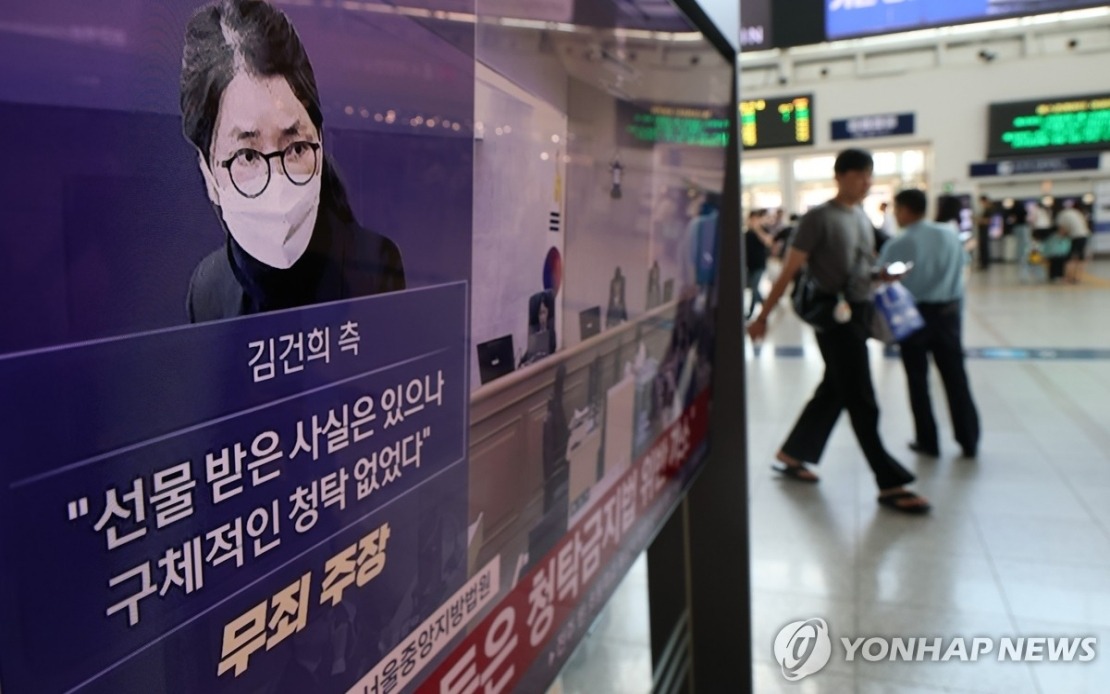
South Korea's former first lady Kim Keon Hee has been handed a seven-year prison sentence by the Seoul Central District Court for corruption charges involving the acceptance of high-value gifts in exchange for political patronage and business favours. The conviction represents a significant moment in South Korean politics, underscoring how institutional safeguards around presidential families have been tested and, in this case, found wanting.
The charges against Kim centred on her acceptance of luxury items totalling approximately 300 million won over a concentrated period spanning from March 2022 to September 2022, with additional gifts received as late as February 2023. Presiding judge Cho Sun-pyo found Kim guilty on all counts, determining that she had systematically leveraged her position as first lady not as a ceremonial role serving broader national interests, but rather as a vehicle for personal enrichment and the advancement of private agendas. The scale of the gifts and the brazenness of the exchanges shocked the South Korean public and lawmakers alike.
Among the items gifted to Kim were a Van Cleef & Arpels necklace and matching jewellery worth over 100 million won from the chairman of a major construction company, offered in direct exchange for securing a government position for the businessman's son-in-law. A golden turtle ornament was presented to her by Lee Bae-yong, the former head of the National Education Commission, as part of a quid pro quo arrangement for his appointment to that same position. Additional treasures included a Dior handbag valued at 5.4 million won from a pastor, a Vacheron Constantin timepiece from another businessperson in September 2022, and a painting by renowned artist Lee Ufan from a former prosecutor seeking her assistance in winning an election nomination.
The timing of these transactions carries particular weight. The exchanges occurred predominantly while Kim's husband, Yoon Suk Yeol, held the presidency from May 2022 until his removal from office in April 2025. This temporal overlap demonstrates how the first lady weaponised her proximity to executive power during the most consequential period of the administration. The court found this context essential in establishing the illicit nature of the arrangements, as recipients clearly understood they were paying for access to presidential influence rather than engaging in ordinary social gift-giving.
During the televised hearing, Judge Cho delivered a damning assessment of Kim's conduct, stating that she had fundamentally disregarded the social responsibilities inherent to her position and treated the office exclusively as a means to pursue personal interests. The judgment revealed that Kim attempted to evade accountability once investigations commenced by returning certain gifts or falsely claiming she had purchased them with her own funds. The court interpreted these attempts at concealment as an admission that Kim was fully cognisant of the illegality of her actions, even as she engaged in them.
The prosecution, led by special counsel Min Joong-ki's team, had sought a harsher sentence of seven and a half years, arguing that the severity of the breach of public trust warranted the maximum penalty. While the final sentence fell slightly short of that demand, the seven-year term remains a substantial custodial punishment that reflects the gravity with which South Korean courts treat corruption among high-ranking government figures and their families. Kim's legal representatives have already indicated they intend to file an appeal, suggesting the case will continue through the appellate system.
Other individuals implicated in the bribery scheme received varying sentences. The construction company chairman who gifted the necklace was sentenced to one year in prison, suspended for two years, meaning he would serve time only if he commits further offences during the probation period. The businessman who presented the Vacheron Constantin watch faced a 10-month suspended sentence on identical terms. A pastor involved in the transactions was ordered to pay a fine of 8 million won rather than face imprisonment. These more lenient outcomes reflect the courts' assessment that while these individuals participated in corrupt exchanges, their culpability was secondary to that of Kim, who wielded the power to grant favours.
This conviction arrives alongside prior legal troubles that have engulfed the former first lady. In a separate corruption case, an appeals court has already sentenced Kim to four years in prison, meaning she now faces combined custodial sentences totalling 11 years if both convictions are upheld. Additionally, she faces further trial proceedings related to allegations of her involvement in coercing members of the Unification Church to join the People Power Party ahead of the 2022 presidential election in an apparent effort to manipulate the party's primary process in her husband's favour. These cascading legal challenges paint a portrait of an individual who allegedly operated far beyond the symbolic boundaries traditionally associated with a first lady's role.
For Southeast Asian observers and political analysts, the Kim case offers instructive lessons about the risks of permitting presidential family members to exercise informal political authority without corresponding accountability mechanisms. Malaysia and other regional democracies have occasionally grappled with questions about how to regulate the activities of politicians' spouses and relatives who lack formal office yet wield substantial influence. The South Korean precedent demonstrates that courts possess both the tools and the willingness to prosecute such misconduct when evidence of bribery and quid pro quo arrangements emerges, though only after considerable damage to public institutions may have already occurred.
The broader context of Yoon Suk Yeol's presidency and subsequent removal from office has been marked by extraordinary political turbulence. His impeachment in December 2024 followed a short-lived declaration of martial law, and his subsequent arrest on insurrection charges sent shockwaves through South Korean politics. The concurrent prosecutions of both the former president and his wife signal that no family member remains insulated from judicial scrutiny once allegations of serious wrongdoing surface. Whether this represents a strengthening of South Korean democratic institutions or a politically motivated witch-hunt against a conservative administration remains contested, with supporters of Yoon arguing the prosecutions are disproportionately harsh while critics contend they represent overdue accountability.
As Kim's legal odyssey continues through appellate proceedings and further trials, the case exemplifies a fundamental tension within presidentialist systems: the difficulty of constraining the political power wielded by executive families without clear rules, transparent procedures, and vigilant oversight. The seven-year sentence represents the courts' affirmation that even the highest-ranking individuals cannot exploit their station for personal profit with impunity.

