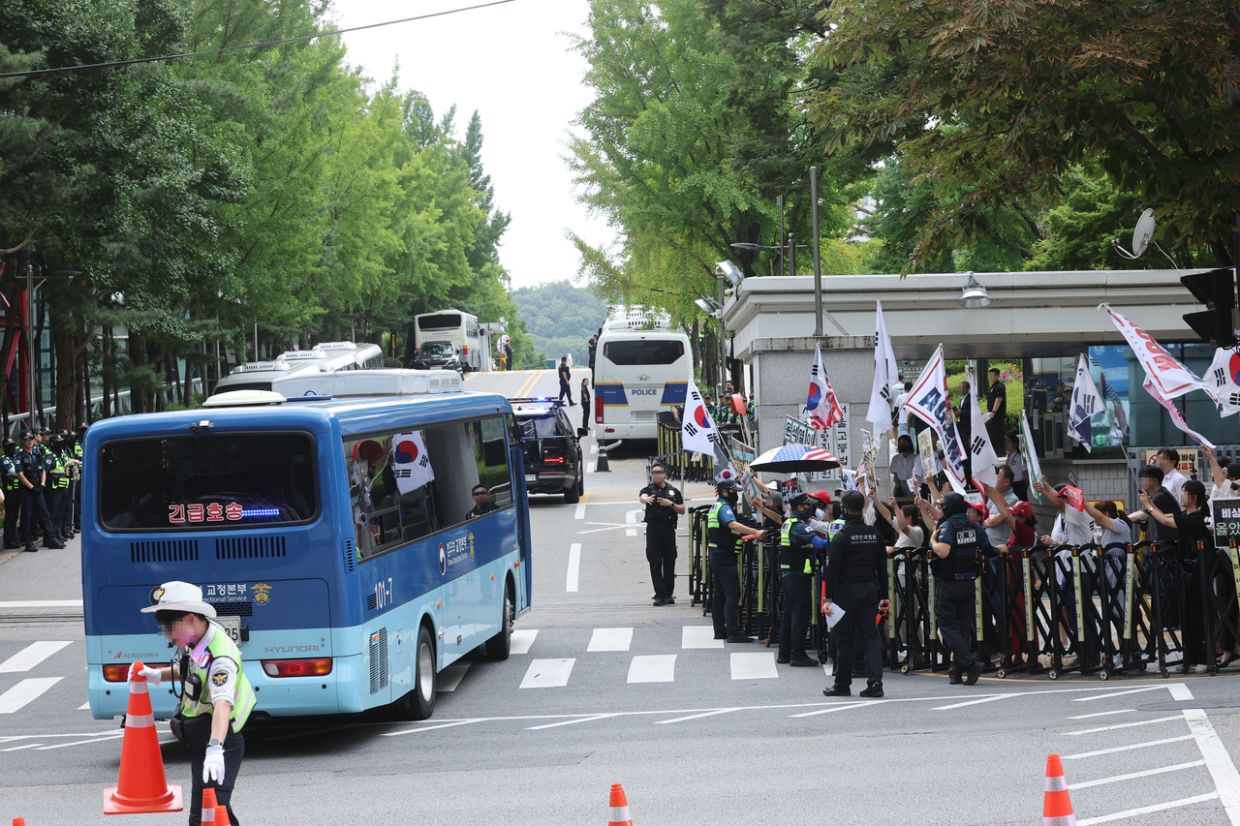
South Korea's former President Yoon Suk Yeol received a two-year prison sentence on Monday from the Seoul Central District Court for breaching electoral finance regulations by accepting complimentary political polling services during his presidential campaign. The conviction marks a significant legal development in a country where presidential transitions frequently trigger corruption investigations, underscoring ongoing tensions between electoral integrity and political patronage networks that persist across East Asia.
The court determined that Yoon had accepted 14 surveys valued at 27.92 million won ($18,600) from political broker Myung Tae-kyun without paying for them, thereby violating the Political Funds Act. Prosecutors had originally alleged that Yoon and his wife, former first lady Kim Keon Hee, had collectively received 58 unpaid surveys worth more than 270 million won between June 2021 and March 2022. However, the court found sufficient evidence for conviction only regarding the 14 surveys, representing a partial success for the prosecution's broader allegations of systematic impropriety.
Presiding Judge Lee Jin-gwan emphasised that opinion polls carry substantial weight in shaping electoral outcomes and that their credibility forms a foundational pillar of democratic governance. The judge articulated a fundamental concern that when political figures receive undeclared contributions in violation of established financial reporting requirements, and polling firms provide survey data in exchange, the result inevitably distorts public opinion formation and compromises the fundamental fairness of elections. This judicial reasoning reflects growing international recognition that campaign finance transparency constitutes a prerequisite for genuine democratic competition.
The court's investigation uncovered that Kim Keon Hee had granted Myung authority over critical polling decisions, including the timing of surveys, their substantive content, methodology employed, and decisions about publication and distribution. The evidence demonstrated that Yoon had been aware of this arrangement and had given his implicit approval, establishing what the court characterised as a successive and tacit understanding among all three parties regarding the provision of unpaid polling services.
Beyond the technical violation of finance regulations, the court also established that Yoon had provided assurances to Myung that former lawmaker Kim Young-sun would secure the People Power Party's presidential nomination in return for the polling services. Subsequently, court documents showed that Yoon exerted influence over the nomination process through Chang Je-won, who held the position of chief of staff to the president-elect, ensuring that the promised nomination materialised. This arrangement illustrated how informal political networks can circumvent formal institutional processes.
Notably, the court determined that proving an explicit quid pro quo arrangement between the polling services and the nomination promise was not a necessary prerequisite for establishing a violation of the Political Funds Act. This legal interpretation broadens the scope of potential prosecution in future cases, as courts need not demonstrate direct cause-and-effect relationships to establish unlawful campaign finance conduct. Such an approach represents stricter application of electoral finance standards than previously applied in comparable cases.
Myung Tae-kyun, the political broker who orchestrated the polling arrangement, received an 18-month prison sentence and was remanded into custody immediately following the pronouncement of judgment. His involvement as a middleman facilitating the transaction between the former presidential couple and the polling firm underscores the role that political fixers play in circumventing transparency requirements in South Korean politics.
The conviction of Yoon stands in sharp contrast to the legal treatment of his wife in a related case involving the identical polling services. Kim Keon Hee was acquitted at both trial and appellate court levels of comparable Political Funds Act charges stemming from the same arrangement. In her case, lower courts concluded that prosecutors had failed to demonstrate that Kim had received a measurable financial benefit equivalent to the survey costs or that the polling services had been furnished specifically in exchange for Kim Young-sun's nomination.
Judge Lee acknowledged these procedural differences, noting that the allegations concerning polling services in Kim's separate case and those in Yoon's case could not be treated as legally identical, thereby justifying divergent outcomes. This distinction raises questions about prosecutorial strategy and the varying burdens of proof applied to different defendants in related matters, issues that resonate beyond South Korea's borders as societies grapple with consistent application of electoral finance enforcement.
The Supreme Court is scheduled to deliver its definitive ruling in Kim Keon Hee's case on Thursday, which may either affirm the acquittals or overturn them based on a fresh legal assessment. Should the Supreme Court reverse the acquittals, it would create a situation where the former first lady faced imprisonment for conduct that is legally and factually intertwined with her husband's conviction, potentially reshaping the boundaries of campaign finance liability for family members of political candidates.
This case carries significance for Malaysian observers as South Korea, like Malaysia, operates within a parliamentary democratic framework where the boundary between permissible political networking and unlawful quid pro quo arrangements often remains contested. The Yoon verdict demonstrates how courts in one major Asian democracy are attempting to strengthen electoral finance enforcement mechanisms that have historically been vulnerable to circumvention through informal arrangements and intermediaries.
The conviction also reflects broader regional governance challenges as Southeast Asian nations including Malaysia continue debating how strictly to enforce campaign finance regulations and whether electoral reform should prioritise transparency requirements over concerns about restricting political participation. The Yoon case provides instructive precedent regarding how courts can intervene to strengthen financial accountability without requiring explicit documentary evidence of corrupt intent.
Moving forward, the ruling establishes that former heads of state are not shielded from electoral finance prosecution and that courts will scrutinise informal arrangements between political leaders and service providers with heightened skepticism. For Malaysia and other democracies navigating similar electoral integrity challenges, the Yoon judgment offers both a cautionary tale about the consequences of circumventing campaign finance rules and a model for how judicial systems can actively police the boundaries between legitimate political activity and unlawful financial arrangements.

