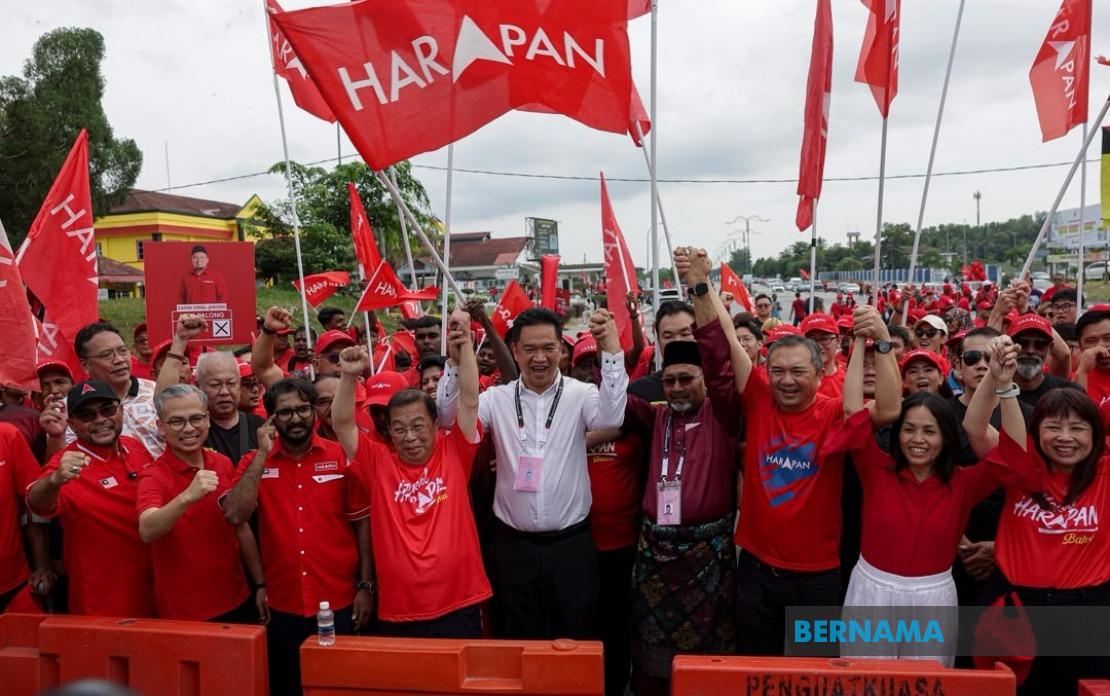
Jeram Padang has emerged as the most closely contested battleground in the Jempol state constituency for the 16th Negeri Sembilan State Election, with four candidates filing nominations to represent competing political forces vying for voter support in the July 18 nomination process held at the Jempol District and Land Office Hall. The announcement by Returning Officer Amino Agos Suyub confirmed that this four-cornered contest distinguishes Jeram Padang from neighbouring seats in the constituency, setting the stage for a multidirectional political struggle that will test voter allegiances across different political blocs.
The Jeram Padang race features G. Manivannan as the Pakatan Harapan candidate challenging incumbent Datuk Mohd Zaidy Abdul Kadir of Barisan Nasional, who seeks to retain the seat he currently holds. These two represent the established poles of Malaysian politics, but they will not contest unopposed. R. Sri Sanjeevan of Parti Pribumi Bersatu Malaysia and Dayana Dal of Parti Orang Asli Malaysia will also vie for the seat, introducing additional political dynamics into what might otherwise have been a conventional two-front battle. The presence of these alternative candidates could significantly fragment the vote, potentially determining the election outcome in ways that would not occur in more straightforward contests.
Dayana Dal's candidacy carries particular significance as the sole Orang Asli representative in the Jempol constituency races, reflecting broader attempts by various political parties to mobilise indigenous voter blocs and secure marginal constituencies through targeted community engagement. Her presence in the race addresses representation concerns within the Orang Asli community and signals the strategic importance that all contesting parties attach to this demographic group. The timing of nominations illustrated the intensity of competition, with Sri Sanjeevan filing first at 9.09 am, followed by Dal at 9.12 am, Manivannan at 9.17 am, and incumbent Mohd Zaidy at 9.20 am. Manivannan's entry was notably accompanied by Datuk Seri Fahmi Fadzil, PH Communications director, underscoring the national political importance attached to this particular state-level contest.
The broader Jempol constituency presents a mixed political landscape beyond Jeram Padang. The Serting state seat is configured as a three-way contest between Yaacob Mahmood representing PH, incumbent Mohd Fairuz Mohd Isa of Perikatan Nasional, and Muhammad Noraffendy Mohd Salleh of Bersatu. This composition reflects the increasingly fragmented nature of Malaysian state politics, where traditional two-party competition has given way to multi-polar contests. Similarly, Palong will witness a three-cornered battle pitting incumbent Datuk Mustapha Nagoor of BN against Muhammad Zahin Zinal Abidin of PH and Rebin Birham of Bersatu. In contrast, Bahau presents the constituency's sole straight fight, with DAP's Teo Kok Seong defending his seat against MCA's Chong Fui Ming in a direct BN-versus-PH contest.
The concentration of multi-candidate races across Jempol reflects broader strategic calculations by political parties in Negeri Sembilan, a state that has experienced significant political shifts in recent electoral cycles. The proliferation of three-way and four-way contests complicates seat predictions and prevents any single party from achieving commanding electoral superiority through first-past-the-post mechanisms. Bersatu's consistent presence across multiple constituencies suggests the party is attempting to carve out a distinct political space in the state, neither fully aligned with BN nor completely integrated into PH's broader electoral coalition. This positioning creates genuine uncertainty about how Negeri Sembilan voters will ultimately align their preferences across different constituencies.
For Malaysian observers tracking state-level political developments, Negeri Sembilan holds significance as a barometer of shifting voter sentiment outside the peninsula's largest states. The state's political trajectory influences perceptions about the durability of current political coalitions and the viability of alternative groupings. The complexity of the Jempol constituency races, particularly the four-way contest in Jeram Padang, will generate valuable insights into how voters navigate multiple choices when presented with candidates spanning different ideological and communal backgrounds. The electoral mechanics of plurality voting means that victory margins could prove extremely narrow, with potential second and third-place finishes separated by only hundreds of votes.
The Election Commission has scheduled early voting for July 28, providing voters with flexibility in the lead-up to the main polling day on August 1. This two-stage voting process allows certain categories of voters, including election officials and security personnel, to cast ballots early. The compressed campaign timeline between nominations and early voting allows candidates and parties only limited time to conduct ground-level outreach and persuasion activities. In a four-cornered race like Jeram Padang, where vote fragmentation becomes strategically consequential, the intensity of campaign activity will likely reflect the competitive stakes involved.
The Negeri Sembilan state election represents one of several state-level contests scheduled in Malaysia's extended electoral calendar, contributing to an environment where political parties must simultaneously manage resources across multiple geographical arenas. For voters in Jempol, particularly those in Jeram Padang, the election presents substantive choices across ideologically differentiated political formations. The four-way contest in Jeram Padang specifically offers voters an unusually broad spectrum of political representation, from PH's social democratic orientation through BN's incumbent conservatism to Bersatu's centrist positioning and Parti Orang Asli Malaysia's community-focused advocacy. This diversity of choice enriches democratic participation even as it complicates the electoral arithmetic.
Analysts monitoring Malaysian politics will watch closely how voters in constituencies like Jeram Padang ultimately resolve their preferences when presented with multiple viable alternatives. The outcome could provide signals about the regional viability of different political parties and coalitions, particularly regarding Bersatu's capacity to function as an independent electoral force rather than merely as a junior coalition partner. Negeri Sembilan's results will feed into broader assessments about the direction of Malaysian political realignment and the sustainability of current power-sharing arrangements at state and federal levels. The concentration of multi-candidate races across the state suggests that final results could produce surprising outcomes that defy conventional pre-election predictions based on simple party-versus-party calculations.

