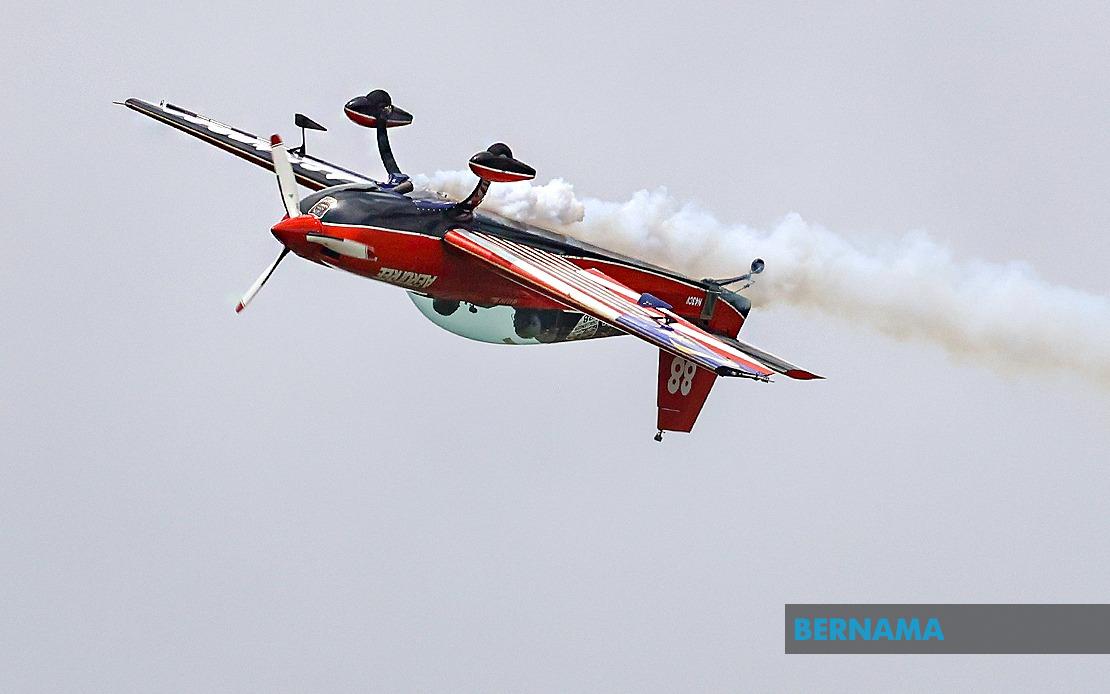
When Major (Rtd) Datuk Halim Othman took to the skies at 7 pm on August 30 in Putrajaya, the retired Royal Malaysian Air Force fighter pilot carried with him the weight of a nation's aspirations. At 60 years old, Halim commanded the inaugural 'Merdeka Sunset Show: Melukis Senja' during Malaysia's 69th National Day celebrations, a twin-engine display that merged precision aerobatics, pyrotechnics and smoke against the fading sunset. Four decades of aviation expertise converged in those twilight moments, offering Malaysian audiences a glimpse into the skill and discipline required to operate at the highest echelons of aerial performance.
The concept itself was not entirely new to Halim. He had previously introduced the 'Melukis Senja' format at the Langkawi International Maritime and Aerospace Exhibition during last year's event in Chenang. That preliminary showing proved the viability of marrying artistic aerial choreography with National Month festivities, creating a spectacle that transcended traditional military flyovers. What set this Putrajaya iteration apart was the national platform—a celebration of independence anchored by demonstrations of homegrown aviation excellence, sent as a message to both domestic and international observers.
Halim's trajectory through military and civilian aviation circles positioned him uniquely to helm such an undertaking. Beginning his career as an RMAF fighter pilot in 1985, he quickly distinguished himself through discipline and aptitude, eventually receiving the 'Top Gun' designation. Over the subsequent years, his portfolio expanded dramatically. He transitioned from fast-jet operations to aerobatic flying, a discipline demanding not merely courage but an intimate understanding of aircraft stress limits, energy management and three-dimensional spatial awareness. His aircraft roster reads as a who's who of modern combat aviation: the MiG-29N, F/A-18D Hornet, A-4 Skyhawk and F-5E Tiger aircraft. Beyond military platforms, he mastered corporate jets including the Learjet 35A and King Air 350i, and the aerobatic specialist aircraft Extra 300L—the latter essential for the precision performances that define his current role.
Yet perhaps Halim's most distinctive credential emerged from his venture into international air racing. He became the first Malaysian to qualify for the Red Bull Air Race World Championship, an accomplishment that placed him among the world's most elite aerial competitors. The racing circuit attracted globally renowned pilots, predominantly non-Asian competitors whose experience and resources dwarfed those available to Malaysian contenders. Competing in that arena required more than technical proficiency; it demanded the psychological fortitude to challenge assumptions about regional aviation capability. In 2014, Halim proved the point convincingly by capturing the Challenger Cup title at events in Ascot, United Kingdom, and Las Vegas, United States, followed by a runner-up finish in the Challenger Cup Final at the Red Bull Ring in Austria.
During his exclusive remarks, Halim reflected on the broader significance of his international racing participation. The Red Bull circuit exposed him to pilots and engineers from Europe, North America and other established aviation powers. Standing among them as a Malaysian competitor presented both challenge and opportunity. He articulated his motivation not as personal accolade but as representation, seeing his performances as proof that Malaysian aviators could execute at championship level. This reframing of individual achievement as national testimony illuminates Halim's approach to public displays and mentorship. He deliberately positions himself as an ambassador, demonstrating to younger Malaysian audiences that the barriers to high-performance aviation are surmountable through dedication and systematic training.
Beyond his own flying, Halim channelled his expertise into institutional development. He founded and leads Aerotree Defence and Services Sdn Bhd, a consultancy focused on aviation operations and training. More significantly, he spearheaded the establishment of Krisakti, Malaysia's first official aerobatic display team, which debuted at LIMA 2011. This initiative transformed Malaysian air shows from purely military exhibitions into demonstrations of cultivated artistic skill combined with technological mastery. Building such a team required not only identifying and recruiting talented pilots but creating a training programme, standardizing procedures, and building the aircraft platform capabilities necessary for synchronized multi-aircraft displays.
Looking forward, Halim envisions expanding the aerobatic display ecosystem within Malaysia. He has publicized plans to inaugurate a new aerobatic team comprising six aircraft, each equipped with advanced coloured smoke systems. These upgraded platforms would appear at future National Day celebrations and at LIMA events, effectively establishing aerobatic displays as a recurring fixture within Malaysia's aerospace calendar. The investment in coloured smoke systems specifically speaks to the theatrical dimension Halim emphasizes—aerobatics is not merely manoeuvre execution but visual storytelling, creating emotional resonance through colour and motion against natural backdrops.
Halim's articulation of aerobatic flying reveals a philosophical dimension often absent from technical discussions of aviation. He insisted that the discipline transcends extreme manoeuvres; instead, it represents applied mastery developed through rigorous training regimes, continuous refinement, and profound knowledge of aircraft structural and performance limitations. Pilots who ignore these fundamentals, however brave, inevitably encounter disaster. Conversely, those who synthesize technical knowledge with disciplined execution can reliably perform manoeuvres that appear to violate physical intuition. This distinction—between recklessness and controlled precision—undergirds professional aerobatic practice and differentiates championship-level performers from capable amateurs.
Within the Malaysian context, Halim's activities carry particular significance. Southeast Asia historically imported aerospace expertise and imported display teams for major exhibitions. Developing indigenous aerobatic capability reduces this dependency while simultaneously positioning Malaysia as possessing sufficient aviation infrastructure and talent to generate world-class performances domestically. This has implications for aerospace education and recruitment; younger Malaysians witness homegrown examples of what dedicated training and institutional support can achieve, potentially motivating interest in engineering, piloting and related fields. The visibility of Malaysian excellence in specialized domains like aerobatic flying strengthens the regional aerospace ecosystem more broadly.
Halim explicitly framed his aerobatic initiatives as corporate social responsibility, a deliberate invocation of sustainability language. Rather than treating elite aviation displays as isolated spectacles, he positioned them as instruments for youth engagement and aerospace career inspiration. Krisakti's existence and recurring appearances at LIMA create touchpoints where young Malaysians encounter professional aviators in venues designed for learning and discovery. The planned expansion to six-aircraft teams with enhanced visual capabilities only amplifies this educational reach. These displays implicitly communicate that aerospace careers remain accessible to Malaysian citizens willing to pursue the necessary training and meet rigorous professional standards.
The 69th National Day context amplified the symbolic dimensions of the Merdeka Sunset show. Independence celebrations traditionally emphasize national achievement and forward-looking vision. Integrating cutting-edge aerobatic displays into such occasions signals that Malaysia aspires to global excellence in specialized high-technology domains. Halim's personal journey from RMAF cadet to international racing competitor to display team founder and mentor embodies the possible trajectories available within Malaysian aerospace. His willingness to mentor younger pilots and invest resources in developing institutional display capabilities suggests awareness that sustainable excellence requires cultivating talent across generations, not relying solely on individual practitioners however accomplished. The sunset backdrop chosen for these displays carries its own meaning—twilight periods between day and night symbolize transitions, new chapters, and the promise embedded in moments of change. For Malaysian aviation enthusiasts, the Merdeka Sunset show represented precisely such a transition, signalling that homegrown aviation expertise had matured sufficiently to command national platforms and international respect.

