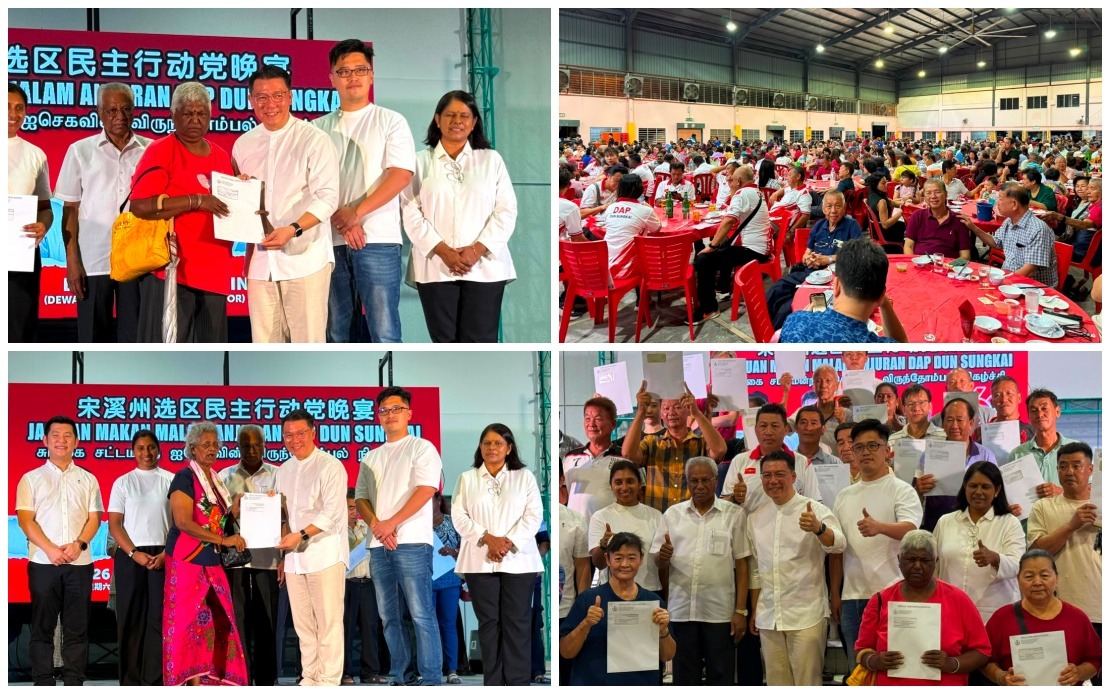
A decades-long housing struggle affecting 120 families in the Sungkai and Kuala Bikam areas of Perak has finally reached resolution, with Housing and Local Government Minister Nga Kor Ming presenting land grants to the recipients at a DAP community dinner in early August. The resolution marks a significant milestone in addressing one of Malaysia's persistent informal settlement challenges, particularly among vulnerable communities who have endured housing insecurity for over four decades.
The settlement of this protracted issue underscores broader government commitments to inclusive development, according to Nga. Speaking at the well-attended event that drew more than 1,200 participants from diverse backgrounds, the DAP national deputy chairman characterised the land grants as tangible evidence that the MADANI Government prioritises citizen welfare beyond considerations of ethnicity or socioeconomic standing. Such long-standing disputes often reflect systemic gaps in land administration and the challenges faced by marginalised communities in formalising their residential status within Malaysia's complex property ownership framework.
The minister framed the resolution within a larger narrative of equitable nation-building, emphasising that the government's approach rejects the notion that any Malaysian should experience marginalisation or exclusion from development opportunities. This framing carries particular resonance for Indian and Tamil-speaking communities, demographics historically underrepresented in formal housing schemes and land ownership discussions at the national policy level. The symbolic weight of presenting these grants at a DAP Sungkai divisional event reflects deliberate political messaging around inclusive governance and community-responsive administration.
Beyond the immediate Sungkai and Kuala Bikam resolution, Nga highlighted broader financial commitments toward Indian community welfare and development. The government has allocated RM20 million specifically for Indian settlements, recognising that housing challenges extend across multiple informal communities nationwide. This allocation addresses not only immediate shelter needs but also the precedent-setting value of formal land tenure in enabling beneficiaries to build assets, secure mortgages, and pass property rights to future generations—critical pathways for economic mobility that squatter status fundamentally obstructs.
Educational investment formed another pillar of the government's outreach to Indian communities, with RM50 million directed toward Tamil vernacular schools. This parallel commitment demonstrates a holistic approach to community development that extends beyond housing into human capital formation. Simultaneously, the Malaysian Indian Transformation Unit received a substantial increase to RM150 million, broadening the scope for targeted interventions addressing specific challenges within Indian communities across employment, health, and social services. These figures collectively signal substantial fiscal commitment, though their translation into meaningful outcomes depends heavily on implementation efficiency and ground-level accessibility.
Prime Minister Datuk Seri Anwar Ibrahim's administration positions itself as fundamentally opposed to exclusionary politics, with Nga invoking the leadership's commitment to building an inclusive, equitable Malaysia guided by the principle that no citizen is left behind. This rhetorical positioning represents a deliberate counter to opposition narratives that sometimes invoke communal grievance frameworks. The government's emphasis on performance-based achievements rather than perception-driven politics reflects awareness that credibility among diverse constituencies requires demonstrable delivery on concrete commitments—a particularly acute challenge in Malaysian politics where communal trust remains fragile and historically conditioned.
The minister's caution against allowing performance to be overshadowed by perception introduces a critical tension in contemporary Malaysian governance. While the government's actions merit evaluation on their substantive merits, perception management operates as an independent political reality, particularly in communities with historical experience of exclusion or neglect. The completion of a 40-year-old settlement case might reasonably be questioned: why did resolution require four decades, and what institutional barriers prolonged the dispute? Such questions, while potentially uncomfortable for officials, reflect legitimate public scrutiny of administrative capacity and political priority-setting.
Sungkai assemblyman Datuk A. Sivanesan, serving as state Human Resources, Health, Indian Community Affairs and National Integration Committee chairman, received specific ministerial acknowledgment for his role in advancing the resolution. This recognition highlights the crucial intermediary function that state-level politicians play in translating national policy intentions into local outcomes. Sivanesan's dual positioning—as elected representative and portfolio-holding committee member—exemplifies how Perak's political structure enables focused advocacy for specific communities, though such concentration also risks marginalising other constituencies from equivalent attention and resources.
The broader political ecology surrounding this announcement reflects DAP's strategic positioning within Pakatan Harapan and its particular appeal to urban, diverse, and often left-behind communities. The Sungkai divisional celebration itself, marking the party's 60th anniversary alongside the land grant distribution, served dual purposes of community recognition and political reinforcement. For the 120 families receiving grants, the symbolic and material significance of formalised land ownership cannot be overstated—it represents transition from precarious tenure to legally recognised property rights, enabling access to formal credit systems, government services, and inheritance mechanisms previously unavailable to squatters.
Regional implications merit consideration, as Southeast Asia confronts vast informal settlement populations across Bangkok, Manila, Jakarta, and other major urban centres. Malaysia's approach to incrementally resolving decades-long disputes through government allocation of land grants offers limited but noteworthy contrast to some neighbouring governments' strategies of eviction or benign neglect. However, the extended timeline raises questions about scalability: if resolving a 120-family settlement requires 40 years and ministerial-level coordination, how can similar programmes address the estimated hundreds of thousands of squatters across Malaysia? The Sungkai model's replicability remains uncertain.
Moving forward, the resolution should be situated within broader discussions about formalising informal settlements, upgrading kampung housing stock, and establishing clear pathways through which precarious communities can achieve residential security. The presence of multiple elected representatives—Ipoh Timur MP Howard Lee Chuan How, assemblypersons M. Thulsi, V. Bavani, and Jason Ng Thien Yong—alongside local community leaders underscores this commitment's cross-level political backing within Perak. Whether this represents a sustainable, government-wide programme or a politically opportunistic resolution of a legacy case will become clearer as similar disputes either accelerate toward resolution or remain stalled, revealing the true institutional capacity and political will underlying Malaysia's inclusive development aspirations.

