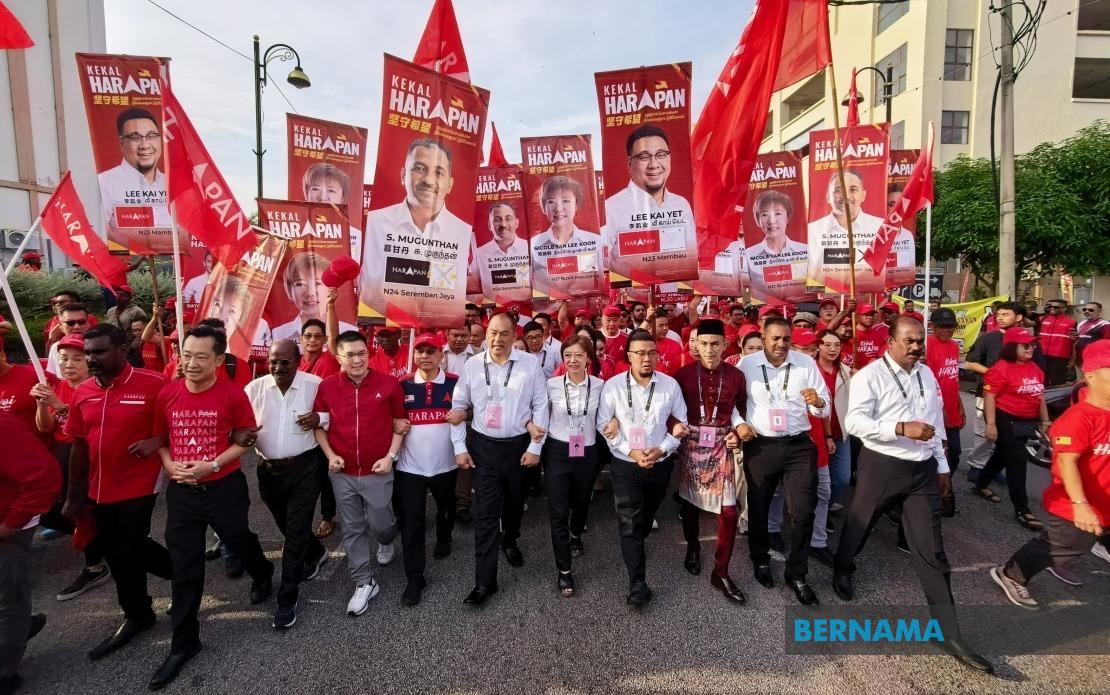
The Negeri Sembilan state election is shaping up as a competitive affair with numerous multi-cornered contests, most notably in the Rahang constituency where Pakatan Harapan incumbent Siaw Meow Keong will face a significant challenge from three opposition candidates. Siaw, who holds the position of DAP treasurer in the state, has represented Rahang since his election in 2023 and will seek to retain the seat for his coalition. The returning officer announced all eligible candidates for the contest on July 18 following the nomination submission process held at Seremban City Council Hall.
The Rahang seat has attracted a diverse field of contenders, reflecting the fractious opposition landscape in the state. Siaw's principal challenger from the Barisan Nasional camp is Yap Siok Moy, currently serving as chief of the Rasah MCA Women's section. Representing the left-wing alternative is S. Thinagaran, standing for Parti Sosialis Malaysia, while Bersatu has fielded Tang Jay San as its candidate. The variety of candidates demonstrates the ongoing realignment of Malaysian politics at the state level, with opposition parties competing for space rather than presenting a unified front against the ruling coalition.
Nomination submissions occurred in rapid succession, with candidates registering their candidacy between 9.06 and 9.13 am on July 18. Thinagaran filed first at 9.06 am, followed by Tang at 9.10 am and then Siaw at 9.12 am, with Yap completing the quartet at 9.13 am. The close timing of submissions suggests organised coordination among the respective parties, each seeking to ensure timely registration and avoid last-minute complications.
Beyond Rahang, the electoral landscape in Negeri Sembilan presents voters with choices ranging from direct two-way contests to more complex three-way battles. The Bukit Kepayang seat represents the simplest scenario, with DAP's Nicole Tan Lee Koon, who chairs the party's women's wing in the state, defending against Perikatan Nasional's Lee Boon Shian in a straight fight. This represents a relatively clear binary choice for constituents, though Tan will need to mobilise her incumbent advantage effectively.
Three-cornered contests elsewhere in the state add layers of complexity and unpredictability to the electoral equation. In Labu, DAP-backed Datuk Ahmad Faez Abdul Razak will compete against Bersatu's Mohamad Hanifah Abu Baker and Siti Nur Umaira Hasim of Barisan Nasional. The Mambau constituency presents PH candidate Lee Kai Yet facing off against Bersatu's N. Sarawanan and Perikatan Nasional's Eric Michael. Meanwhile, Seremban Jaya offers voters a three-way choice between PH's S. Mugunthan, Barisan Nasional's Datuk T. R. Thinalan, and Bersatu's R. Mahendran.
The proliferation of three and four-cornered contests reflects the deeper fragmentation of Malaysia's political landscape. Rather than exhibiting bipolar competition, the Negeri Sembilan state election demonstrates how opposition parties have splintered across multiple groupings, each commanding pockets of support and organisational capacity. Bersatu in particular appears as a consistent third force across multiple constituencies, suggesting the party retains organisational reach despite its fractious relationship with Perikatan Nasional in some quarters.
For Malaysian voters and observers, the electoral calendar established by the Election Commission requires attention to key dates. Early voting has been scheduled for July 28, providing opportunities for those unable to vote on the main polling day. The official election date of August 1 will determine which candidates successfully navigate the multi-way contests and secure victory. The timeframe allows political parties roughly two weeks to campaign and mobilise their supporters, a compressed schedule that intensifies campaign activities.
The Negeri Sembilan state election carries implications extending beyond the state's boundaries. As a relatively balanced swing state with mixed urban and rural constituencies, the results will provide early indicators of political sentiment within the Klang Valley's periphery and the broader central region. DAP's performance in defending seats like Rahang and Bukit Kepayang will test the party's continued appeal among urban and semi-urban voters, while Barisan Nasional's prospects depend partly on whether it can reclaim ground from various opposition quarters.
Bersatu's presence across multiple constituencies also warrants scrutiny, particularly given the party's evolving political positioning. The party's decision to field candidates independently rather than through Perikatan Nasional in the Negeri Sembilan state poll suggests distinct strategic calculations for state-level contests. How voters respond to these multiple Bersatu candidates will indicate whether the party maintains meaningful electoral support or whether its presence merely splinters anti-government votes.
The competitive dynamics in constituencies like Rahang also highlight the challenges facing urban-based DAP in maintaining its legislative foothold. Siaw's need to defend against Yap of MCA suggests that Rahang contains significant middle-class constituencies where both parties compete for voter affections. The presence of PSM's candidate adds an ideological dimension often absent from mainstream Malaysian electoral contests, potentially appealing to younger voters seeking alternatives to mainstream political narratives.
For the broader Malaysian political landscape, these state elections serve as important testing grounds for emerging coalition dynamics. The competition between Pakatan Harapan, Barisan Nasional, Perikatan Nasional and independent forces demonstrates how Malaysian politics has become increasingly pluralistic and unpredictable at state level, even as federal configurations remain more stable. Voters in constituencies like Rahang will effectively be choosing not merely between individual candidates but between competing visions of state governance and political representation.
The August 1 polling day will thus represent a significant moment for assessing political momentum in one of Malaysia's economically important central states. Results will illuminate which coalition strategies prove most effective in persuading voters, whether incumbent advantages translate into electoral success, and how fragmented opposition forces perform when competing simultaneously rather than presenting unified alternatives.

