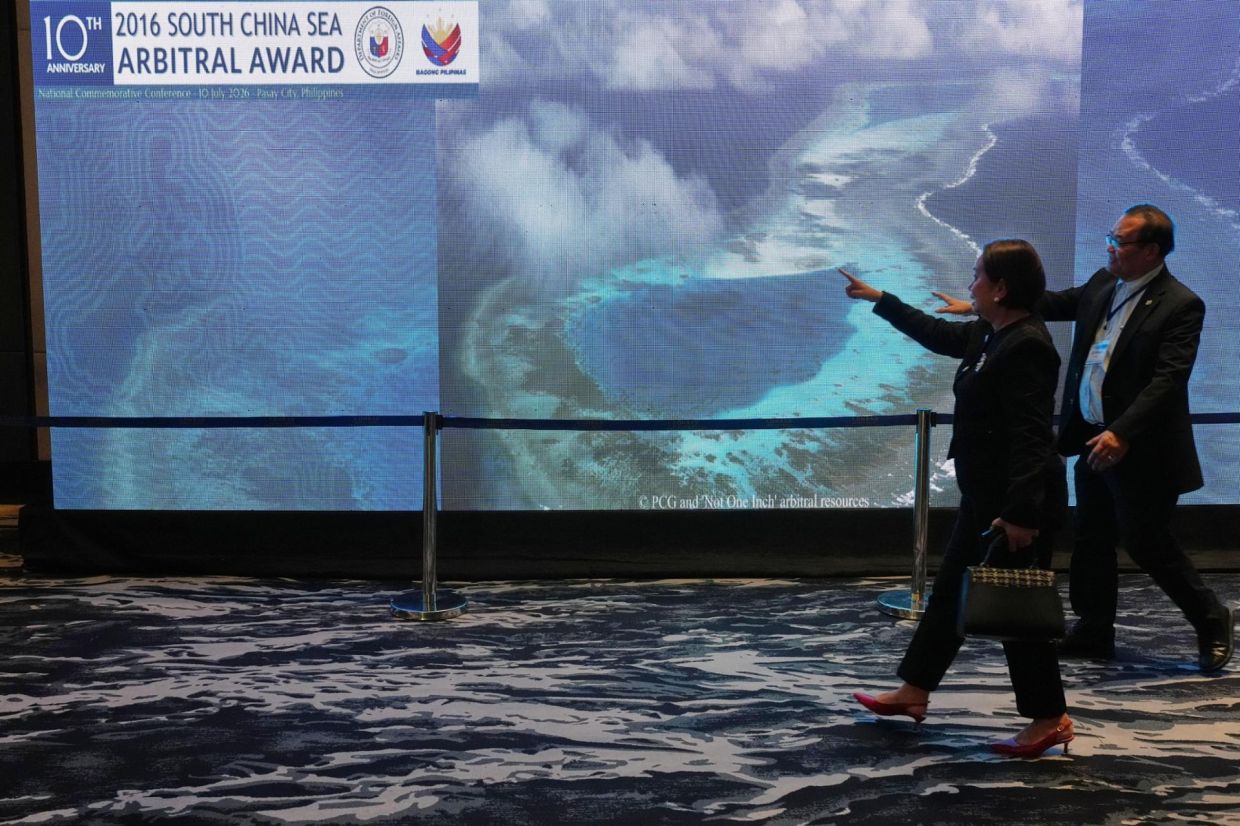
A grouping of 14 countries assembled to commemorate a decade since the historic arbitration decision that reshaped legal understanding of contested waters in Southeast Asia. Led by the Philippines alongside Australia, Canada, Estonia, Germany, Italy, Japan, Latvia, Lithuania, New Zealand, Romania, Slovenia, the United Kingdom and the United States, the coalition released a joint statement underscoring the permanence and enforceability of the tribunal's 2016 judgment. The declaration, issued on Sunday, represented a rare unified diplomatic moment on one of Asia's most sensitive geopolitical questions.
The tribunal's decision of July 12, 2016, delivered under mechanisms established by Annex VII of the United Nations Convention on the Law of the Sea, carries profound legal weight that the signatories moved to reinforce. Rather than fade with the passage of time, the ruling has become a touchstone for international maritime law, establishing conclusive determinations about the maritime entitlements and competing claims at stake in the waterway. The joint statement characterised the judgment as "final, legally binding, and definitive between China and the Philippines," signalling that the matter has been settled through lawful adjudication rather than remaining open for renegotiation.
At the heart of the tribunal's reasoning lay a rejection of China's sweeping territorial assertion. Beijing had long claimed rights over most of the South China Sea through an ill-defined "nine-dash line" that encompassed roughly 90 percent of the strategic waterway. The tribunal determined this historic rights argument lacked any foundation in international maritime law. More concretely, the decision affirmed that specific features—notably Panganiban Reef, known internationally as Mischief Reef, and Ayungin Shola or Second Thomas Shoal—fall within the Philippines' exclusive economic zone rather than representing Chinese territory or waters. This clarification mattered enormously for Filipino fishing communities and resource security.
The 14-nation coalition framed their commemoration within a broader philosophical commitment to what they termed a "free and open Indo-Pacific that is peaceful, stable, and rules-based." This phrase has become standard language in Western and allied nations' strategic documents, reflecting a conviction that regional stability depends on adherence to established international norms rather than force or fait accompli. By invoking this framework, signatories positioned themselves not as opponents of any particular nation but as defenders of a rules-based order from which all maritime nations theoretically benefit.
Central to the coalition's message was an insistence that maritime disputes must be resolved through peaceful mechanisms grounded in UNCLOS. The statement explicitly underscored the importance of protecting freedom of navigation and overflight, principles enshrined in international law but frequently tested through confrontational tactics. These freedoms extend beyond military vessels to merchant shipping and civilian aviation, making them vital to global commerce and freedom of movement. The coalition's reaffirmation suggested concern that these liberties face mounting pressure in the disputed waters.
The Philippines initiated the arbitration process in 2013, bringing the dispute before the Permanent Court of Arbitration when bilateral negotiations with China yielded no resolution. Rather than seeking territorial conquest, Manila's case aimed to establish legally defensible boundaries for its maritime claims and protect its fishermen and resource interests. The tribunal's subsequent validation of those contentions represented a diplomatic and legal triumph for the Philippines, though one that China has refused to recognise or implement.
The signatories expressed explicit opposition to what they characterised as "destabilising or unilateral actions including by force or coercion." This language appeared aimed at incidents in which coast guard, military and maritime militia vessels have harassed, obstructed or intimidated lawful operations by other nations. These confrontations have endangered personnel and fishermen while generating tension that threatens regional stability. The coalition's members evidently sought to establish clear red lines against such conduct, warning that such behaviour endangers lives and undermines the peaceful coexistence essential for prosperity.
The coalition also reaffirmed its support for ASEAN's vision of transforming the South China Sea into "a sea of peace, stability, cooperation, and prosperity driven by vibrant lawful commerce." This formulation reflects Southeast Asian states' desire to benefit from the waterway economically while avoiding military conflict. ASEAN's emphasis on dialogue and consensus-building has long shaped regional diplomacy, though enforcement of these principles against major powers remains challenging. The 14-nation statement effectively positioned itself as reinforcing ASEAN's normative framework rather than circumventing it.
The timing of this commemoration carries significance beyond mere anniversarial marking. Rising tensions in the waterway, including incidents involving Filipino vessels resupplying outposts, have periodically escalated friction. By assembling a coalition to reaffirm the tribunal's authority, the signatory nations signalled that the 2016 decision retains contemporary relevance and international backing despite the passage of ten years. For Malaysia and other Southeast Asian nations not explicitly mentioned, the statement implicitly offered reassurance that established maritime law principles remain actively defended by major powers, even as the strategic landscape continues evolving.

