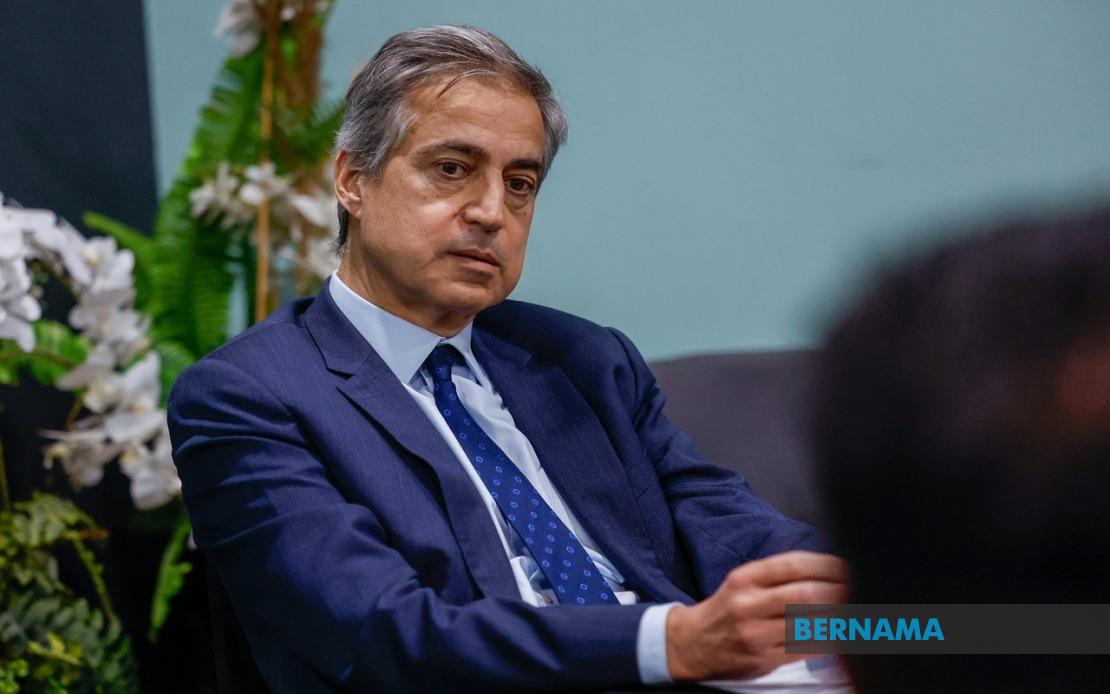
France and Malaysia are committed to deepening their partnership as a deliberate strategy to foster stability and cooperation in an increasingly divided international landscape, according to French Ambassador to Malaysia Marc Abensour. Speaking at a French National Day reception at the ambassador's residence in Kuala Lumpur on Tuesday evening, Abensour underscored that both nations recognise their shared responsibility to serve as bridges across a world fractured by competing interests and geopolitical tensions. This positioning reflects a broader diplomatic approach where mid-sized powers seek to demonstrate relevance and constructive engagement rather than align rigidly with major power blocs.
The foundation of the France-Malaysia relationship rests substantially on measurable economic performance. Bilateral trade between the two countries expanded by 11 percent in the preceding year, signalling robust commercial momentum despite global economic headwinds. More significantly, approximately 600 French companies have established operations across Malaysia, collectively generating employment for more than 30,000 Malaysian workers. This substantial presence underscores France's confidence in Malaysia's business environment and the reliability of Malaysian markets and labour. For Malaysian policymakers, the figure carries strategic weight, demonstrating that France views the country not merely as a trade partner but as a destination worthy of significant capital commitment and long-term operational investment.
Malaysia's standing within French strategic economic calculations extends beyond routine bilateral metrics. The country ranks as the world's tenth-largest recipient of French foreign direct investment, a distinction that places it alongside major global economies in terms of French capital allocation. This ranking reflects years of accumulated confidence in Malaysia's regulatory frameworks, political stability, and growth potential. For Malaysian stakeholders in government and commerce, this position validates economic policies that have encouraged foreign direct investment whilst maintaining reasonable standards of governance and protection for investor interests. It also suggests that Malaysia's role in regional affairs—particularly in Southeast Asia—appeals to French investors seeking exposure to Asian growth trajectories.
Cultural and educational dimensions substantially complement the economic architecture of the relationship. The ambassador highlighted that more than 3,700 candidates across Malaysia are currently pursuing French-language certification, placing the country third throughout Asia in terms of French-language learner numbers, trailing only India and China. This linguistic engagement carries implications beyond simple cultural curiosity. Language proficiency facilitates business communication, supports potential career mobility within French multinational corporations operating regionally, and creates networks of French-educated Malaysians who often maintain professional and personal ties to France throughout their careers. Such human capital flows have historically proven durable as foundations for sustained diplomatic and commercial relationships.
People-to-people exchanges have become increasingly important in diplomatic relations, particularly as governments seek to build constituencies within their societies that favour cooperation with other nations. The vibrant educational and cultural interchange between France and Malaysia cultivates mutual understanding at grassroots levels, creating constituencies in both countries with vested interests in maintaining constructive relations. When thousands of Malaysians study French language and culture, they develop familiarity with French values and perspectives that extends beyond official government pronouncements. Similarly, French expatriates and their families living in Malaysia build personal attachments to Malaysian communities, creating informal networks that often prove more durable than formal diplomatic channels alone.
The ceremony itself carried significant symbolic weight through the attendance of Federal Territories Minister Hannah Yeoh as guest of honour, alongside approximately 800 other attendees including senior government officials, diplomats, and ambassadors representing numerous countries. This level of participation from Malaysia's political establishment signals official endorsement of deepening France-Malaysia ties at a moment when Malaysian leadership is calibrating the country's external engagement strategy. The presence of multiple ambassadors underscores that France-Malaysia relations occur within a broader context of regional and global diplomatic activity, with neighbouring and distant powers observing the trajectory and substance of this bilateral partnership.
The celebration of French National Day on July 14 itself carries historical significance that extends beyond ceremonial observance. The commemoration of the Storming of the Bastille in 1789 celebrates principles of liberty, equality, and fraternity—values that France identifies as foundational to its national identity and international positioning. By hosting this commemoration in Malaysia with substantial attendance from Malaysian officialdom, France broadcasts its commitment to universal democratic principles whilst implicitly extending an invitation to Malaysia to align itself with these values-based frameworks. For Malaysia, participation in such celebrations represents diplomatic endorsement of liberal democratic principles without necessitating any shift in domestic governance arrangements.
The inclusion of distinctly Malaysian elements within the French celebration—notably a durian-tasting booth alongside traditional French cuisine—reflects sophisticated cultural diplomacy that acknowledges local identity whilst promoting French cultural offerings. Rather than presenting French culture as a replacement for or superior to Malaysian traditions, this approach positions French and Malaysian cultures as complementary and mutually enriching. Such reciprocal recognition creates space for deepened engagement without demanding cultural subordination or assimilation. This stands in contrast to historical colonial frameworks where cultural hierarchy was often explicitly promoted, suggesting that contemporary France-Malaysia relations operate within fundamentally different power dynamics and mutual respect paradigms.
For broader regional implications, strengthened France-Malaysia ties contribute to a wider pattern of Southeast Asian nations cultivating diverse international partnerships. Rather than concentrating engagement exclusively within Asian frameworks or between major powers, Malaysia's investment in relationships with European nations like France expands its diplomatic options and reduces dependency on any single power centre. This approach aligns with Malaysian foreign policy traditions that have historically emphasised strategic autonomy and non-aligned positioning. France's reciprocal emphasis on Malaysia as a priority relationship within Southeast Asia reflects Paris's own strategic interest in remaining relevant within the Indo-Pacific region and avoiding marginalisation as global attention increasingly concentrates on Asian geopolitical dynamics.
The ambassador's framing of France-Malaysia cooperation as a response to global fragmentation deserves analytical attention, as it positions bilateral engagement not as a parochial interest but as a contribution to international stability. By emphasising bridge-building and cooperation during times of international division, both nations present their relationship as constructively engaged with global challenges rather than narrowly self-interested. This rhetorical framing appeals to international audiences and creates diplomatic space for expanded engagement by suggesting that deepening ties serves purposes beyond bilateral advantage—it contributes to countering polarisation and promoting multilateral cooperation. For Malaysian policymakers evaluating external relationships, this alignment with stated international purposes provides additional legitimacy for closer France-Malaysia engagement.
Looking forward, the growth trajectory of France-Malaysia relations appears oriented toward expansion across multiple dimensions. The 11 percent trade growth, combined with France's ranking among leading sources of foreign direct investment, suggests economic momentum likely to continue. Educational and cultural exchanges show no signs of saturation, with continuous growth in French-language learners indicating sustained interest from younger generations. Political engagement, demonstrated through the presence of Federal Territories Minister Hannah Yeoh and broader official participation, indicates governmental commitment to nurturing the relationship through formal channels. Together, these factors suggest that France-Malaysia bilateral relations will likely deepen further in coming years, potentially encompassing new domains of cooperation such as technology transfer, green energy initiatives, or regional security cooperation as both nations navigate an evolving global order.

