The quarter-final clash between France and Morocco in Boston on Thursday carries far more weight than a typical knockout match. Beneath the competitive surface lies a complex tapestry of historical ties, migration patterns and personal bonds that have woven together the footballing cultures of both nations. The fixture represents not merely a test of tactical superiority but an encounter between countries whose destinies have been intertwined for more than a century, now playing out on American soil rather than in the heightened security environment of France itself.
Morocco's relationship with France stems from a protectorate agreement that lasted from 1912 until independence in 1956. The legacy of this colonial period extends far beyond history books, manifesting instead through education systems, business networks and population movements that continue to shape North African and European dynamics today. Football has emerged as perhaps the most visible and powerful expression of these enduring connections, creating a sporting bridge that reflects real human experiences of migration, cultural identity and belonging that characterise modern Europe.
The composition of Morocco's World Cup squad vividly illustrates the depth of these links. Six players were born on French soil, while numerous others developed their craft in the French domestic league or rose through Ligue 1 academies before committing to represent Morocco internationally. This pattern reflects a deliberate strategy by the Moroccan football federation to harness the talent developed within French football systems and convert it into national competitive strength. The approach acknowledges a practical reality: that many young Moroccan players find better development pathways in Europe while maintaining their original national allegiance.
Ayyoub Bouaddi exemplifies this trend with particular clarity. The teenager was born in France, honed his skills at Lille, and represented France at youth level before selecting Morocco as his senior international home. His journey encapsulates the dual footballing identities that increasingly characterise modern international football, where players navigate multiple cultural and sporting influences before making their ultimate choice of representation. Such cases transform what might appear as straightforward sporting decisions into deeply personal statements about identity and belonging.
The bond between Kylian Mbappe and Achraf Hakimi, forged during their time as teammates at Paris Saint-Germain, adds another personal dimension to this fixture. These individual friendships, built through daily training and competition at one of Europe's most prestigious clubs, remind us that international rivalries exist alongside genuine human connections that transcend national boundaries. The players themselves often inhabit spaces where national and personal identities coexist in ways that older generations of football observers might find unfamiliar.
Boston provides an intriguing alternative venue for renewing this rivalry compared to a hypothetical French setting. The Moroccan community in the greater Boston metropolitan area, though smaller and less visible than counterparts in Paris or Marseille, maintains an established presence spanning families, students, professionals and business people. This setting permits a different kind of encounter, one less shaped by nationalist fervour and more reflective of how these communities actually coexist in diaspora spaces. Mohammed Saadi, a 57-year-old taxi driver, captured this sentiment perfectly, noting that neighbours of French and Moroccan origin will watch together and shake hands afterwards, because for them football ultimately represents a shared family experience rather than a zero-sum nationalist competition.
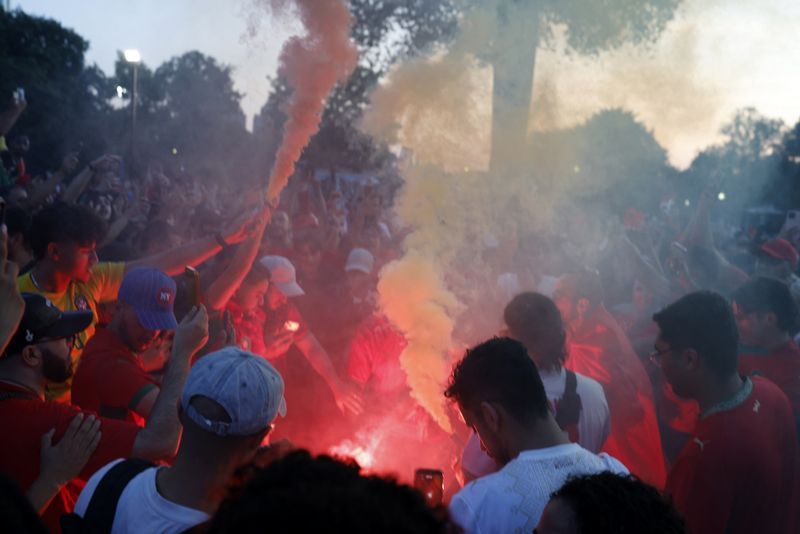
The gathering of over one thousand supporters at Boston Common ahead of the match demonstrated the peaceful tenor that has characterised Moroccan fan engagement throughout this tournament. Fans sang Dima l-Maghrib (Always Morocco) and waved flags in a celebration that reflected genuine enthusiasm without the antagonism that sometimes mars international fixtures. Youssef Bennani, a 36-year-old software engineer who travelled from Finland to support Morocco, reported meeting both Moroccan and French supporters in an atmosphere building toward what he anticipated as a positive celebration rather than a divisive confrontation.
The context of this rematch differs markedly from when these nations last met in Qatar in 2022, a fixture France won 2-0. Morocco has since consolidated its status as a genuine tournament contender rather than a compelling underdog story. By becoming the first African nation to reach a World Cup semi-final four years ago, Morocco altered the narrative surrounding African football's potential. That historical achievement has elevated expectations and fundamentally changed how their participation is perceived by the broader football world. They arrive in Boston not as plucky outsiders but as a team that has demonstrated sustained excellence and organisational quality.
Morocco's federation has implemented a strategic approach to player development that bridges domestic Moroccan football with talent cultivated across European leagues. This sophisticated approach recognises that elite player development often requires European resources and exposure, while maintaining structures that allow successful European-based players to contribute to national ambitions. The strategy has produced tangible results: a squad capable of executing disciplined, organised football that proved devastating in their 3-0 demolition of Canada, highlighting the pace and ambition that carried them back to the quarter-finals.
France enters the match as defending world champions from 2018 with all the tournament experience and established power that status implies. Their attacking capability has been among the tournament's most dangerous, evidenced by their progression past Paraguay. Yet Morocco's performance against Canada suggests that France cannot rely on offensive dominance alone. The Moroccan team has shown capability to neutralise attacking threats through structured defensive organisation while maintaining their own threatening transitions. This squad possesses the confidence born from exceeding external expectations, creating a psychological advantage that sometimes proves as valuable as individual technical superiority.
The historical resonance of France-Morocco fixtures has only deepened as Morocco's football has matured. No longer representing simple David-versus-Goliath drama, this encounter pits two teams with genuine claims to excellence against each other. For Malaysian and Southeast Asian observers, the match illuminates broader questions about how post-colonial relationships function in contemporary football, how diaspora communities maintain sporting identities across borders, and how migration transforms national football programmes. These issues carry particular relevance in Southeast Asia, where regional players increasingly develop careers abroad while maintaining commitments to national teams.
The Boston setting itself carries symbolic weight. Rather than playing in the heightened emotional and security environment of France, this fixture unfolds in a city where both nations' communities coexist in practical, daily proximity. This creates space for the match to be contested with full intensity while remaining embedded within frameworks of mutual respect and shared humanity that colonial history and subsequent migration have established. The fixture thus becomes not merely a sporting encounter but an expression of how historical antagonisms can evolve into complex, multifaceted relationships where competition and kinship coexist.

