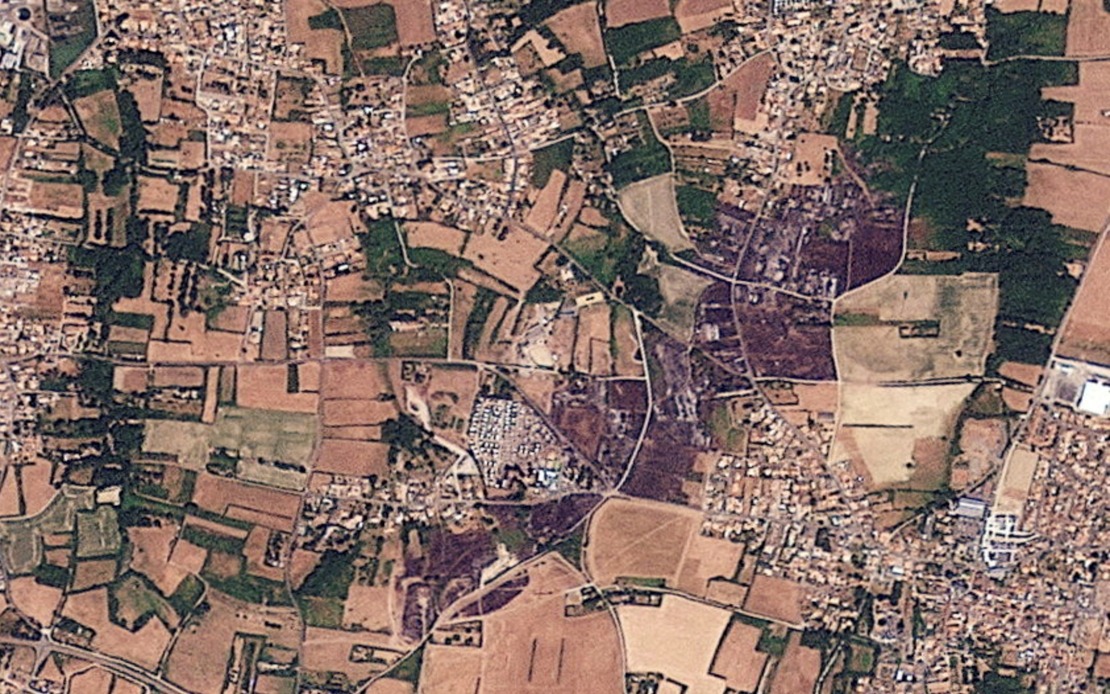
France is facing a severe wildfire crisis that has stretched emergency services and highlighted the persistent threat of arson during the summer season. Two active fires burning across the Fontainebleau forest have consumed 1,920 hectares of woodland, forcing authorities to deploy approximately 600 firefighters in intensive containment operations. The situation has been further complicated by the arrest of two individuals suspected of deliberately igniting the first blaze, underscoring the role of human negligence and criminal intent in exacerbating the nation's fire season challenges.
The Fontainebleau fires have developed in two distinct episodes since the beginning of the fire season. The initial outbreak, which erupted on Sunday, has already destroyed around 1,500 hectares of forest, while a subsequent blaze has consumed between 300 and 400 additional hectares. Despite the significant firefighting response, the overnight spread of these fires demonstrates the rapid acceleration that occurs during warm, dry conditions, a pattern increasingly familiar to Mediterranean nations and other regions experiencing climate-driven fire seasons.
The arrest of two arson suspects has prompted strong reactions from French government officials, particularly Transport Minister Philippe Tabarot, who has called for rigorous legal consequences for those deliberately setting fires. His comments reflect growing frustration with repeat offenders and the broader challenge of distinguishing between deliberate criminal acts and cases involving individuals with psychological compulsions toward fire-setting. Tabarot's statement advocating for both severe punishment and psychiatric intervention for those suffering from pyromania indicates recognition that a dual approach—combining legal penalties with mental health treatment—may be necessary to address the root causes of intentionally set fires.
The scale of arson as a nationwide problem extends well beyond the current Fontainebleau crisis. French authorities have documented 59 arrests across the country since the fire season commenced, all on suspicion of deliberately starting wildfires. This statistic reveals a troubling pattern of criminal behavior that places additional strain on firefighting resources that might otherwise be directed toward combating naturally occurring blazes triggered by lightning strikes or accidental human activity. The concentration of arrests underscores the need for enhanced surveillance, public awareness campaigns, and community engagement to deter would-be arsonists.
Beyond the immediate Fontainebleau emergency, France is contending with fire outbreaks across geographically dispersed regions, each presenting distinct logistical and operational challenges. The Trevillach wildfire, which erupted in the Pyrenees-Orientales region earlier this month, has caused sufficient damage to railway infrastructure along the Perpignan-Villefranche-Vernet-les-Bains route to warrant the suspension of train services. National railway operator SNCF has announced that services between Ille-sur-Tet and Villefranche-Vernet-les-Bains will remain out of service until at least July 20, affecting passenger movement and freight transport through this important corridor linking Catalonia with the French interior.
The Trevillach fire exemplifies how wildfires have consequences extending far beyond their immediate environmental impact. Railway infrastructure damage represents a secondary but significant disruption to economic activity and civilian life, forcing authorities to divert resources toward repair assessments and service rerouting. The extended suspension period suggests substantial structural damage requiring careful evaluation before services can safely resume, a process that compounds the initial emergency response burden on local authorities and national operators.
Wildfires have simultaneously affected Brittany and the Lozère region, multiplying the pressure on France's firefighting capacity. In Brittany's Côtes-d'Armor department, a heath fire near Cap Fréhel forced the evacuation of more than 100 residents on Monday and has burned approximately 38 hectares. This incident demonstrates the populated nature of many fire-threatened areas in France, where residential communities intermingle with vulnerable vegetation zones, necessitating rapid evacuation protocols alongside active firefighting efforts. The need to prioritize civilian safety while simultaneously containing spreading flames places additional demands on coordinated response mechanisms.
The Lozère fire, though smaller in scale than the Fontainebleau and Trevillach incidents, nonetheless represents another geographic dispersal of France's wildfire burden. With 107 hectares destroyed in this region alone, firefighting crews have been stretched across multiple departments, each requiring specialized equipment, personnel rotation, and sustained logistical support. The cumulative hectarage burned across these scattered incidents reveals the aggregate toll that multiple simultaneous fire events exact on national emergency infrastructure and regional administrative capacity.
For Malaysian and Southeast Asian observers, the French wildfire crisis offers instructive parallels to regional fire management challenges. While Malaysia and neighboring countries face fires predominantly driven by peat decomposition, deforestation, and agricultural land clearing, the deliberate arson dimension that characterizes the French situation remains relevant. Southeast Asian nations have similarly grappled with intentional fire-setting for land clearing purposes, though often on larger, less prosecuted scales. The French government's emphasis on dual approaches combining criminal penalties with psychiatric evaluation for pyromaniacs suggests a sophisticated policy framework applicable to analogous problems in other jurisdictions.
The climate context underlying these European fires also merits consideration for regional audiences. Warming global temperatures and shifting precipitation patterns are extending fire seasons across temperate Europe, creating conditions increasingly similar to those long familiar in Mediterranean regions and beyond. Southeast Asia, already vulnerable to transboundary haze from regional fire events, faces compounding pressures as climate change potentially intensifies fire weather conditions across broader geographic zones. France's current crisis exemplifies challenges that may become more prevalent across multiple continents in coming decades.
The response mechanisms deployed by French authorities—coordinated deployment of 600 firefighters, arrests of arson suspects, railway service suspension, mass evacuations, and calls for policy adjustments—reflect established crisis management frameworks that larger developed nations can activate when facing acute environmental emergencies. Yet the persistence of preventable fires through arson suggests that technological and personnel resources, while necessary, remain insufficient without concurrent social, legal, and psychological interventions. The challenge of distinguishing criminal arson from pathological fire-setting, as highlighted by Transport Minister Tabarot, underscores the multidisciplinary expertise required for effective wildfire management.
As French emergency services continue containment operations across multiple active fire zones, the broader implications extend to regional cooperation, cross-border coordination, and resource-sharing mechanisms within the European Union. The disruption of international transport corridors, evacuation of significant civilian populations, and environmental damage to protected forest areas necessitate coordinated responses that may involve assistance from neighboring countries. For policymakers and emergency managers globally, including those in Southeast Asia, the French experience demonstrates both the vulnerabilities created by summer fire seasons and the necessity of preparedness frameworks that anticipate simultaneous outbreaks across dispersed geographic locations.

