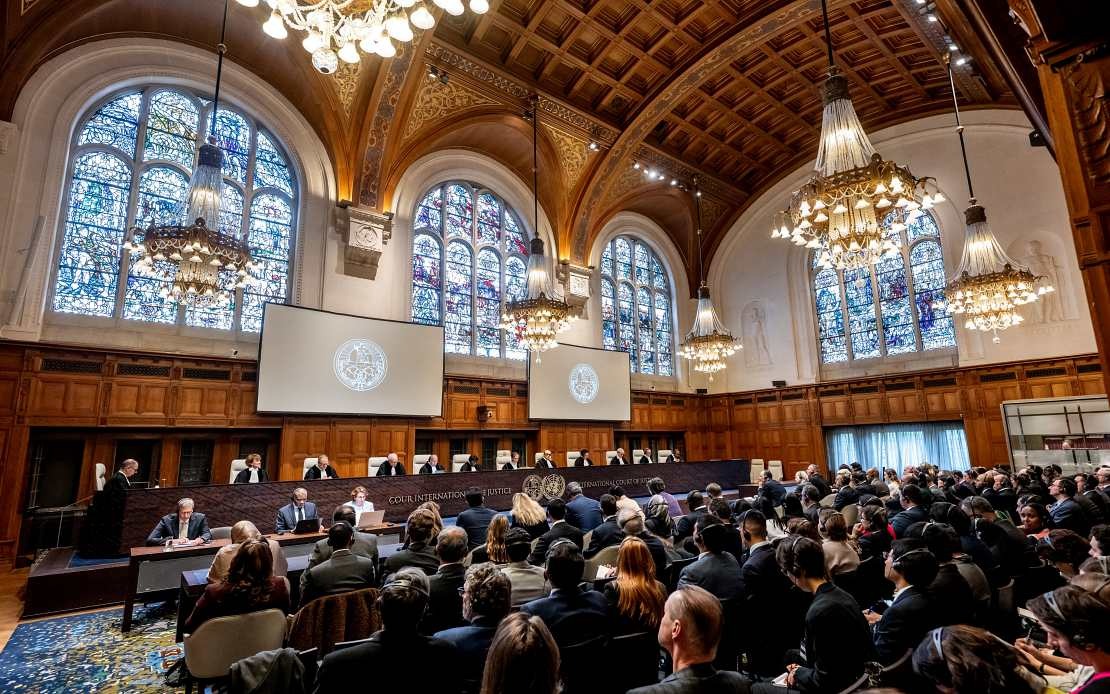
France has doubled down on its commitment to the International Criminal Court despite mounting pressure from the United States, which has launched a coordinated campaign to undermine the tribunal's authority and encourage other nations to abandon it. The French Foreign Ministry's defence of the ICC reflects a fundamental divide between Washington and its traditional European allies over the role of international justice institutions in maintaining global order and accountability.
Spokesman Pascal Confavreux articulated France's position with clarity, emphasizing that the ICC does not pose any threat to state sovereignty because it prosecutes individuals rather than governments themselves. This distinction lies at the heart of the dispute between the US and ICC supporters. Washington contends that the court's expanding jurisdiction and relative independence from state control create unacceptable risks to American interests, while France and other member states argue the court exists precisely to hold individuals accountable for the most egregious violations of international law.
The timing of France's statement is significant, arriving shortly after US Secretary of State Marco Rubio made sweeping declarations that the ICC threatens American sovereignty and announced Washington's intention to persuade other nations to withdraw their membership. Rubio's rhetoric signals a substantially more aggressive posture toward international courts than in previous administrations, suggesting the US intends to use its considerable diplomatic and economic leverage to isolate the institution.
Beyond rhetorical opposition, the State Department has reportedly initiated a formal initiative designed to constrain what American officials characterize as the ICC's ability to challenge US sovereignty. This multi-pronged approach combines diplomatic persuasion with structural limitations, indicating that Washington's opposition extends beyond mere criticism to concrete action aimed at weakening the court's practical capacity to operate.
France's statement additionally condemned what it characterized as unacceptable attacks and threats directed against ICC personnel, officials, and support staff. This criticism appears directed at the broader climate of intimidation surrounding the court, including political pressure from powerful nations and security threats faced by those who work to advance international justice. The French position implicitly connects the protection of the court's institutional independence with the safety of those responsible for its operations.
The ICC, headquartered in The Hague since its establishment in 2002, functions as a permanent institution designed to prosecute individuals responsible for genocide, war crimes, crimes against humanity, and aggression. Unlike many international bodies, it operates with a degree of independence that can sometimes bring it into conflict with powerful member states or major nations whose actions fall within its potential jurisdiction. This independence is precisely what proponents like France consider essential to its legitimacy, while critics view it as problematic overreach.
The fundamental distinction between the US and France reflects contrasting philosophical approaches to international order. The United States has historically maintained a preference for bilateral arrangements and American-led multilateral institutions where it retains substantial control. The ICC's structure, with an independent prosecutor and judges who can act without state permission, contradicts this preference. France, conversely, has championed binding international legal frameworks and institutional independence as mechanisms to constrain power and establish rule-based order transcending individual states.
The US has notably never become a member of the ICC, despite supporting its creation. This non-membership status has allowed Washington considerable rhetorical freedom while avoiding direct jurisdictional constraints. However, the court's evolving case portfolio, which has occasionally touched on matters involving NATO members and US partners, has sharpened American concerns about its practical implications. Recent investigations and prosecutions have demonstrated the court's willingness to pursue cases that major powers find inconvenient.
For Southeast Asian observers, this transatlantic friction carries broader implications. The region includes several ICC members and several non-members, creating a complex landscape where the court's legitimacy and effectiveness directly impact regional justice mechanisms. The US campaign to limit the ICC simultaneously signals its broader skepticism toward binding international institutions, a position that could influence how Washington approaches regional disputes, treaty obligations, and justice mechanisms relevant to Southeast Asia.
France's reaffirmation of support should be understood within the context of European commitment to multilateralism and international law. The European Union views the ICC as foundational to a rules-based international system that protects smaller states and constrains hegemonic power. For France specifically, backing the court aligns with its diplomatic tradition of emphasizing universal principles and institutional solutions to global challenges, even when those institutions complicate relations with allies.
The intensity of American pressure reflects genuine concerns within Washington about ICC independence, but it also demonstrates the growing fragmentation of the Western alliance on questions of international governance. Where previous administrations sought to influence the ICC through participation or back-channel diplomacy, the current approach prioritizes withdrawal and isolation. This represents a significant departure from post-Cold War consensus that international institutions, however imperfect, represent preferable mechanisms to unilateral action.
The coming months will likely see increased diplomatic activity as the US presses other nations to reconsider their ICC membership or participation. France's public stance provides a counterweight to American pressure and signals that some allies will not retreat from commitments to international justice institutions. However, the effectiveness of France's position may depend on whether other democracies, particularly in Europe and beyond, prove willing to withstand American pressure and maintain their own support for the court's independence and authority.

