France's World Cup campaign imploded in dramatic fashion on Tuesday as Spain delivered a comprehensive 2-0 victory in the semi-final, shattering the widespread assumption that Les Bleus would emerge as tournament champions. The match in Arlington, Texas laid bare the gap between expectation and reality, with the pre-tournament favourites reduced to passive observers as their Spanish opponents orchestrated a masterclass in controlled, possession-based football. Where France had managed a comeback from adversity in the 2022 World Cup final against Argentina, finding resilience through sheer determination, Tuesday's encounter offered no such redemption narrative. This was an unambiguous examination of their credentials, and they failed catastrophically.
The magnitude of France's collapse became apparent within the first hour, mirroring their opening performance in that Argentine final two years earlier. Yet the circumstances this time proved fundamentally different. Rather than a contest that swung momentum through individual brilliance and penalty drama, this was a systematic dismantling orchestrated by a Spanish side operating with clinical precision. Coach Didier Deschamps acknowledged the harsh reality in his post-match assessment, accepting that his team had been outclassed across the pitch. The admission carried particular weight given that France had been widely expected to possess the experience, depth, and individual talent to navigate this tournament successfully. Instead, they fell victim to a tactical and technical superiority that exposed long-standing vulnerabilities in their approach.
The prevailing consensus before the match had fundamentally misjudged the balance of power between these two European heavyweights. Spain, emboldened by the confidence of teenagers like Lamine Yamal who publicly declared that France should fear them, understood the game's tempo and rhythm far better than their opponents. France's second-half substitute Rayan Cherki later reflected on how Spain's ability to control the match's pace—deliberately slowing play to dictate proceedings—had created challenges his side failed to adequately address. The psychological aspect proved equally damaging, as France appeared to approach the encounter with an assumption of superiority that evaporated once they encountered genuine resistance. By contrast, Spain arrived with clear-eyed understanding of how to neutralise their opponents and impose their own system.
The symbolism of France's failure crystallised around Michael Olise, the player who had been positioned as their creative fulcrum and thrust into elite-level discourse surrounding Ballon d'Or contenders. Operating on the Dallas Stadium pitch, Olise appeared fundamentally disconnected from the match, starved of the space and service that typically define his play. His performance against Rodri, Spain's midfield dictator, proved utterly one-sided. The Spanish midfielder glided through proceedings with authority, controlling every transition while Olise surrendered possession twenty times and completed zero successful dribbles. For a player expected to unlock Spain's defensive structure, this represented a damning indictment of France's tactical setup and individual capabilities under pressure.
Olise's struggles formed merely the most visible manifestation of a broader attacking collapse. Ousmane Dembele, another player expected to create genuine problems for Spain's defence, posed minimal threat throughout the ninety minutes. The forward line—featuring Bradley Barcola, supplemented later by Desire Doue—delivered blunt, ineffective performances that rendered France's celebrated attacking depth strangely impotent. Even Kylian Mbappe, the tournament's standout performer, failed to generate the moment of magic required to shift the match's trajectory. The afternoon's loudest roar came not from any French attacking thrust but from David and Victoria Beckham's appearance on the stadium's giant screen, an inadvertent commentary on how thoroughly France's offence had been neutralised.
France's midfield infrastructure crumbled under sustained pressure, with the double pivot system proving inadequate against Spain's coordinated pressing and possession dominance. Adrien Rabiot's early yellow card fundamentally altered his approach, constraining the aggression required to disrupt Spanish rhythm. More critically, Aurelien Tchouameni never recovered his equilibrium throughout proceedings, having missed two previous matches with hamstring injury. His lack of match fitness and rhythm became apparent as he struggled to maintain pace with Spain's midfield runners. The defensive line, starved of midfield protection and cover, became chronically exposed. Spain capitalised ruthlessly on these vulnerabilities, with Mikel Oyarzabal converting a penalty after twenty-two minutes before Pedro Porro added a second goal shortly before the hour mark.
The tactical deficiencies evident in France's setup suggested deeper problems with how Deschamps had approached this particular knockout encounter. Rather than adapting to Spain's system or implementing counter-measures to nullify their possession threat, France appeared wedded to an approach that proved ineffective against such organised, technically sophisticated opposition. The reliance on individual talent—a strategy that had previously served French football well—proved insufficient when confronting a Spanish team functioning as a coherent unit. Spain's willingness and capability to engage France directly in possession battles rather than inviting French attacks represented a critical distinction from other opponents France had faced throughout the tournament.
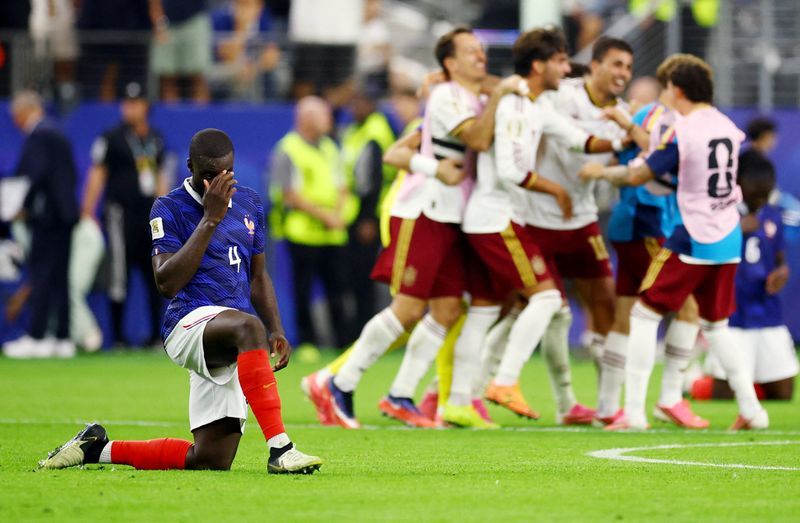
The final whistle brought scenes of profound devastation. Kylian Mbappe stood isolated on the pitch while teammates dropped to their knees or buried their faces in their hands, physical manifestations of the emotional weight of such a comprehensive defeat. The narrative that had dominated the build-up to the match—repeated discussions of team cohesion, unity, and collective strength—suddenly felt hollow and irrelevant. France had arrived in Texas with the weight of expectations accumulated through successful recent campaigns and a squad brimming with world-class individuals. They departed having suffered one of the tournament's most definitive setbacks, their campaign concluded not through a closely contested battle but through systematic, methodical destruction.
For Southeast Asian observers and Malaysian football enthusiasts, France's collapse offers instructive lessons about the limitations of star power and historical prestige when confronting tactical sophistication and collective discipline. Spain's victory vindicated an approach centred on fundamental technical excellence, positional discipline, and controlled possession—principles increasingly important across global football regardless of which confederation dominates particular tournaments. The Spanish model, emphasising systematic development and cooperative football, contrasts sharply with France's reliance on assembling elite individual talents. This distinction may resonate particularly in regional contexts where developing cohesive team systems remains an ongoing challenge for emerging football nations seeking to compete at international level.

