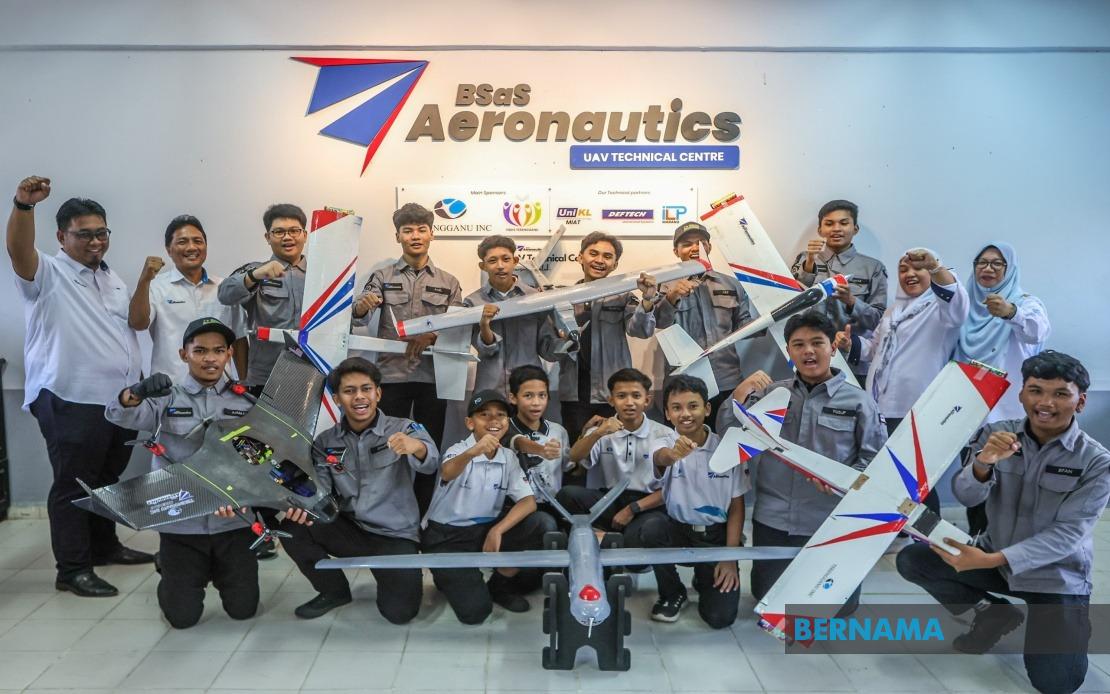
At SMK Bukit Sawa in Marang, Terengganu, what began as one teacher's passion for remote-controlled aircraft has blossomed into an ambitious vocational initiative preparing secondary school students for careers in Malaysia's emerging aerospace sector. Badrul Hisyam Zakaria, an English teacher, has leveraged his expertise to spearhead the TI-BSAS UAV In School programme, a hands-on learning venture that has already guided 35 students through the complex process of designing and constructing their own unmanned aerial vehicles. Since launching in 2023 with crucial corporate backing, the initiative has produced more than five fully operational UAVs, each representing a substantial investment of between RM6,000 and RM10,000 and embodying industrial-standard construction practices scaled appropriately for an educational setting.
The programme's technical ambitions are considerable and reflect a serious commitment to equipping students with genuine engineering knowledge rather than mere theoretical exposure. The vehicles being constructed employ the same methodologies and materials found in commercial aerospace development, though adapted to school-based production. Current-generation UAVs are equipped with Global Positioning System technology enabling sophisticated target tracking, while the team is progressing toward a more advanced generation incorporating artificial intelligence capabilities for autonomous visual target identification. This technological progression mirrors the trajectory of professional aerospace development programmes and signals the school's intention to maintain pedagogical relevance as the field evolves.
The programme's early success crystallised in June 2026 when SMK Bukit Sawa claimed the championship title in the UAV Avionics Integration Challenge for secondary schools at the MyAERO Challenge 2026 competition held at MAEPS in Serdang, Selangor. This achievement carries particular significance beyond the trophy itself, serving as validation that students in a regional Malaysian school can compete at national level in a technologically sophisticated discipline. The victory demonstrates that students without access to major urban centres or elite institutions can nonetheless develop world-class technical competencies when provided with adequate resources, mentorship, and institutional support.
Perhaps more tellingly, the programme's true measure of success extends beyond competition results into the long-term trajectories of its participants. Two former SMK Bukit Sawa alumni who participated in the UAV initiative are currently pursuing aircraft engineering degrees at Universiti Kuala Lumpur, while three additional graduates have advanced to matriculation-level science programmes. These progression pathways suggest the programme is functioning exactly as intended—not merely as a novelty activity but as a genuine feeder system into serious technical education. Badrul Hisyam has explicitly articulated an expectation that within three to four years, the first programme alumni will emerge with professional aircraft engineering qualifications, creating a pipeline of genuinely skilled technical professionals rooted in Malaysian institutions.
The initiative's architects view the programme through a deliberately expansive lens encompassing national industrial capacity development. Beyond the immediate benefits to participating students, the TI-BSAS UAV In School scheme targets a strategic goal: reducing Malaysia's dependence on foreign suppliers for unmanned aerial vehicle technology by cultivating domestic expertise and establishing local manufacturing capability. This objective aligns with broader government initiatives promoting technological self-sufficiency and positions secondary education not merely as knowledge transfer but as critical infrastructure for national industrial development. By demonstrating that Malaysian students can successfully design and build sophisticated aerospace systems, the programme contributes to shifting perceptions about local technical capacity and capability.
The corporate partnership underpinning the programme illustrates how private sector engagement can meaningfully amplify educational outcomes. Terengganu Incorporated, the state's primary development agency, has committed substantial resources totalling RM75,000 since 2023 to underwrite the aviation and UAV development activities at SMK Bukit Sawa. The initial investment of RM45,000 established the programme's foundational infrastructure in 2023, with an additional RM30,000 committed in 2026 to sustain operations and drive technological advancement. This sustained funding approach differs markedly from one-off sponsorships, instead signalling long-term institutional commitment to the initiative's success and expansion.
Terengganu Incorporated president and group chief executive officer Datuk Burhanuddin Hilmi Mohamed articulated the corporate rationale explicitly: the investment targets students from the B40 income bracket, addressing both social equity and national skills development objectives simultaneously. By providing early exposure to aviation industry practices and fostering technological proficiency in high-demand fields, the programme channels resources toward populations traditionally underrepresented in technical professions while simultaneously addressing documented skills shortages in aerospace sectors. This dual-benefit approach renders the initiative attractive to corporate partners concerned with corporate social responsibility while delivering measurable workforce development outcomes.
The programme's governance structure involves meaningful collaboration across multiple institutional levels. Terengganu State Education Department involvement ensures curricular alignment and institutional legitimacy, while partnerships with multiple companies beyond Terengganu Incorporated extend the network of mentorship, expertise access, and material support. This multi-institutional architecture reduces dependency on any single corporate entity, creating structural resilience and enabling sustained programme operation even if individual sponsor priorities shift. Such collaborative frameworks increasingly characterise successful educational initiatives in the region, reflecting recognition that complex technical training requires resources, expertise, and networks beyond what individual schools or companies can furnish independently.
The broader implications for Malaysian educational policy merit serious consideration. SMK Bukit Sawa's experience suggests that secondary schools, even those located beyond major metropolitan areas, can serve as sites of sophisticated technical education when provided with strategic support and industry partnerships. The programme implicitly challenges assumptions about where advanced technical training must occur, demonstrating that well-designed initiatives can enable regional schools to deliver outcomes comparable to urban alternatives. For policymakers, the initiative offers a replicable model potentially applicable to other technical disciplines facing skills shortages, from renewable energy to semiconductor manufacturing.
Looking forward, the programme's trajectory suggests momentum toward substantive scaling. The progression from basic UAV construction toward AI-integrated systems reflects genuine technological advancement rather than static repetition of foundational projects. As alumni advance into tertiary education and eventually professional practice, a feedback loop could emerge wherein graduates return as mentors or collaborators, deepening the initiative's technical sophistication. Within Terengganu specifically, concentrated development of aerospace expertise could gradually create agglomerative benefits, attracting related industries and establishing the state as a regional technology hub.
The SMK Bukit Sawa initiative ultimately represents something more consequential than an extracurricular enrichment activity for motivated students. It embodies a deliberate strategy to democratise access to technical education, cultivate domestic aerospace capability, and create genuine career pathways into high-value sectors. By transforming a secondary school into a functioning aerospace development site, the programme challenges conventional boundaries between educational institutions and industry practice. For Malaysian readers observing broader skills shortages and youth unemployment challenges, particularly in technical fields, the model offers evidence that investment in school-based technical education, supported by industry partnerships and sustained corporate commitment, can catalyse meaningful workforce development and economic capability building.

