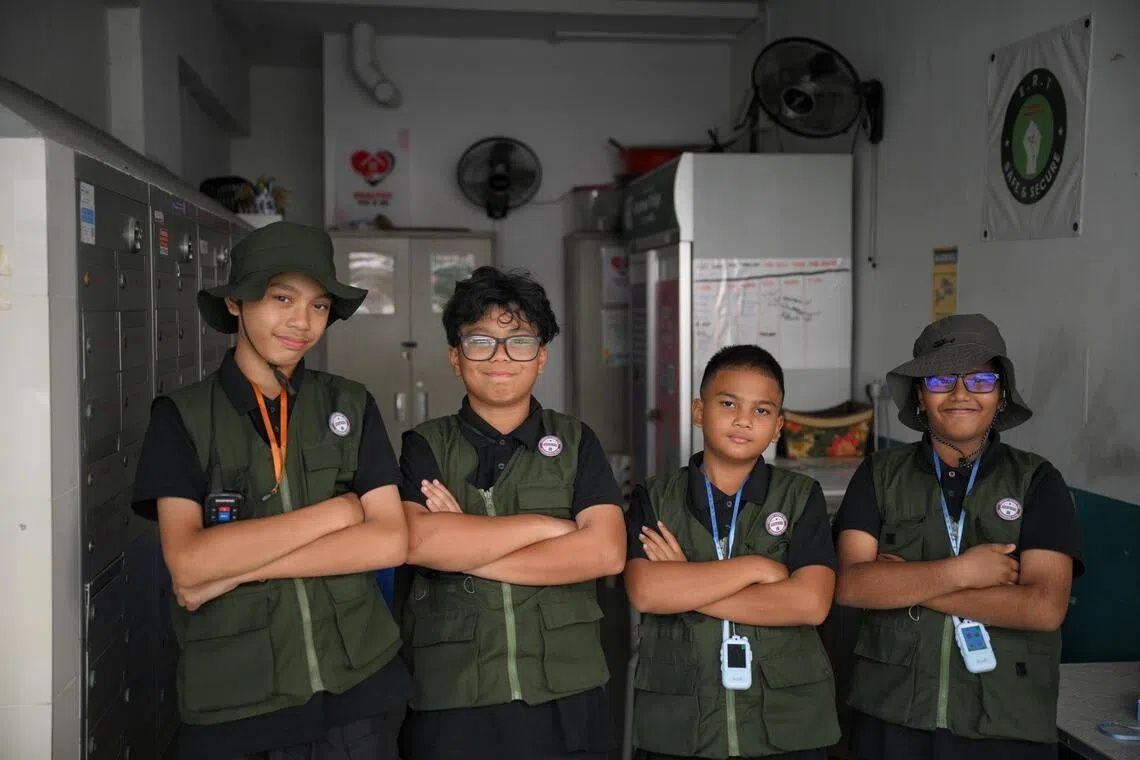
When twelve-year-old Rafieq Sahin Rafizal observed strangers repeatedly plundering the unlocked community refrigerator stocked with milk and drinks for underprivileged neighbourhood children in Lengkok Bahru, he resolved to take action. Rather than simply guard the fridge itself, his mother Marlina Yased proposed a more expansive vision: mobilise a group of young residents to monitor the entire neighbourhood. This modest idea has since blossomed into the Emergency Response Team LB, a volunteer patrol comprising four pupils from Gan Eng Seng Primary School, each between 11 and 14 years old, who now conduct daily rounds across their public housing estate.
The quartet—Rafieq, Aaron Sarandev aged 11, Al-Mirza Danish aged 12, and Didie Andiqa Muhaimin aged 14—operates with the discipline and purpose of far more experienced enforcers. Dressed in matching vests emblazoned with their names and organisational insignia, they traverse up to six blocks of their estate in pairs each afternoon following school, maintaining communication with Marlina and fellow volunteer Fahmidah Farihullah, 21, via walkie-talkie. Their vigilance extends across multiple dimensions of neighbourhood wellbeing: they document instances of indiscriminate dumping, acts of vandalism, and the dangerous practise of charging personal mobility devices in common areas—a fire risk that authorities have increasingly prioritised. Upon documenting concerns through photographs, the boys notify Marlina, who escalates matters to estate management for remediation.
Since commencing their regular patrols in August 2025, the team has transcended the narrow remit of property maintenance to become genuine community connectors. They have assisted an elderly resident with impaired mobility in conveying groceries to her residence and intervened to resolve conflicts amongst younger children. Their most harrowing contribution came earlier in 2026, when they detected an unpleasant odour emanating from a residential unit. Following Marlina's notification to estate cleaners and subsequent police involvement, authorities discovered the decomposed body of an elderly man within the flat—a discovery that underscores how youth presence and attentiveness can serve vulnerable populations in ways traditional oversight cannot.
The genesis of this neighbourhood initiative traces to Marlina's earlier establishment of the community fridge itself. In 2023, the 48-year-old homemaker, motivated by the financial hardship affecting numerous neighbours, launched the initiative with sponsorship support. Positioned at the void deck of her two-room rental flat at Block 59 Lengkok Bahru, the fridge operates with a dual-access system: essential groceries remain secured, whilst a separate unlocked unit contains complimentary milk and beverages for schoolchildren to consume before classes commence. Marlina's observation that some residents consumed the drinks themselves proved acceptable, yet the systematic emptying of the unit necessitated intervention. Her solution—redirecting youthful energy from passive guarding to active neighbourhood stewardship—reflects a sophisticated understanding of how young people require purposeful engagement.
Rafieq drew inspiration for the group's nomenclature from Singapore's Emergency Response Team, the police unit mobilised for high-risk incidents, deliberately modelling his neighbourhood initiative on professional emergency protocols. The Primary 6 pupil articulates the commitment with clarity beyond his years, stating that whilst recreation remains available perpetually, dedicating one hour daily to community service represents a meaningful allocation of his limited free time. For Didie, participation emerged from boredom transformed into purpose; he recognised that belonging to a structured project addressing tangible neighbourhood challenges provided genuine significance. Aaron, a Primary 5 student, has internalised lessons in responsibility and perseverance through daily patrols, particularly on occasions when fatigue tempts him to abandon his rounds yet he proceeds regardless.
The patrol team's composition has fluctuated since inception; the group originally numbered seven members but has stabilised at four, suggesting that sustaining youth volunteer commitment across multiple cohorts presents ongoing challenges. When not conducting patrols, the boys navigate the ordinary rhythms of primary school existence—completing homework and engaging in play—yet they have carved out a distinct identity within their housing estate. This role adjustment has produced measurable developmental outcomes observable to Marlina and the boys' families. Marlina notes discernible improvements in certain team members' school attendance and concentration spans, according to feedback from their mothers, indicating that purposeful community engagement correlates with enhanced academic engagement.
Community reception to the boys' activities has demonstrated interesting variation. While certain residents initially harboured scepticism regarding whether primary school pupils could meaningfully contribute to estate management, others have embraced their presence enthusiastically. Lengkok Bahru resident Nasha Asrin, 27, articulates a widely-held perspective that observing young people actively serving their neighbours represents a welcome alternative to youth loitering—a distinction that reflects broader anxieties about adolescent leisure time and social contribution. The boys' high visibility through their branded vests transforms them from incidental residents into recognisable community fixtures, fundamentally altering how established residents perceive youth agency within public housing contexts.
The trajectory of the Emergency Response Team LB extends beyond quotidian estate management into symbolic representation of Singapore's civic values. In August 2026, the four boys will participate in the National Day Parade as part of a dedicated segment honouring Singaporeans whose efforts strengthen the nation. For each team member, this represents their inaugural participation in the annual spectacle—an opportunity to position their neighbourhood initiative within Singapore's broader narrative of collective responsibility and social cohesion. The parade appearance transforms their localised mission into nationally-recognised service, validating their commitment whilst potentially inspiring comparable initiatives across other housing estates.
The broader implications of this initiative resonate particularly for Malaysia and the region, where public housing estates similarly grapple with maintenance, social cohesion, and youth engagement challenges. The Emergency Response Team LB demonstrates how intergenerational collaboration—specifically mobilising young people's energy and idealism whilst channelling parental wisdom and institutional knowledge—can address multiple community concerns simultaneously. Marlina's strategic reframing of youthful enthusiasm from passive guarding into active patrolling illustrates sophisticated community organisation principles: she recognises that sustainable social initiatives must address underlying motivations and provide genuine purpose rather than mere task assignment. The model suggests that housing estate management need not rely exclusively on formal authorities; rather, cultivating youth ownership of communal spaces and facilitating their structured participation can generate both practical benefits and profound developmental outcomes for young people themselves.

