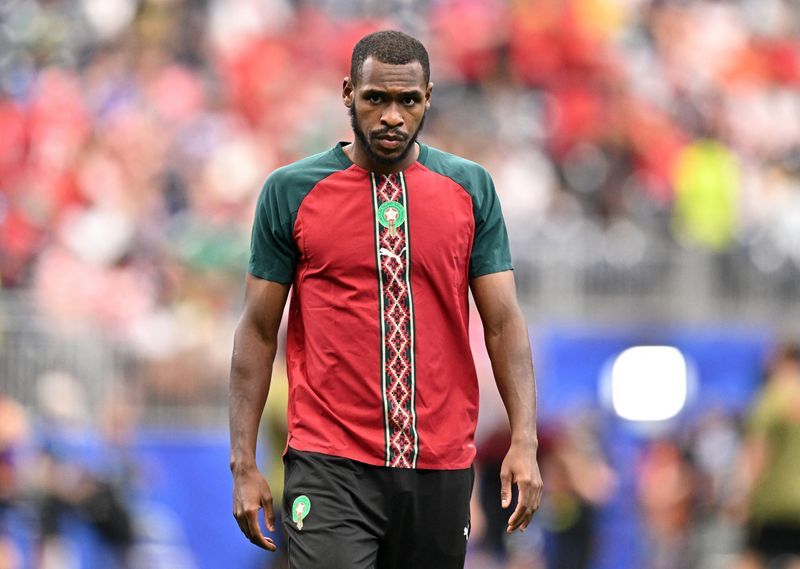
Moroccan centre-back Issa Diop finds himself at the centre of one of the World Cup's most compelling personal stories as his nation prepares to face France in Thursday's quarter-final contest. The 29-year-old's journey from emphatic France loyalist to integral member of Morocco's defensive unit represents a dramatic reversal that few could have predicted, transforming what might otherwise be a straightforward knockout fixture into a clash laden with subtext and intrigue. Diop's appointment as a key barrier against the French attack—and specifically against prodigious forward Kylian Mbappe—carries the weight of his earlier categorical rejection of Morocco's repeated overtures, making this assignment both a redemptive opportunity and a test of his commitment to his adopted nation.
Diop's connection to football spans continents and cultures. Born in Toulouse to a Senegalese father and Moroccan mother, he descended from footballing heritage; his grandfather ranked among Senegal's pioneering national team coaches. Yet despite these familial ties to West African football, the defender harboured singular devotion to France throughout his formative years. This commitment crystallised during his involvement with France's Under-21 programme seven years ago, when he articulated his position to Canal Plus with unambiguous clarity. "I am French," he declared. "I was born in France. France has given me everything. Joining another national team simply because I didn't make the French squad would be a bit hypocritical of me. It would be something of a default choice." Such categorical statements foreclosed any possibility of his representing Morocco or Senegal, seemingly closing the door on alternatives permanently.
The reversal came abruptly in March when Diop agreed to commit to Morocco's colours ahead of the World Cup campaign. His decision triggered considerable reaction across social media platforms, with observers noting the apparent contradiction between his earlier proclamations and his sudden willingness to don Morocco's shirt. Sceptics questioned his motivations and the authenticity of his attachment to his mother's homeland, framing the switch as mercenary rather than heartfelt. Yet coach Mohamed Ouahbi perceived something more genuine in Diop's commitment. The coach recognised in Diop "someone who is committed, who lives a somewhat Moroccan lifestyle and visits the country frequently," suggesting that beneath the surface pronouncements lay deeper cultural connections that Diop may not have fully articulated publicly.
Practical necessity accelerated Diop's integration into Morocco's setup. Captain Romain Saiss departed following January's Africa Cup of Nations, while defender Nayef Aguerd sustained injury in March, creating significant defensive vulnerabilities ahead of the tournament. Ouahbi moved decisively to recruit Diop as reinforcement, recognising that the eight-year Premier League veteran—having competed for both West Ham United and Fulham—possessed the calibre and experience required at international level. Diop made his debut in a March friendly against Ecuador and subsequently established himself as first-choice central defender alongside Crystal Palace's Chadi Riad, suggesting that Ouahbi's faith in the recruitment proved justified across Morocco's qualifying campaign.
Disp's contribution during the group stage and knockout rounds substantiated the coaching staff's confidence. Most dramatically, he provided the pivotal moment that kept Morocco alive in the round-of-32 encounter against the Netherlands, when his stoppage-time header from Chemsdine Talbi's cross equalised a seemingly lost fixture. "I went forward, I don't know what I was doing there, it was the end of the match. I tried to find some space and scored," Diop reflected with characteristic understatement about the goal that forced extra time and ultimately delivered victory on penalties. The equaliser transcended its immediate sporting significance; it erased much of the lingering resentment about his late-stage international switch, transforming perceptions within Morocco and among global observers who recognised the moment as a turning point in both the match and his own narrative arc.
Ouahbi's perspective on moving forward reflects pragmatism rather than dwelling on the defender's earlier statements. "We shouldn't dwell too much on the past but rather focus on what lies ahead," the coach stated. "What matters most is his attitude on the pitch. I am certain he will be a very positive influence for Morocco and we've welcomed him with open arms." This measured stance acknowledges without dwelling upon the awkwardness of Diop's conversion, instead emphasising performance and commitment as the criteria for evaluation. For Malaysian audiences familiar with domestic football dynamics involving naturalised players, the situation carries resonance—debates about loyalty, authenticity, and selection of foreign-born players recur regularly within regional football circles.
Thursday's challenge against France elevates Diop's personal narrative into international significance. Tasked with neutralising Mbappe—arguably the tournament's most dangerous attacking force—Diop must demonstrate that his pledged commitment to Morocco transcends convenient circumstance. The irony runs deep: the player who seven years ago declared that joining Morocco would constitute a "default choice" now must perform heroically against his nation of birth to advance his adopted country's World Cup campaign. Success would vindicate both his decision and Morocco's faith in recruiting him despite the controversial circumstances; failure would invite renewed scrutiny about whether his motivations aligned with genuine footballing commitment or merely expedient timing.
For Morocco, Diop's performance carries implications extending beyond individual defensive matchups. The nation's ambition of reaching back-to-back World Cup semi-finals depends substantially upon a resilient defensive foundation that frustrates French attacking intent. If Diop performs with distinction against Mbappe and his supporting cast, he completes a redemptive arc that resonates far beyond football—a narrative of reinvention, cultural reconciliation, and redefinition of identity through commitment and performance. Conversely, should defensive vulnerabilities emerge, observers will retrospectively question the wisdom of late recruitment and the coherence of Morocco's tactical preparation. Either outcome contributes significantly to the quarter-final's unfolding drama.

