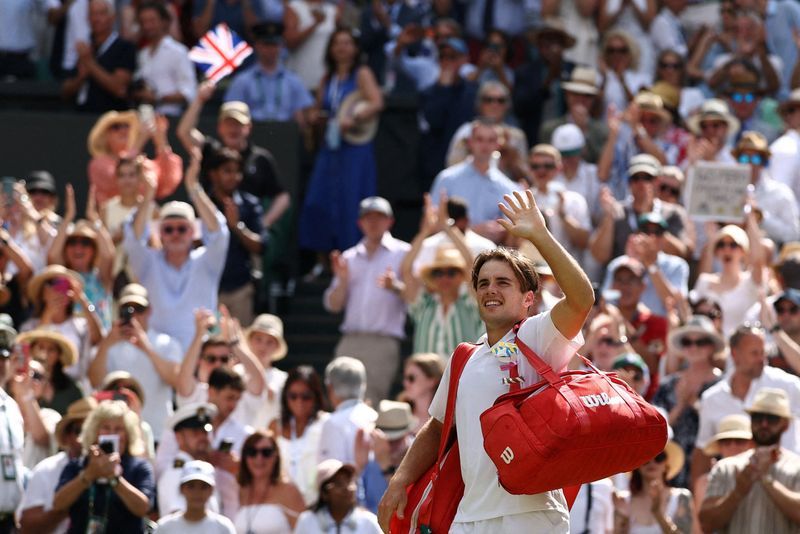
Arthur Fery's remarkable journey at Wimbledon this summer represents one of professional tennis's most improbable fairy tales, a narrative that has captivated the British public and redefined expectations for a player who merely weeks ago would have seemed destined for a low-profile summer break. The 23-year-old British player, languishing at 114th in the world rankings, had planned to trade his tennis whites for beach attire in Greece during July, a sensible respite for a journeyman professional whose career had shown modest progress at best. Yet his extraordinary run through the Wimbledon draw, eliminating five opponents in succession, transformed those vacation plans into an afterthought and thrust him into the semi-final stage—a milestone only fractionally less surprising than if he had won the tournament itself.
The statistical improbability of Fery's achievement cannot be overstated. Before arriving at the All England Club as a wildcard entrant, he had accumulated merely two career victories across all Grand Slam tournaments combined, a record that would ordinarily consign a player to anonymity outside specialist tennis circles. His ranking of 114th placed him nowhere near the elite tier of players who typically populate Wimbledon's later rounds, and tournament organisers certainly did not anticipate that their wildcard selection would metamorphose into a genuine contender. The last wildcard to accomplish what Fery has managed was a quarter-century ago, a drought that underscores just how exceptional his performance has been across the ten days of competition leading to his semi-final appearance.
The human interest angle proved irresistible to British audiences, particularly given Fery's status as a homegrown talent competing on his nation's most prestigious sporting stage. His progress through the tournament garnered increasingly fervent support, eventually attracting the attention of celebrities and dignitaries who might ordinarily ignore early-round matches played under the Wimbledon sun. The England football team, still basking in memories of their World Cup aspirations, sent a video message of encouragement, while Queen Camilla and Princess Kate made appearances in the stands to witness his matches firsthand. This convergence of support reflected something deeper than merely appreciating a good underdog story; it represented the collective investment of a nation in one of its own athletes, a phenomenon that elevates even modest achievements into moments of genuine national significance.
Fery himself has maintained a refreshingly candid perspective throughout his unexpected elevation, displaying none of the defensive bravado that sometimes accompanies sudden fame. When discussing his abandoned Greece holiday, he revealed that one particularly pessimistic friend had travelled ahead to the Mediterranean, apparently confident that Fery's elimination would free up valuable vacation time. The friend's subsequent return to England two days later, when Fery's victories continued accumulating, became something of a running joke—a reminder that even those closest to him harboured doubts about his capacity to sustain such an improbable run. His willingness to share such anecdotes has endeared him to the public, presenting a personality far removed from the polished, media-trained athletes who populate professional tennis's upper echelons.
Although Alexander Zverev terminated Fery's semi-final ambitions in straight sets on Friday, the German's victory altered nothing regarding the transformative nature of Fery's tournament experience. The ranking boost he will receive—projected to catapult him into the mid-30s—represents far more than mere numerical advancement; it constitutes a fundamental restructuring of his professional opportunities. Players outside the top 50 typically face severe constraints in accessing tour-level events, remaining dependent on qualifying rounds or wildcard invitations that gatekeepers dispense sparingly. Fery's new ranking bracket will grant him direct entry to tournaments throughout the men's professional circuit, opening doors that remained hermetically sealed during his previous career trajectory.
The financial windfall accompanying his semi-final appearance—£900,000, or approximately $1.21 million in US currency—transcends the typical prize money considerations that dominate professional sports narratives. For a player of Fery's previous standing, such a sum likely represents more than his total career earnings combined, immediately transforming his capacity to invest in training facilities, coaching staff, and the infrastructure necessary to compete at elevated levels. Moreover, this financial security provides breathing room that many aspiring athletes never experience, permitting him to focus on tennis development rather than desperately pursuing sponsorship deals or supplementary income streams that often distract less established professionals.
Fery's own reflections on the demands ahead demonstrate surprising maturity and self-awareness regarding the psychological dimensions of sudden prominence. He acknowledges the substantial challenge of managing the expectations that now attach to his name—expectations emanating from himself, from an increasingly invested public, and from the professional establishment that has suddenly taken notice of his existence. The transition from obscurity to visibility introduces pressures that transcend simple technical tennis concerns; they involve managing psychological state, maintaining perspective, and navigating the amplified scrutiny that accompanies any upward trajectory in sport. His recognition of these dynamics suggests that he possesses the emotional intelligence necessary to sustain rather than squander the opportunities his Wimbledon breakthrough has created.
The United States hardcourt season beckons as the next testing ground for Fery's credentials, with his impending debut at the US Open representing another significant milestone. The transition from Wimbledon's grass courts to America's hard surfaces presents a distinct technical challenge, requiring adaptation in movement patterns, stroke mechanics, and tactical approaches. Yet Fery approaches this prospect with the same thoughtful optimism that characterised his Wimbledon campaign, viewing the rigours of major championship competition not as burdensome but as an opportunity to validate his newfound status across diverse surfaces and competitive environments.
For Malaysian and Southeast Asian observers, Fery's trajectory carries particular resonance within the broader context of tennis development in the region. His rise demonstrates that breakthrough performances at the sport's highest level remain possible even for players from comparatively modest backgrounds, a message that carries implications for tennis federations and young athletes throughout Asia. The notion that sustained excellence at professional tennis requires neither consistent top-ranking status nor childhood grooming in privileged academies offers encouragement to emerging players in nations where such infrastructure remains limited or unevenly distributed. Fery's example suggests that preparation, opportunity, and performance, when properly aligned, can overcome substantial systemic disadvantages.
His immediate priority involves recuperation and psychological consolidation before launching into the demanding schedule that now stretches before him. The intensity of competing at Wimbledon's pace, combined with the emotional and mental toll of managing expectations across ten consecutive days, necessitates deliberate recovery and reflection. Fery plans to use this period processing the astonishing transformation his career has undergone, affording himself the space to absorb what has transpired before redirecting his focus toward the sustained excellence that will determine whether his Wimbledon breakthrough becomes a career-defining moment or merely an isolated bright spot in an otherwise undistinguished professional narrative.

