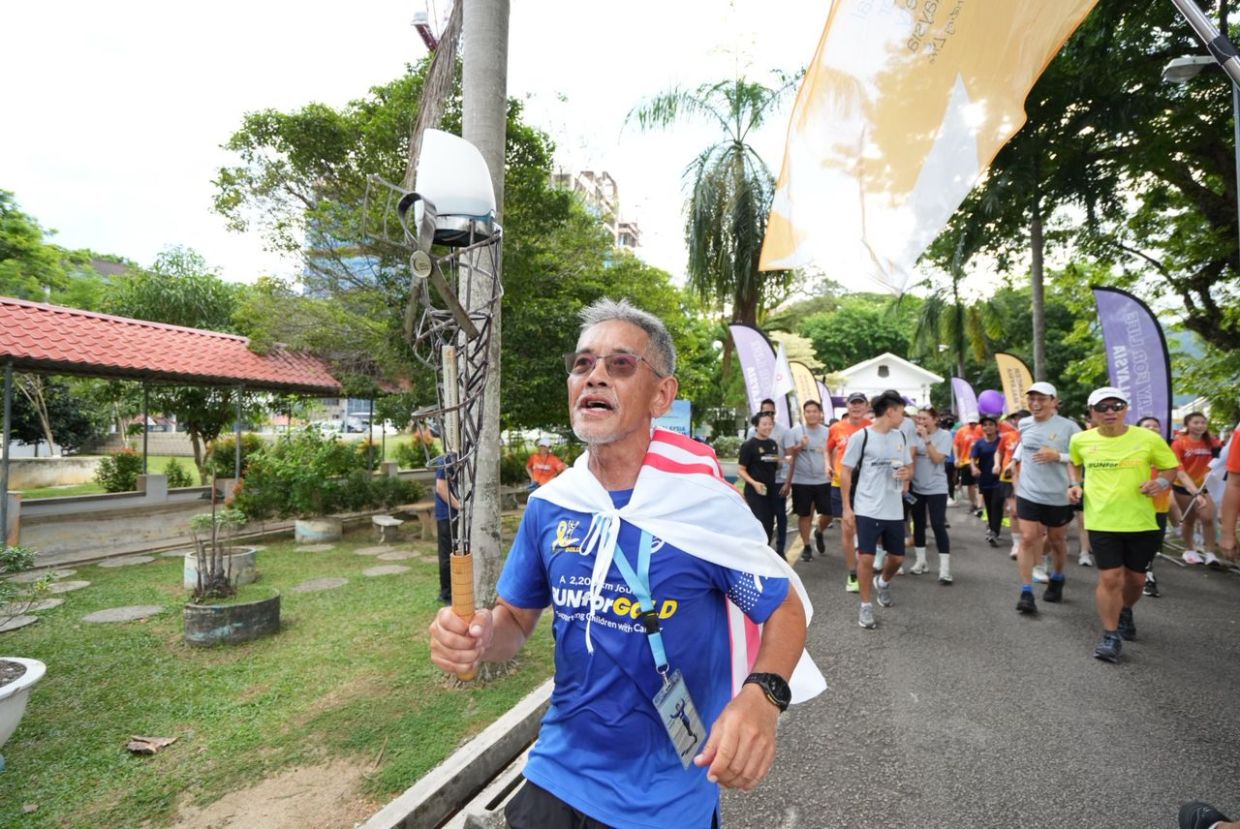
When SG Lim turned 66, retirement offered the conventional promise of leisure and rest. Instead, the retired civil engineer from Penang found himself grappling with an unexpected void. His wife of decades, Goh Joo Lee, succumbed to cancer in 2024 at just 63 years old, leaving him to navigate a world fundamentally altered. Rather than seeking solace in stillness, Lim embarked on a path that would test his physical endurance while honouring her memory through purposeful action.
In the immediate aftermath of his loss, Lim distributed his time across continents and relationships—weeks in Australia with his two children, stretches in Malaysia reconnecting with his mother and siblings, and solitary retreats in Hong Kong for reflection. Yet these geographical shifts could not fill the emptiness left behind. When describing his wife, Lim's vocabulary crystallises around two qualities that defined her existence: loving and caring. Beyond mere sentiment, these were characteristics manifest in concrete acts. Even as she lay hospitalised and battling her own mortality, Goh remained preoccupied with the welfare of others. Lim recalls witnessing her compassion extend to a fellow cancer patient in an adjacent hospital ward, a woman she had never met before their illness created proximity. His wife's concern transcended personal struggle, a testament to the depth of character that now lived only in memory.
Goh's creative spirit provided additional dimensions to his recollection. She cultivated an artistic practice centred on drawing, painting, and handmade creations that she shared across social media platforms. These digital artefacts have become precious anchors to her presence, allowing Lim periodic access to the tangible evidence of her imagination and skill. The convergence of her compassion and creativity formed the emotional substrate from which Lim's subsequent journey would emerge.
Transforming grief into purpose required external catalyst. Reading a book by Laurence Carter sparked an idea within Lim—the possibility of running or walking across Peninsular Malaysia, a physical journey that would convert personal suffering into collective benefit. He reached out directly to Carter for guidance, grounding his ambitious concept in the wisdom of someone who had already attempted similar ventures. This consultation proved pivotal, providing both validation and practical perspective for the undertaking ahead.
The National Cancer Society Malaysia adopted Lim's initiative, christening it "Run For Gold" and aligning his personal mission with institutional infrastructure focused on supporting children diagnosed with cancer. The naming carried deliberate symbolism, elevating both the financial goal and the human value at stake. What began as one man's grief management transformed into an organised campaign with explicit objectives: to amplify awareness surrounding childhood malignancy and to mobilise resources that could directly support affected families navigating treatment protocols and emotional upheaval.
Preparing for this ambitious crossing demanded rigorous conditioning. Following his completion of the Sydney Marathon in August, Lim redirected his training focus toward the specific demands of sustained terrestrial running across varying Malaysian terrain and climate. He restructured his daily rhythm, committing to 5am wake-ups that replicated the early starts his journey would require. Deliberate exposure to peak midday heat steeled him against the environmental challenges awaiting on Malaysian roads. Concurrent strength training sessions fortified his musculature against the cumulative stress of thousands of kilometres. Beyond physical preparation, Lim acquired technical competency, teaching himself video editing to document his odyssey on social media, thereby extending the reach of his narrative beyond his physical presence.
The experiential dimension of the journey proved equally transformative. His first encounter with the paediatric oncology ward organised by NCSM crystallised the moral weight of his undertaking. Observing children rendered fragile by disease and parents hollowed by helplessness infused his exertion with profound purpose. He was no longer simply moving his body across distance; he was bearing witness to suffering while channelling his own pain toward alleviation. Encounters with strangers along the route reinforced this reciprocal dynamic. A retired teacher and his wife materialised during Lim's passage through Pekan in Pahang, drawn by his cause. Rather than merely spectating, they became active participants, running alongside him across multiple state lines and deliberately entering local establishments to evangelize the mission to shopkeepers and patrons. Their partnership embodied the collaborative spirit that Lim's enterprise cultivated.
These spontaneous fellowships held particular poignancy for Lim, who observed in the teacher and his wife a relational tenderness that resurrected longing for his departed companion. The couple's mutual devotion and coordinated support mirrored the partnership he had lost, a bittersweet reminder of what motivated his entire endeavour. Yet witnessing such love in others paradoxically affirmed rather than diminished his commitment. Their presence demonstrated that compassion remains operative in the world, that strangers mobilise on behalf of abstract others, that his wife's character was not anomalous but part of a broader human capacity for caring that transcends kinship and proximity.
After nearly three months traversing 11 states and federal territories and covering 2,200 kilometres, Lim crossed the finish line in George Town, his native Penang. The culmination of this physical odyssey occurred not in private triumph but in a flood of recognition. Family, friends, school contemporaries, and complete strangers converged to celebrate his arrival. Yet in that moment of accomplishment, his consciousness centred not on the assembled crowd but on the absent figure whose memory propelled every stride. His first utterance—"Darling, we made it!"—collapsed temporal boundaries, addressing his late wife as though she occupied the space beside him, which in the most meaningful sense she did.
The journey's significance transcended individual catharsis. By channeling personal bereavement into institutional support for childhood cancer patients, Lim demonstrated how private anguish might generate public good. His endeavour illustrates a particular Malaysian narrative strand wherein individuals transform tragedy into collective action, mobilising social networks and geographic traversal as vehicles for advocacy. In doing so, Lim's "Run For Gold" stands as testimony to human resilience and the enduring power of love to animate meaning even after mortality has severed its immediate object. For Malaysian readers and Southeast Asian observers, his story illuminates how grief, properly harnessed, becomes not mere emotion to be overcome but fuel for transformation that extends far beyond the individual sufferer.
The completion of his marathon across Peninsular Malaysia represents merely a waypoint rather than an endpoint. The funds raised and awareness amplified constitute measurable outcomes, yet the deeper significance lies in how Lim has modelled a particular response to loss—one that refuses mere survival and instead seeks to transfigure personal catastrophe into structural support for others navigating similar terrain. His late wife's character persists not merely in nostalgic recollection but in the tangible institutional support now flowing toward children battling the disease that claimed her.

