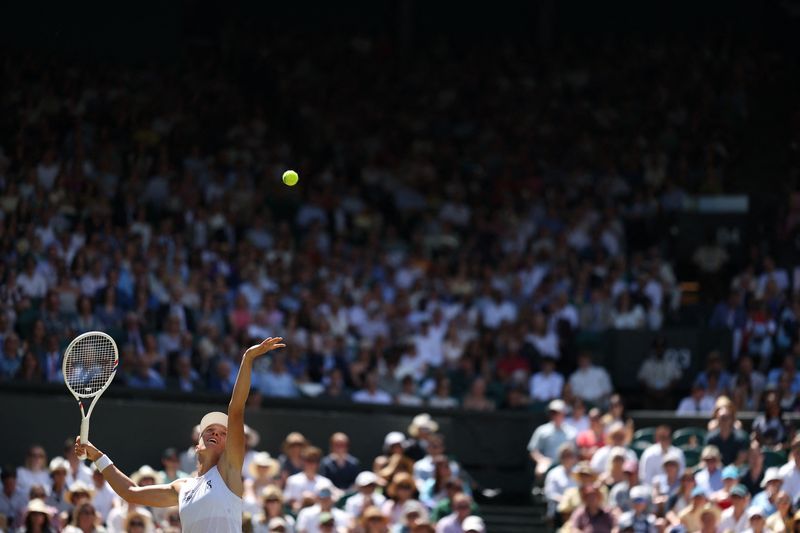
Alexandra Eala's Wimbledon breakthrough came at the expense of one of the sport's most accomplished players. The ascending Filipino star dismantled Polish third seed Iga Swiatek in a thrilling third-round encounter at the All England Club on Saturday, securing a 7-6(9) 6-2 victory in front of a captivated Centre Court audience. The result eliminated the previous year's champion from the competition and propelled Eala into the second week of a Grand Slam tournament—a milestone that represents a watershed moment in her career trajectory.
Swiatek arrived at London's venerable grass courts seeking to build momentum following her maiden Wimbledon triumph twelve months earlier, yet her path through the fortnight proved considerably more treacherous than anticipated. The 25-year-old Polish player had stumbled unexpectedly at Bad Homburg in the lead-up to the Championships, and while she had mounted assured performances against Taylor Townsend and Karolina Pliskova in earlier rounds, consistency remained elusive on a surface that had long challenged her competitive credentials. Against the relentless court coverage and athleticism of Eala, however, Swiatek's typically formidable game unraveled in dramatic fashion.
The opening set epitomised the intensity of the contest, with neither competitor yielding advantageous ground to the other. Eala's powerful baseline repertoire subjected Swiatek to sustained pressure from the earliest exchanges, generating the kind of directional precision and depth that prevented the defending champion from establishing her preferred rhythm. The tie-break proved decisive in this extended opening salvo, with Eala clinching the set through superior execution under pressure. Though Swiatek managed a fractional smile at the set's conclusion, frustration soon manifested in sharper ways—animated exchanges with her coaching team and a racket struck against a courtside chair signalling mounting exasperation at her inability to control the match's narrative.
Eala's momentum proved irresistible once the second set commenced. The left-handed Filipino constructed a commanding 3-0 lead through aggressive returning and opportunistic break conversions, momentarily appearing poised to cruise toward a straightforward victory. Yet Swiatek, her competitive instincts activated by the jeopardy confronting her tournament, engineered a recovery that brought her within a break of parity. The rally proved temporary, however, as Eala successfully weathered the comeback attempt and ultimately sealed the victory with a striking forehand placement that left no doubt about the superior authority she had demonstrated throughout the afternoon.
For Eala, the magnitude of her achievement transcended the mere scoreline. In her post-match reflection, an emotionally charged Eala articulated the personal significance this breakthrough represented—not merely as a professional athlete, but as a competitor whose formative years embodied the provincial dedication and sacrifice characteristic of players developing their craft without the infrastructural advantages available in more established tennis nations. She referenced the elementary apparatus of her childhood training: the mismatched socks and illuminated shoes that accompanied daily practice sessions with family members following school, the embodiment of determined resourcefulness in pursuit of excellence. For a player whose entire career has unfolded within the comparative disadvantages of Philippine tennis infrastructure, reaching the second week of a Grand Slam tournament while vanquishing a recent major champion represents validation of an ambition that had seemed audacious when measured against conventional pathways to tennis prominence.
Eala's reflections on her achievement balanced genuine gratitude with undiminished competitive hunger. She acknowledged the psychological weight of competing against Swiatek—an athlete whose trophy cabinet encompasses numerous Grand Slam victories—while simultaneously recognising that her childhood context made this particular achievement something approaching transcendent. The enthusiasm emanating from the Centre Court crowd undoubtedly amplified this emotional crescendo, as spectators responded warmly to the underdog narrative and Eala's evident appreciation for the privilege of competing on tennis's most prestigious stage. However, she was careful to subordinate sentiment to purpose, dismissing the notion that reaching the second week might constitute satisfaction, and instead framing it as a waypoint in her competitive journey rather than a destination.
The path that delivered Eala to this spectacular upset illuminates the broader dynamics of professional tennis at the highest levels. Their previous encounter in Miami had resulted in an Eala victory, yet Swiatek claimed revenge when they subsequently met on the clay courts of Madrid—a sequence that underscores the volatility inherent in matchups between competitors at proximate levels of accomplishment. Grass courts, however, distinctly favour players whose game combines explosive power generation with superior court movement, attributes that evidently suited Eala's style considerably more effectively than her opponent's preferred clay-based approach. The surface transformation created tactical circumstances that partially neutralised Swiatek's most potent weapons while simultaneously amplifying the effectiveness of Eala's aggressive baseline artillery.
Eala's progression into the fourth round has established a meeting with 2024 runner-up Jasmine Paolini, presenting another examination of her capacity to sustain her elevated performance level against opponents of unquestionable top-tier credentials. The trajectory of this tournament demonstrates that her Wimbledon breakthrough extends beyond mere upset victory; rather, it represents the emergence of a competitor whose development has reached a threshold where victories over celebrated opponents appear increasingly plausible rather than exceptional occurrences.
For Malaysian and broader Southeast Asian tennis audiences, Eala's achievement carries particular resonance as evidence that elite professional tennis success remains attainable for competitors emerging from the region's developing tennis infrastructure. Her advancement demonstrates that sustained investment in skill development, combined with exposure to international competition, can produce performers capable of defeating established global stars on sport's grandest stages. The narrative of her childhood training regimen—conducted within modest circumstances—offers inspiration to young players throughout the region whose aspirations exceed the apparent limitations of their immediate environments.

