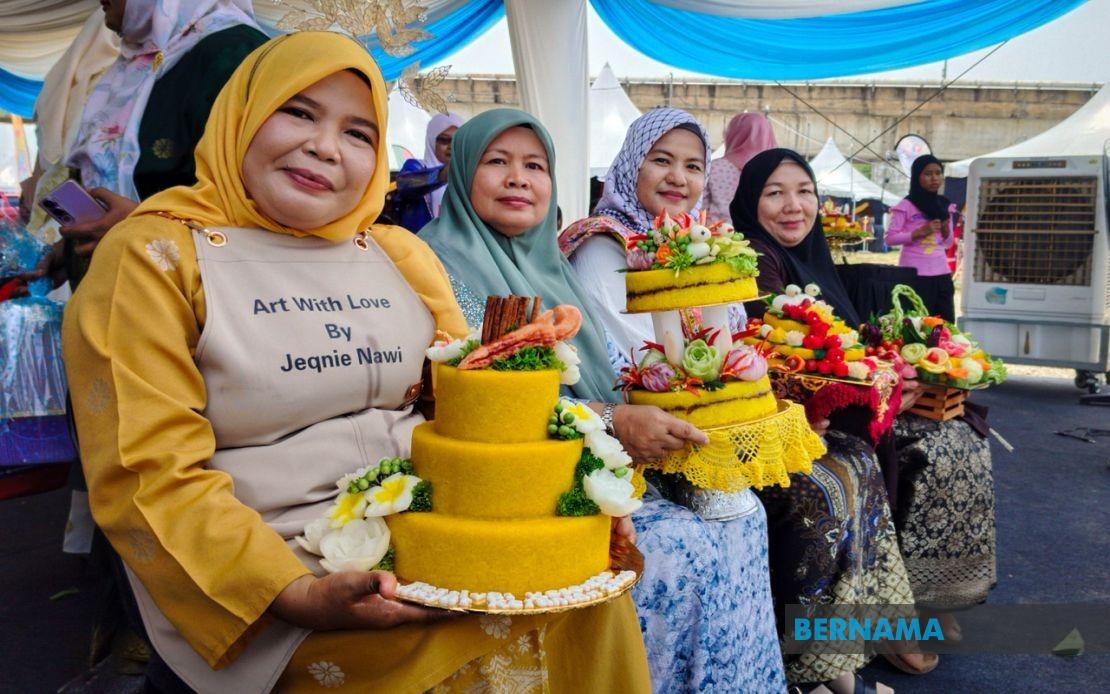
Nortiny Nawi's journey from corporate employment to culinary entrepreneurship offers an inspiring glimpse into how Malaysians are leveraging traditional food craftsmanship to build sustainable livelihoods. Four years after stepping away from her position as a resort marketing officer, the 46-year-old has established a flourishing pulut kuning arrangement business operating from her home in Kampung Gong Cokoh, Pasir Puteh, Kelantan, now generating income that rivals and exceeds her previous salary.
The transition from marketing to food artistry was not precipitous. During her resort employment, Nortiny spent her spare moments observing professional chefs at work, gradually nurturing an interest in cooking that had germinated during her teenage years. This patient cultivation of skill and knowledge proved essential when she eventually decided to pursue her passion full-time. Rather than treating the shift as a risky gamble, she had already invested years of informal apprenticeship before making the formal leap into self-employment, a calculation that has clearly paid dividends.
Today, her decorative pulut kuning creations command prices ranging from RM100 to RM280 per arrangement, with the variation reflecting both the weight of the glutinous rice used and the intricacy of the design. This pricing structure positions the products within the premium segment of traditional Malay cuisine offerings, suggesting that consumers view her creations as luxury items suitable for special occasions rather than everyday consumption. Her customer base extends across Kelantan and encompasses individuals planning celebratory events, educational institutions, and government departments—a diversified portfolio that insulates her business against seasonal fluctuations in domestic demand.
The recent recognition at the Kelantan Folk Arts Festival underscores the artistic dimension of her work. Her prize-winning entry featured an eight-kilogramme pulut kuning arrangement embellished with elaborate floral carvings fashioned from white radish. This achievement validates the quality of her craftsmanship while providing valuable marketing exposure within a state where traditional food arts carry cultural significance. Such festival appearances function as de facto certification, signalling to potential customers that her work meets recognized standards of excellence.
Operating at near-capacity, Nortiny manages up to six orders daily when design complexity permits. This production ceiling reflects both the technical demands of her craft and the physical limitations of her current home-based setup. Unlike baked goods that can be prepared in advance and refrigerated, pulut kuning requires a precise production schedule aligned with delivery dates. She typically begins work at 3 am, steaming the glutinous rice before subjecting it to a series of labour-intensive processes—kneading, cooling, and hand-shaping into decorative forms. This time-sensitive production model explains her capacity constraints and justifies her stated intention to relocate to larger premises as demand continues climbing.
The business model demonstrates how traditional Malaysian culinary knowledge can be commodified without industrialization or loss of artisanal character. Nortiny maintains direct engagement with customers, accepting personalized requests and executing bespoke designs rather than producing standardized products. This customization-centric approach commands premium pricing while building customer relationships that encourage repeat business and word-of-mouth referrals. The near-daily booking pattern she reports suggests that market demand substantially exceeds her current supply capacity, a position that few small enterprises enjoy.
For Kelantan specifically, Nortiny's success story carries implications for rural economic development and women's entrepreneurship. The state has historically relied on agricultural production and light manufacturing, with service sectors remaining underdeveloped outside major urban centers. Home-based food businesses offer a pathway for rural residents, particularly women balancing family responsibilities with income generation, to monetize traditional skills without requiring significant capital investment or geographic relocation. The success of Nortiny's venture demonstrates the economic viability of this model within contemporary Malaysian consumer markets.
The psychological dimension of her narrative warrants emphasis. Despite the physical demands of rising at 3 am and working through labour-intensive production cycles, she attributes her perseverance to passion rather than economic necessity alone. Customer appreciation and the opportunity to refine her craft provide intrinsic motivation that sustains engagement with work that is repetitive and physically demanding. This alignment between personal satisfaction and commercial success creates a business that is resilient to the burnout that often accompanies small-enterprise ownership.
Looking forward, Nortiny's expansion plans hinge on securing larger premises while maintaining the artisanal production standards that distinguish her offerings. Scaling production while preserving quality represents the classic challenge facing craft-based businesses. Premature expansion could dilute the craftsmanship that generates her premium pricing, while failure to expand constrains revenue growth and leaves customer demand unmet. Her awareness of this tension suggests a thoughtful entrepreneurial approach rather than simple growth-at-all-costs mentality.
The broader narrative illustrates how individuals can construct viable careers from cultural traditions in an era when many assume globalization necessarily erodes locally-rooted practices. Pulut kuning carries deep cultural significance within Malay-Muslim traditions, yet Nortiny has successfully positioned it within contemporary consumer culture as a luxury product for modern celebrations. This cultural translation—maintaining authenticity while adapting to present contexts—represents sophisticated entrepreneurial thinking. Her achievement offers a model for other Malaysians exploring how heritage crafts and culinary traditions might generate sustainable income in the twenty-first century economy.

