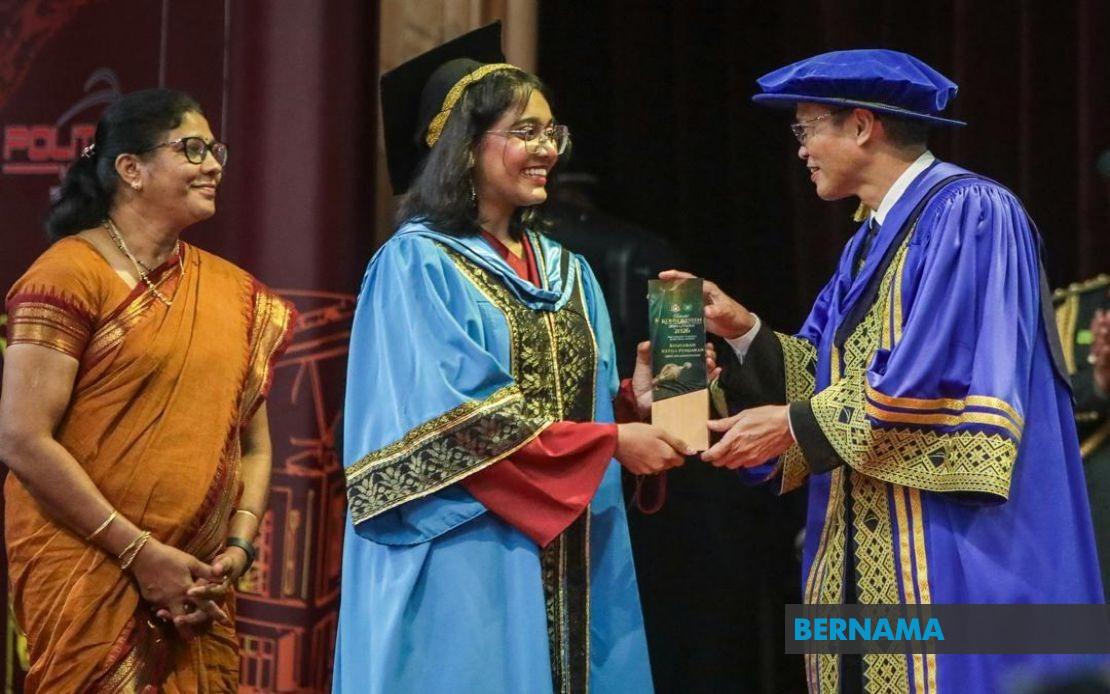
Teerti Ganapathi Rao's achievement at Politeknik Tuanku Syed Sirajuddin represents a powerful testament to resilience in the face of profound personal tragedy. The 22-year-old diploma graduate in Digital Technology, affiliated with the Department of Information and Communication Technology (JTMK), received both the Director-General's Award and the Academic and Co-Curricular Excellence Award during the first session of the 2026 Northern Zone Polytechnic and Community College Convocation Ceremony held at the institution in Arau, Perlis. What makes her accomplishment particularly striking is the circumstances under which she pursued her studies—her father passed away while she was sitting for her Semester Two examinations in 2023, a moment that could have derailed her academic journey entirely.
The convocation ceremony, which runs through August 9, saw the Raja of Perlis, Tuanku Syed Sirajuddin Jamalullail, gracing the occasion. The event brought together 6,104 graduates from polytechnics and community colleges across Perlis, Kedah and Penang. Teerti's selection among these thousands of graduates underscores the exceptional nature of her academic performance and contribution to campus life. She concluded her three-year programme with a cumulative grade point average of 3.61, a strong indicator of consistent excellence across her coursework and assessments.
When informed of her selection for the prestigious awards, Teerti expressed genuine surprise and gratitude. She noted in an interview following the ceremony that she had not anticipated receiving such recognition, particularly given the emotional and psychological burden she carried during crucial examination periods. Her response reflects both humility and the weight of the personal struggles she navigated throughout her studies. The acknowledgement from the institution validated her determination to succeed despite circumstances that would have provided legitimate justification for withdrawal or deferment.
Central to Teerti's perseverance was the philosophical and emotional support provided by her late father. As the youngest of four siblings, she relied heavily on his counsel, particularly during moments of doubt about continuing her education. She had initially considered enrolling in a foundation programme rather than pursuing a full diploma, a path that would have extended her time in higher education. Her father's consistent encouragement to complete the diploma degree became the anchor that sustained her through loss and grief. This paternal guidance, even in his absence, shaped her decision-making and provided her with an internal compass during disorienting periods.
Beyond raw academic metrics, Teerti distinguished herself through active involvement in campus leadership and institutional service. She served as a member of the Student Representative Council, where she developed crucial competencies in communication, teamwork and leadership. These roles extended beyond ceremonial positions; they reflected genuine engagement with the polytechnic community. Additionally, she received the Head of Department's Award in four separate semesters—Semesters One, Three and Four—demonstrating sustained excellence rather than isolated high performance in a single term.
Teerti's intellectual interests extended into research and practical application of her field. She represented Politeknik Tuanku Syed Sirajuddin in a collaborative programme and presented seminar papers at Universiti Putra Indonesia, contributing to scholarly discourse within her discipline. Her final-year project, the Koop Printing System, showcases applied problem-solving oriented toward institutional improvement. This system was specifically designed to enhance the efficiency of cooperative printing service management, translating theoretical knowledge into practical solutions with tangible operational benefits.
Language proficiency constitutes another dimension of Teerti's intellectual development. Beyond her fluency in Bahasa Melayu and English, she possesses working competency in Mandarin, Tamil and Telugu, reflecting her cultural awareness and commitment to cross-cultural communication. She has also developed foundational understanding of French, Japanese and Korean. This linguistic breadth positions her advantageously for careers that demand international collaboration or regional engagement, increasingly important in a globalised technology sector.
Teerti's trajectory into information technology emerged from an unconventional origin point. Her interest in the field crystallised at age 16 following exposure to computers and coding through friendships formed via video gaming communities. This entry point—far from traditional institutional pathways—demonstrates how contemporary technological careers can be discovered and pursued through informal social networks. Her perspective on the field is pragmatic; she acknowledges the inherent challenges but emphasises the importance of foundational understanding and incremental skill development. This measured approach contrasts with narratives that romanticise technical professions as inherently difficult or inaccessible.
Looking forward, Teerti is pursuing further academic advancement through applications for Bachelor's degree programmes in Information Technology. She has selected Universiti Malaya as her first choice, a strategic decision reflecting the institution's standing and programme reputation. Her ambitions extend beyond undergraduate study; she has articulated aspirations to eventually complete a Doctor of Philosophy degree, positioning herself for advanced research or leadership roles within the technology sector. This multi-stage educational pathway demonstrates strategic long-term planning and commitment to continuous intellectual development.
For Malaysian polytechnic education, Teerti's success illustrates the sector's capacity to produce graduates capable of competing within rigorous higher education environments and knowledge-intensive industries. Her achievement also highlights the institution's role in providing pathways for students facing adversity. The recognition awarded to Teerti by PTSS leadership sends a meaningful message that personal circumstances, however challenging, need not determine educational outcomes when institutional support and individual determination align. Her story carries particular resonance for Malaysian students navigating grief, loss or other personal challenges while pursuing technical qualifications in an increasingly competitive global landscape.
The broader context of her achievement extends into discussions about equity and access within Malaysia's technical education ecosystem. Politeknik institutions serve students across diverse socioeconomic backgrounds, often providing crucial alternatives to university-track pathways. Teerti's accomplishments suggest that high-achieving students within the polytechnic system can seamlessly transition into advanced degree programmes and competitive professional fields. As Malaysia positions itself as a technology-driven economy requiring skilled IT professionals, graduates like Teerti represent the human capital foundation upon which such ambitions depend.
Teerti's journey also speaks to the importance of institutional cultures that recognise and reward holistic development. Her awards acknowledged both academic excellence and co-curricular contribution, reflecting an understanding that graduate competency encompasses leadership, communication and civic engagement alongside technical mastery. This comprehensive approach to student development aligns with employer expectations in technology sectors increasingly seeking professionals with soft skills and collaborative capabilities alongside technical expertise. As she transitions toward university-level studies and eventual professional practice, Teerti carries forward both the credentials and the character formed through her polytechnic experience.

