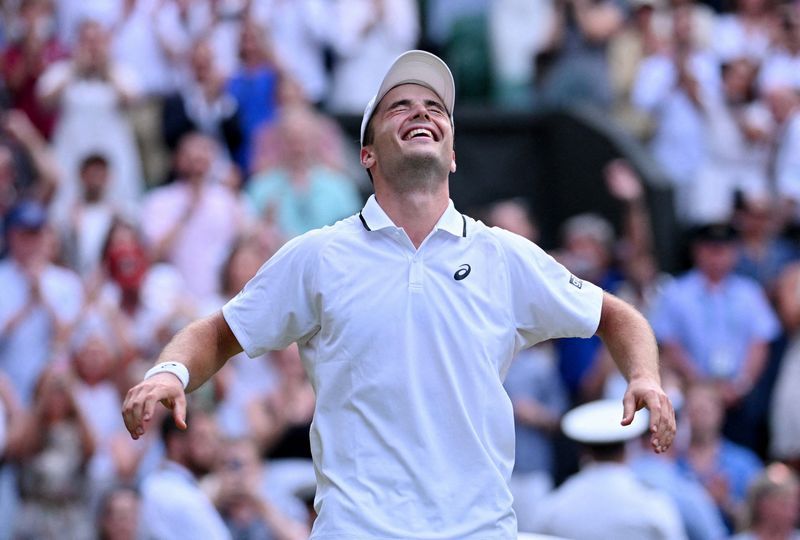
Arthur Fery's path to the Wimbledon semi-finals reads like a Hollywood screenplay that studio executives might dismiss as too implausible for audiences to accept. The 23-year-old British player, who grew up within walking distance of Centre Court and entered the tournament as a wildcard with just two previous Grand Slam match victories to his name, has already beaten the odds by reaching Friday's semi-final against French Open champion and second seed Alexander Zverev. Should Fery pull off what would be a monumental upset, he would play in Sunday's final on his 24th birthday, giving him the opportunity to join the exclusive company of Goran Ivanisevic as only the second wildcard entry to claim the Wimbledon singles title in the professional era. Ivanisevic achieved that remarkable feat in 2001, more than two decades ago, making Fery's potential accomplishment all the more significant.
Fery's ascent through this year's tournament has been nothing short of electrifying, particularly his Wednesday quarter-final demolition of ninth seed Flavio Cobolli on Centre Court. Playing in sweltering conditions, Fery dispatched the Italian 6-4, 7-6(4), 6-0 in a performance that belied his relatively modest ranking of 114th in the world. His victory elevated him to an exclusive tier: only the fifth British man in the professional era to reach a Wimbledon semi-final. What made the occasion even more significant was the presence of Queen Camilla in the Royal Box, who congratulated Fery immediately after the match. "The queen, she was waiting for me at the end of the match. She congratulated me. I told her how much of an honour it was for me to play in front of her. She just said, 'Congratulations, keep going'," Fery recounted to reporters, his measured composure evident even in a moment of obvious emotion.
The emerging champion has attracted admiration from tennis legends as well as members of the royal family. Eight-time Wimbledon champion Roger Federer watched Fery's dramatic five-set victory over Grigor Dimitrov in the previous round and offered his visible approval. Princess Kate had also been present to cheer on the young Briton in an earlier match against Otto Virtanen. This convergence of sporting pedigree and royal attention underscores just how captivating Fery's journey has become for the British public and the wider tennis world.
What distinguishes Fery's composure under extraordinary pressure is his deliberate approach to building his career, one that prioritised education alongside athletic development. Rather than rushing into professional tennis immediately, he pursued the American college route, attending Stanford University where he majored in science, technology and society whilst becoming the top-ranked college player in the country. This measured career path suggests a maturity and perspective unusual in young professional athletes, qualities that appear to serve him well on the pressure-cooker stages of Grand Slam tennis.
Despite the fairytale narrative surrounding his run, Fery maintains an almost philosophical detachment from the whirlwind of expectation now swirling around him. When asked about the intensity of consecutive matches, he noted the advantage of the schedule itself. "It's good that I don't have two weeks before my next match. They keep coming fast. So that's good," he explained, emphasising that he prefers to remain focused on the immediate challenge rather than dwelling on what might come next. "Just staying in my bubble and just carrying on," he added, reflecting a mental approach that mirrors the calm precision he displays during matches.
On court against Cobolli, Fery appeared to possess reserves of talent that belied his 5 feet 9 inches frame. He retrieved balls that seemed beyond reach, positioning himself in seemingly impossible positions whilst maintaining control. At times during the match, his defensive positioning became virtually impenetrable, suggesting he had tapped into the energy generated by the Centre Court crowd in that steamy summer atmosphere. This ability to feed off crowd momentum, combined with his technical mastery, created a performance that transcended the usual gap between his ranking and that of a ninth seed.
Fery's emergence as the unlikely standard bearer for British tennis comes at a moment when the home nation's participation has been severely depleted. The Lawn Tennis Association suffered a devastating early exit, with 15 of its 19 singles players eliminated in the first round, leaving the tournament's British hopes resting largely on Fery's unexpected shoulders. The irony is not lost on observers that France might rue allowing such a talent to slip away, given his birthplace and background.
Born in Sevres, a Paris suburb adjacent to Roland Garros, Fery grew up in a household where tennis pedigree ran deep. His father, Loic Fery, is a multi-millionaire hedge fund manager who owns French soccer club Lorient, whilst his mother Olivia was a professional tennis player herself. Despite this French heritage and a brief junior career representing France, Fery's identity as a British player is unquestionable and genuine. He moved to London as a child and attended King's College in Wimbledon, putting him through the British tennis system and cementing his allegiance to his adopted nation. When the question of national representation arose, Fery apparently saw no difficult decision to make.
Loic Fery himself articulated his son's authentic connection to Britain and specifically to Wimbledon in an interview with French sports daily L'Equipe. "He's a true Wimbledon boy," the father stated. "It's like someone who grew up in Boulogne playing at Roland Garros. He went to school five minutes from here. He's always lived here." This description captures the essence of why Fery's achievement resonates so powerfully in British tennis circles—he is not a mercenary foreigner recruited to wave the flag, but a product of the Wimbledon environment itself, someone whose entire formation occurred within sight of the grass courts where he now competes.
The challenge before Fery on Friday is formidable but perhaps not insurmountable. Alexander Zverev represents a significant step up in quality compared to Cobolli, possessing the ranking, seeding and recent major championship credentials that suggest a commanding favourite. Yet Fery's performances throughout this fortnight have already exceeded reasonable expectations by such a margin that dismissing his prospects would be foolish. The burden of expectation, however, will be considerably heavier now than it was when he arrived as an obscure wildcard a fortnight ago. Whether his measured temperament and carefully constructed mental approach can withstand that pressure whilst maintaining the aggressive, intuitive tennis that has brought him this far remains the central question for Friday's encounter.

