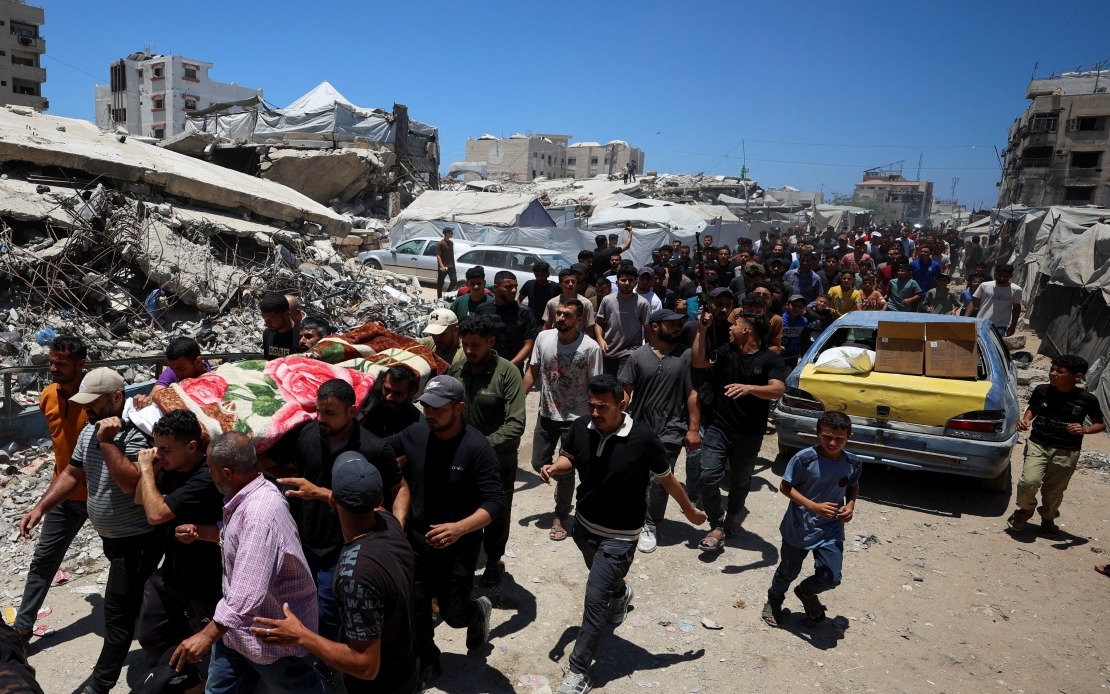
The humanitarian situation in Gaza has continued to deteriorate sharply even after the implementation of what was meant to be a ceasefire agreement, according to fresh data released by the Palestinian Prime Minister's Office this week. Since the ceasefire formally took effect, Israeli military operations have claimed the lives of 1,021 Palestinians, bringing the cumulative death toll across the enclave to 73,032 since the conflict began in October 2023. The Government Communication Centre warns that rather than bringing relief, the ceasefire period has witnessed the persistence of both Israeli bombardments and serious restrictions on the movement of humanitarian assistance into the territory.
The scale of destruction across Gaza's residential infrastructure underscores the scale of the humanitarian emergency unfolding on the ground. Israeli military operations have destroyed or damaged approximately 76.6 per cent of the enclave's housing stock, leaving nearly one million Palestinians without permanent shelter and forcing them to live in makeshift tent camps. This unprecedented level of residential destruction has created cascading problems throughout Palestinian society, with shortages of clean water becoming so severe that the vast majority of residents now depend almost entirely on limited humanitarian rations and supplies delivered by international organisations.
Children have proven particularly vulnerable during this period. According to United Nations data compiled by UNICEF, 265 Palestinian children have been killed and more than 400 others have sustained injuries specifically since the ceasefire announcement. These figures highlight the continued exposure of civilian populations to military operations, raising serious questions about the nature and scope of ongoing military activities. The continued targeting of civilian areas, as documented by humanitarian organisations, suggests that the restrictions placed on military operations through the ceasefire agreement may not be translating into meaningful protection for vulnerable populations.
The nature of Israeli military operations during the ceasefire period reveals a pattern of sustained military pressure across multiple population centres. Over the past week alone, air strikes and drone operations have targeted Nuseirat, Al-Mawasi, Khan Younis, and Gaza City, resulting in fresh waves of civilian casualties and further degrading living conditions already at critical levels. International humanitarian organisations, including Oxfam, have brought these patterns to the attention of the United Nations Security Council, emphasising that Israeli restrictions continue to prevent organisations from delivering essential life-saving assistance to vulnerable populations.
The occupation of Palestinian territory has also seen a marked escalation in forced displacement across the occupied West Bank and East Jerusalem. The United Nations High Commissioner for Human Rights has documented a significant uptick in Palestinians being removed from their homes and land through a combination of settler violence, official demolitions ordered by occupation authorities, movement restrictions, and forced evictions. This pattern represents a systematic effort to alter the demographics and territorial control of Palestinian areas, occurring alongside and compounding the humanitarian crisis in Gaza.
Agriculture, a cornerstone of Palestinian rural livelihoods, has suffered devastating losses during the recent conflict. The Palestinian Ministry of Agriculture has catalogued the destruction of over 7,258 trees, including approximately 1,270 olive trees that represent generations of agricultural investment and cultural heritage. Beyond the immediate agricultural loss, occupation forces and Israeli settlers have inflicted damage valued at approximately US$5.17 million, fundamentally undermining the economic basis of Palestinian communities. Additionally, arson attacks targeting religious sites, including two mosques in the villages of Jiljilya and Mazra' al-Nubani, reflect the broader pattern of targeting Palestinian civilian and cultural infrastructure.
The refugee camps within Palestinian territories have become flashpoints for military operations, with displacement reaching alarming proportions in recent months. Military campaigns conducted in the Jenin, Tulkarem, and Nour Shams refugee camps since the beginning of 2025 have displaced more than 33,000 Palestinians from their homes. These operations have compounded existing humanitarian needs in areas that already house generations of displaced persons from the 1948 and 1967 conflicts, creating overlapping layers of displacement and vulnerability.
International legal frameworks governing occupation appear inadequate to prevent continued violations. The Palestinian Authority has raised specific concerns regarding Israeli control over planning and construction authority at the Ibrahimi Mosque in Hebron, arguing that this arrangement violates the 1997 Hebron Agreement and contravenes international law. Such disputes over sovereignty and administrative control underscore the frozen nature of the broader peace process and the absence of effective international mechanisms to enforce agreements between the parties.
Conditions within detention facilities have become increasingly dire, according to Palestinian prisoners' organisations. Severe overcrowding, deteriorating sanitary conditions, and the spread of infectious diseases within Israeli detention facilities holding Palestinian prisoners represent an additional humanitarian concern extending beyond the visible conflict zones. These institutional failures expose detained individuals to health threats independent of any direct military operations.
Despite the overwhelming humanitarian challenges, Palestinian educational institutions have persisted in maintaining academic continuity. The Palestinian government has completed preparations for this year's General Secondary Education Examination, which will be administered to approximately 91,000 students nationwide. In Gaza specifically, around 37,000 students are preparing to sit for the examinations electronically, marking the third consecutive year that students have been forced to rely on remote examination systems due to the conflict and security circumstances. This educational persistence, even amidst widespread destruction, reflects Palestinian society's determination to maintain institutional functions despite existential pressures.
For Malaysian and Southeast Asian observers, the unfolding situation in Gaza carries several implications for broader regional stability and humanitarian concerns. The apparent insufficiency of ceasefire agreements to halt military operations raises questions about the viability of political settlements in protracted conflicts. Additionally, the scale of humanitarian need underscores the importance of regional states maintaining both diplomatic engagement with international forums and direct humanitarian assistance capabilities. The continued displacement of civilian populations and restrictions on humanitarian access represent patterns that concern multilateral organisations and nations committed to international humanitarian law across the region.