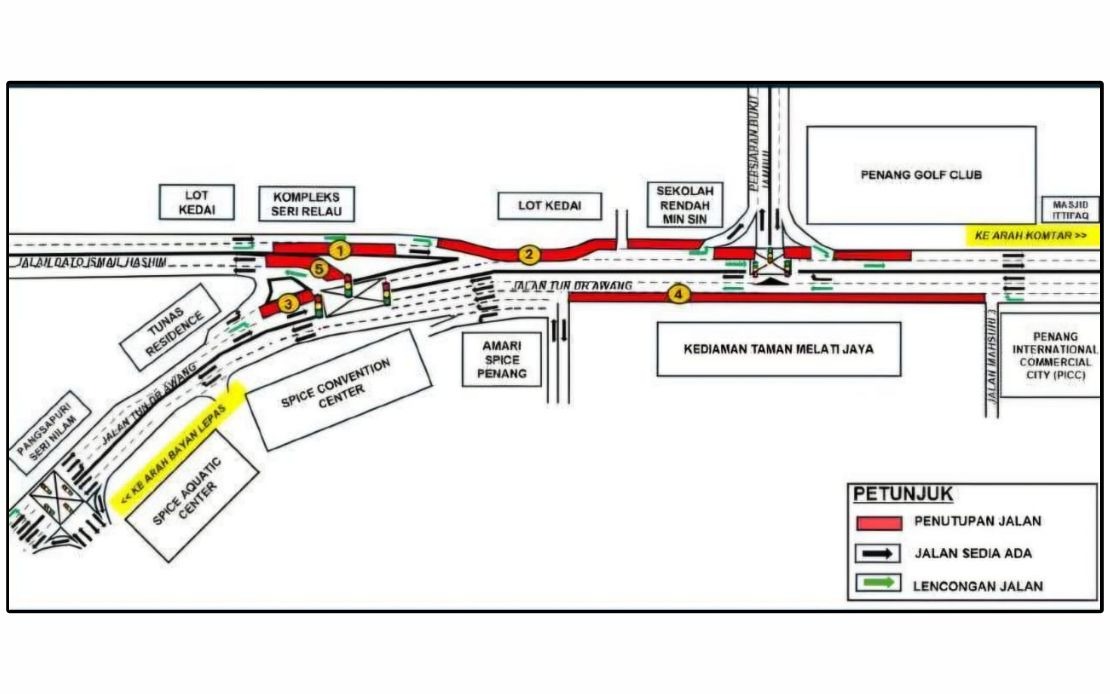
The Mutiara Line Light Rail Transit project is entering a critical phase in George Town, with Malaysia Rapid Transit Corporation Sdn Bhd (MRT Corp) announcing a 72-day schedule of partial road closures beginning August 20. The temporary lane restrictions, which will persist until October 31, affect two major thoroughfares that form crucial connectors through the heart of Penang's capital: Jalan Tun Dr Awang and Jalan Dato Ismail Hashim. The affected corridor stretches from the Sri Relau Complex vicinity to the Penang Golf Club area, a densely travelled section that serves both residential communities and commercial districts.
The scope of preliminary works justifying these disruptions includes essential drainage infrastructure upgrades and road widening initiatives allocated under Package CMC1 of the broader Mutiara Line initiative. Rather than implementing blanket closures that would paralyse traffic flow, MRT Corp has structured the work window to operate from 8.30 am to 4.30 pm daily, preserving peak evening commute periods and early morning hours for relatively normal traffic conditions. This phasing strategy acknowledges the economic realities of George Town's bustling commercial corridors while prioritising the infrastructure investments necessary for the LRT network's successful deployment.
The road closure arrangement involves a carefully orchestrated sequence of lane restrictions rather than complete thoroughfare shutdowns. On Jalan Dato Ismail Hashim, the right lane serving the Sri Relau Complex direction toward Komtar will be closed, while simultaneously the left lane beginning from the vicinity of shop lots near SJK (C) Min Sin and continuing to the Penang Golf Club area heading cityward will experience restrictions. At the traffic light intersection where Jalan Dato Ismail Hashim meets Jalan Tun Dr Awang, the leftmost lane pointing toward Komtar faces closure, and on Jalan Tun Dr Awang itself, the leftmost lane near the Taman Melati Jaya residential zone heading toward Bayan Lepas will be unavailable. The design maintains open access through parallel lanes, preventing total traffic lockdowns whilst isolating work zones.
For Malaysian motorists and George Town commuters, understanding the broader significance of this disruption requires context about the Mutiara Line's importance to Penang's transportation ecosystem. The LRT network represents a major component of the state's long-term infrastructure modernisation strategy, aimed at reducing vehicular congestion and providing sustainable transit alternatives for the growing metropolitan population. Preliminary construction phases like drainage and road widening are foundational requirements that cannot be deferred, as they establish the physical platform upon which rail infrastructure ultimately rests. The temporary inconvenience represents an investment in decades of improved mobility and environmental benefits.
MRT Corp has implemented comprehensive traffic management protocols to mitigate disruption severity. Directional signboards will guide motorists through modified routing, traffic cones will delineate work boundaries and safe passages, and human flagmen will manage real-time traffic flow at critical junctures. This multi-layered approach reflects best practices in construction zone management, ensuring that whilst lanes remain closed, safety remains paramount and confusion among road users is minimised. The corporation acknowledges that public cooperation depends heavily on visible professionalism and clear communication regarding temporary inconveniences.
Motoristes traversing affected areas during the 72-day closure window are being explicitly advised to exercise heightened caution and comply with directional signage. George Town's traffic patterns, particularly during midday business hours, typically experience substantial congestion without construction complications. The introduction of partial lane closures will inevitably create bottlenecks, potentially forcing alternative routing through residential areas or secondary roads. Commuters relying on these corridors are encouraged to adjust departure times, explore alternative paths, or consider transit options during the August through October period to minimise delay accumulation.
The Mutiara Line project itself represents a significant shift in Penang's transportation philosophy, moving toward integrated rapid transit systems that characterise modern Southeast Asian metropolitan areas. Similar to comparable developments in Kuala Lumpur, Bangkok, and other regional cities, the transition from purely road-based mobility to multimodal systems requires substantial interim disruption. However, upon completion, the Mutiara Line is anticipated to significantly alleviate pressure on existing road networks, particularly in congested central areas like George Town where population density and traffic volume continuously strain infrastructure capacity.
MRT Corp has established dedicated communication channels for public enquiries and concerns regarding the closure arrangements. The MRT Careline at 1-800-88-6782 and email contact [email protected] enable motorists and affected residents to obtain current information, report problems, or lodge specific concerns about traffic management effectiveness. This accessibility reflects recognition that large-scale infrastructure projects succeed not merely through engineering competence but through sustained public engagement and responsiveness to legitimate community concerns about temporary inconveniences.
The timing of this preliminary works phase carries implications for George Town's business community, particularly retail establishments, restaurants, and service providers along the affected corridors. Reduced vehicular access during business hours may temporarily impact customer traffic to commercial premises, though the long-term transportation improvements will ultimately enhance accessibility and property values. Business owners are advised to plan for adjustment periods and consider whether modified operating hours or promotional strategies might offset short-term revenue impacts during the construction phase.
Regionally, the Mutiara Line's progression reflects broader Southeast Asian trends toward metropolitan-scale rapid transit infrastructure. Penang, as one of Malaysia's most economically dynamic and internationally integrated states, is positioning itself competitively within the region's urban development hierarchy. Similar LRT and MRT projects across Indonesia, Thailand, and Vietnam demonstrate that temporary construction disruptions are becoming normalised costs of modernisation in growing Asian cities. George Town residents confronting August through October road closures are participating in a larger regional narrative about urban development and infrastructure evolution.
The successful completion of preliminary works depends significantly on public tolerance and cooperation during temporary disruption periods. MRT Corp's structured approach—limiting closure windows to daytime hours, maintaining alternative routes, and implementing visible traffic management—seeks to balance project necessity against community inconvenience. The 72-day timeline, whilst substantial, represents a compressed construction window designed to minimise cumulative disruption whilst achieving essential preparatory work. Motorists who understand the project's significance and accept temporary inconvenience as prerequisite for long-term benefits contribute meaningfully to infrastructure development outcomes that ultimately benefit broader Penang communities.

