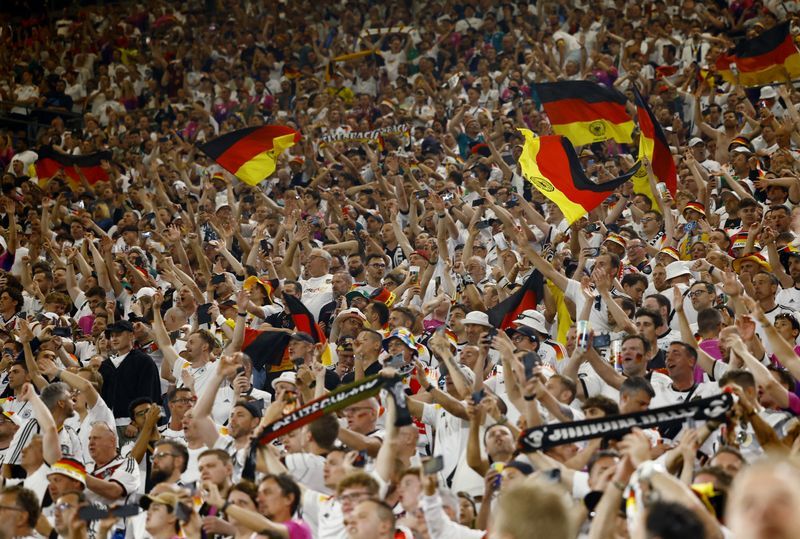
German law enforcement authorities conducted coordinated searches across the country on Wednesday, including at the offices of the Deutscher Fußball-Bund (DFB), the nation's primary soccer governing body, according to reporting by the Bild newspaper. The raids form part of an expanding criminal investigation targeting suspected violations in the allocation of tickets and hospitality privileges during the 2024 European Championship, which was held across ten German cities earlier this year. The operation represents a significant escalation in efforts to uncover potential misconduct within football's administrative structures at a time when major sporting events face increasing scrutiny over governance and transparency issues.
While prosecutors in Bochum and the North Rhine-Westphalia state criminal office confirmed that searches were being executed at several locations throughout Germany, they refrained from specifically naming the DFB in their official statement. However, the Bild newspaper's reporting, citing sources close to the investigation, made clear that the soccer federation's headquarters was among the targeted sites. This distinction between the prosecutors' cautious public comments and the media's more detailed disclosure suggests either differing strategies in managing the investigation's publicity or potential sensitivities surrounding the DFB's institutional reputation.
The investigation centers on what authorities describe as unauthorized advantages distributed in connection with the Euro 2024 tournament, with particular attention to the irregular provision of hotel accommodations and thousands of match tickets that appear to have been allocated outside normal channels to preferred recipients. According to Bild's account, individuals suspected of involvement include both a German national and a French national, among others whose identities have not yet been made public. This international dimension adds complexity to the case and raises questions about whether the impropriety extended beyond Germany's borders or whether it involved coordination with foreign participants in football administration.
One specific case highlighted in the reporting involves a German municipal employee based in Gelsenkirchen, one of the ten host cities for the championship. This individual allegedly benefited from tickets, travel arrangements, and hotel accommodations valued at approximately €2,400 (US$2,736). The targeting of a local government employee suggests that the investigation may be exploring links between civic officials and the football federation, potentially uncovering a network of preferential treatment that exploited the host city's position during the tournament. Gelsenkirchen, located in North Rhine-Westphalia, is home to FC Schalke 04 and has significant football infrastructure that may have facilitated such arrangements.
The formal charge description used by prosecutors—"unauthorized advantages, including a visit to an international football match"—appears deliberately broad, suggesting that investigators are still in the process of determining the full scope and mechanics of the alleged scheme. This language indicates that the distribution of match tickets and hospitality benefits may represent only part of a larger pattern of improper conduct. The phrasing also hints at potential violations of German administrative law, corruption statutes, or fraud provisions, though prosecutors have not yet publicly specified which criminal codes they believe were breached.
For Malaysian and Southeast Asian observers of international football governance, this investigation carries significant implications. The region's own football associations and tournament organizers monitor how established European football bodies handle integrity questions, particularly when major championships are involved. The Euro 2024 scandal demonstrates that even well-resourced, professionally managed organizations in developed nations can face allegations of systemic ticket misallocation and abuse of hospitality privileges. This serves as a cautionary example for Asian football administrators planning future continental championships, including potential ASEAN tournament expansions or AFC competitions held across multiple host nations.
The DFB's immediate unavailability for comment, combined with UEFA's lack of response to inquiries, reflects standard institutional practice when investigations are active. However, the silence also underscores the delicate position in which the German federation finds itself—any statement could be construed as either defensive or incriminating, potentially complicating the investigation. The federation's officials and communications teams are likely operating under legal advice to refrain from substantive discussion until the scope of their potential institutional liability becomes clearer.
The geographical spread of the raids across multiple locations suggests that investigators have identified a network of individuals or entities allegedly involved in the scheme rather than isolated instances of misconduct. The involvement of prosecutors specifically from Bochum, a city in the industrial Ruhr Valley and one of the tournament's host locations, indicates that regional authorities are playing a lead role in the investigation. This localized prosecution approach may facilitate access to host city officials and records while maintaining focus on venues where tickets were most heavily distributed or where hospitality arrangements were most concentrated.
The timing of the raids in early July 2024, just days after the conclusion of the Euro 2024 tournament, suggests that authorities had accumulated sufficient evidence during the competition to justify immediate enforcement action. This rapid response indicates either that monitoring mechanisms detected suspicious patterns during the event itself or that complaints or tips from tournament participants or observers prompted swift investigative steps. The proximity of the raids to the tournament's end means that key witnesses and evidence remain readily accessible, a practical advantage for prosecutors building their case.
Looking forward, the investigation's outcome will likely influence how future major football tournaments manage ticket distribution and hospitality provision, with particular emphasis on accountability measures and audit trails. For the DFB, the reputational damage extends beyond immediate legal liability to questions about internal controls and the culture within Europe's largest national football association. The scandal also arrives as football continues grappling with broader governance challenges, from financial fair play compliance to diversity and inclusion initiatives, making institutional credibility increasingly valuable to sporting bodies seeking public trust and regulatory confidence.

