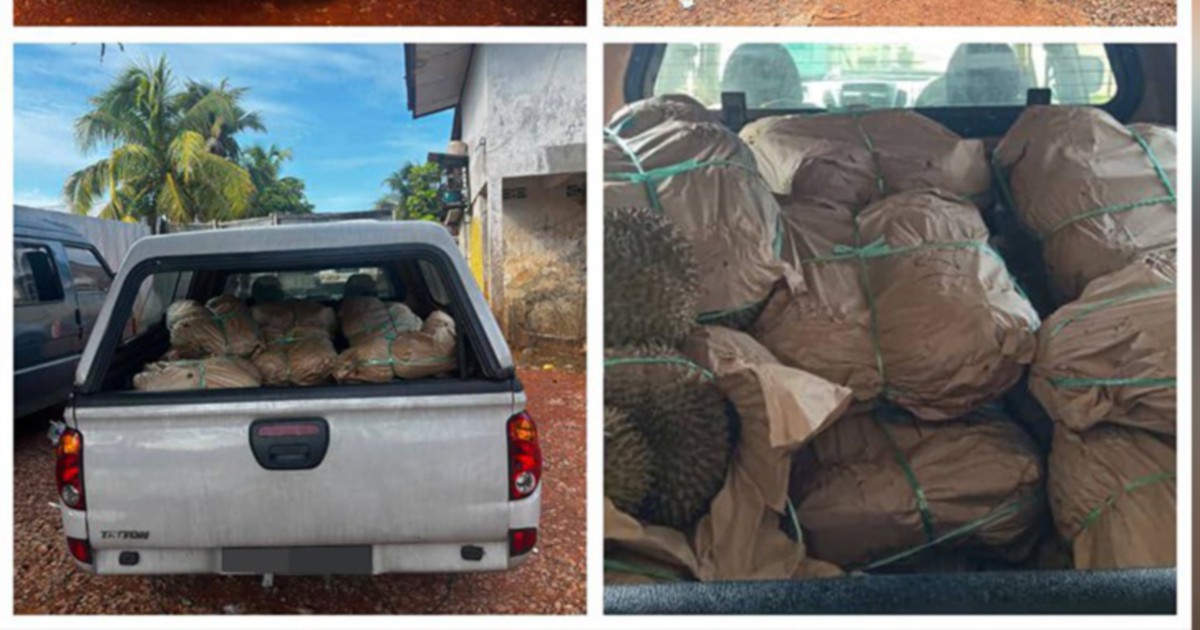
The General Operations Force launched a successful enforcement operation at an unregistered landing point in Rantau Panjang yesterday, resulting in the detention of a 20-year-old driver and the seizure of a substantial haul valued at over RM50,000. Officers discovered and impounded 350 kilogrammes of contraband durians as well as the four-wheel-drive vehicle used to transport the goods, the confiscation highlighting persistent vulnerabilities in Malaysia's northern border security infrastructure.
The operation unfolded at the Abe Li Posmen location, an informal jetty that has emerged as a known smuggling corridor. Illegal cross-border trade through such unmanned waterways represents an ongoing headache for federal authorities, who face resource constraints in monitoring the porous maritime boundary between Malaysia and Thailand. The seizure underscores how organised trafficking networks continue to exploit gaps in surveillance and inspection coverage, particularly in remote areas where conventional border controls prove difficult to enforce.
Durian smuggling occupies a peculiar niche within Malaysia's broader contraband problem. While the spiky fruit's exceptional value and explosive demand across Southeast Asia—particularly in Singapore and China—creates powerful financial incentives for illicit traders, enforcement actions targeting agricultural contraband typically receive less attention than narcotics or weapons interdiction. Yet the economics are compelling: premium Malaysian durians command premium prices in neighbouring markets, and the relatively lower penalties associated with agricultural violations compared to drug trafficking make the venture attractive to criminal syndicates seeking lower-risk profit opportunities.
The vehicle's confiscation carries additional significance beyond its monetary value. Four-wheel-drive vehicles recovered during such operations frequently prove instrumental in piecing together trafficking networks, as investigators can trace ownership, maintenance records, fuel purchases, and toll transactions to identify associates and supply chains. In this instance, the vehicle's presence suggests a organised operation rather than opportunistic smuggling, indicating that multiple parties likely coordinated the procurement, transport, and distribution of the merchandise.
The arrest of the 20-year-old driver raises questions about recruitment patterns within smuggling organisations. Young individuals, often from economically disadvantaged backgrounds near border communities, frequently assume roles as frontline operatives and face arrest while higher-echelon organisers remain insulated from enforcement action. This disparity in risk exposure means that street-level arrests, while important for deterrence, rarely dismantle the underlying networks that orchestrate cross-border trafficking.
Rantau Panjang's designation as a trafficking hotspot reflects broader patterns visible throughout Malaysia's northern frontier. The region's geography—characterised by river networks, coastal zones, and forested terrain—provides traffickers multiple unauthorised entry and exit points. The proliferation of informal jetties, many operating with tacit acquiescence from local communities that derive economic benefit from contraband transit fees, complicates enforcement efforts that rely primarily on overt patrol-based interdiction rather than intelligence-led operations targeting upper management levels.
From a regional perspective, this seizure illustrates how Malaysia functions as both a source and transit point within Southeast Asian illicit trade networks. Thai suppliers can access Malaysian distribution channels through such waterway routes, while Malaysian durians destined for international markets sometimes traverse irregular pathways to avoid legitimate export documentation, tariffs, and phytosanitary certification requirements. The scale of such activity remains difficult to quantify, but enforcement agencies across the region acknowledge that agricultural smuggling represents a significant revenue stream for transnational criminal enterprises.
The operation also demonstrates evolving tactics by authorities tasked with combating cross-border crime. The GOF's presence at Abe Li Posmen suggests increased intelligence gathering and targeted deployment rather than random patrols, pointing toward a more sophisticated enforcement posture. Nonetheless, the continued viability of this particular location indicates that intensive surveillance remains sporadic or that the frequency of operations has failed to achieve adequate deterrent effect.
Economically, durian smuggling carries consequences for legitimate producers and exporters. When illegally sourced fruit circumvents quality controls, certifications, and customs duties, it undercuts compliant traders and damages Malaysia's reputation as a reliable supplier to international markets. Over time, repeated incidents of contamination or quality failures involving smuggled produce can jeopardise market access and consumer confidence in Malaysian durian brands.
Moving forward, this case illustrates the necessity of enhanced intelligence sharing between Malaysian agencies and Thai counterparts, given that the source supply likely originates on the Thai side of the border. Joint task forces, coordinated patrols, and information exchange protocols could substantially complicate smugglers' operational planning. Additionally, greater investment in technology-enabled monitoring systems—including radar, surveillance cameras, and automated detection equipment at identified smuggling points—would reduce reliance on labour-intensive foot patrols.
The broader context suggests that Malaysian authorities recognise durian trafficking as a meaningful enforcement priority, even as it remains secondary to narcotics interdiction. Whether yesterday's seizure prompts sustained crackdown operations or represents an isolated enforcement action will determine whether such incidents become increasingly costly for smuggling networks or merely constitute routine occupational hazards absorbed into operational budgets and criminal enterprise calculations.

